
Eye Shapes: How to Find Yours and the Makeup That Works

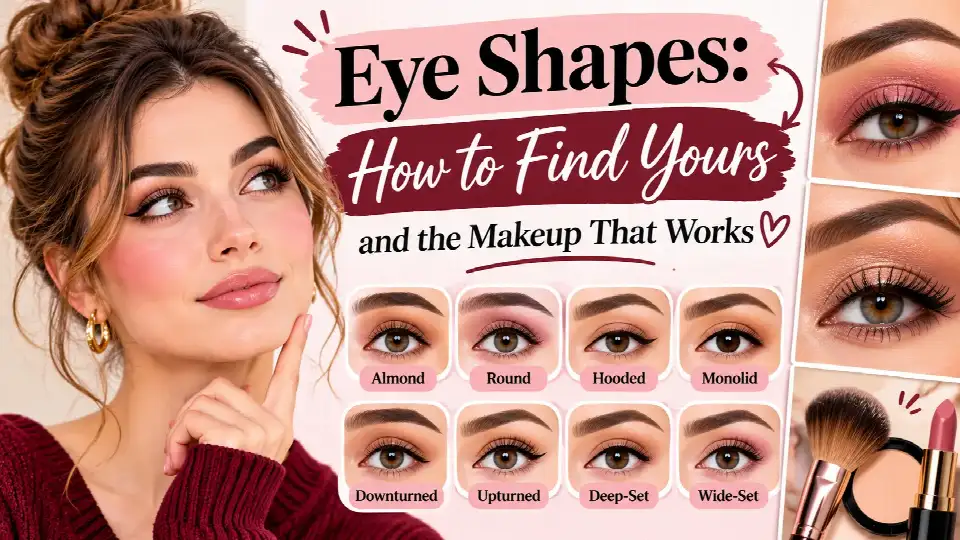
Eye shapes describe how your eyes are built: whether you have a visible crease, which way your outer corners tilt, how much white shows around the iris, and how far apart and deep-set your eyes are. Most people are a mix, such as hooded and almond, and each feature changes where makeup works best.
Knowing your eye shape is the shortcut to eye makeup that looks right the first time. It tells you where to place shadow so it shows, how thick to draw liner and which tricks to skip. This guide gives you a two-minute mirror test, then links to a full guide for every shape, eye color and common concern. If you're new to makeup, read makeup steps in order first, because eye makeup sits in the middle of that routine.
How to find your eye shape
You only need a mirror at eye level and good, even light. Mass Eye and Ear, a Harvard teaching hospital, recommends a simple mirror test: relax your face, look straight ahead, and don't raise your eyebrows or open your eyes wider than usual.
Then ask yourself five questions:
- Can you see your crease with your eyes open? If the crease is visible, move on. If skin covers it, your eyes are hooded. If there's no crease at all, you have monolids.
- Do you see white above or below your iris? If white shows above or below the colored part, your eyes are round. If the iris touches both lids, they're almond.
- Which way do your outer corners tilt? Imagine a straight line across the center of both eyes. Corners above the line are upturned; corners below it are downturned.
- How far apart are your eyes? If the space between them is about one eye's width, they're evenly spaced. Less than that is close-set; more is wide-set.
- Do your eyes sit deep or forward? If your brow bone casts a shadow and your lids look set back, your eyes are deep-set.
Write down every answer. You'll usually end up with two or three traits, such as "hooded, almond and slightly downturned," and that combination is your real eye shape.
| Eye shape | How to spot it | Makeup goal |
|---|---|---|
| Almond | Iris touches both lids, slight lift at the outer corner | Enhance the natural balance |
| Round | White visible above or below the iris | Elongate toward the outer corner |
| Hooded | Skin covers the crease when your eyes are open | Place color where it shows with eyes open |
| Monolid | No visible crease | Build color in gradients upward |
| Upturned | Outer corners lift above the center line | Balance the lift along the lower lash line |
| Downturned | Outer corners dip below the center line | Lift the outer corner with liner and shadow |
| Deep-set | Prominent brow bone, lids sit back | Bring the eye forward with lighter shades |
| Close-set | Less than one eye's width between eyes | Brighten the inner corners |
| Wide-set | More than one eye's width between eyes | Add depth toward the inner corners |
Eye makeup for each eye shape
Every shape can wear every look. Your shape only changes the placement.
Monolid eyes. Monolids have no fold dividing the upper lid. Cleveland Clinic describes them as a common eyelid shape, especially in people of Asian descent, and typically a harmless trait. Build shadow in gradients from the lash line upward, so color still shows when your eyes are open. See monolid eye makeup for looks that stay visible.
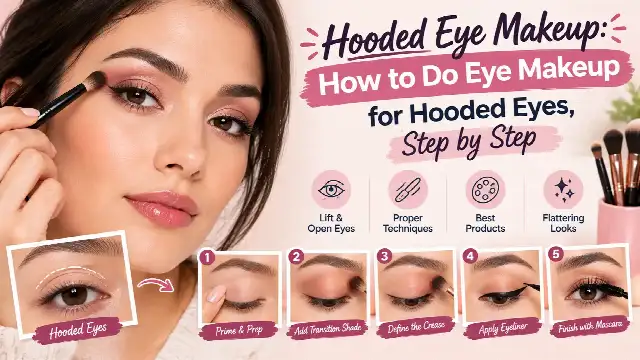
Hooded eyes. Your crease hides under a fold of skin, so shadow placed in the natural crease disappears. Work with your eyes open and place depth slightly above the crease. Our hooded eye makeup guide walks through it step by step.
Almond eyes. Balanced proportions mean most techniques work, from a classic wing to a soft smoky eye. Here's makeup for almond eyes to make the most of it.
Round eyes. Focus liner and darker shadow on the outer third to lengthen the eye. See eye makeup for round eyes.
Upturned eyes. The natural lift is already there, so the goal is balance. A little definition along the outer lower lash line helps. Read upturned eyes makeup.
Downturned eyes. Lift the outer corner by angling liner and shadow up, not following the downward line. Our downturned eyes makeup guide shows how.
Deep-set eyes. A strong brow bone shades the lid, so lighter, brighter shades on the lid bring the eye forward. See eye makeup for deep-set eyes.
Close-set eyes. Light shades in the inner corners and depth on the outer corners create the look of more space. Here's close-set eyes makeup.
Wide-set eyes. Darker shades and liner that start closer to the inner corners help balance the space. See wide-set eyes makeup.
Whatever your shape, a few tricks open the eye: curled lashes, a nude or white liner on the lower lid and a little highlight in the inner corner. Our guide on how to make your eyes look bigger covers them all.
Eye makeup by eye color
Your eye shape decides placement. Your eye color decides which shades make the iris stand out. Shades from the opposite side of the color wheel, or warm shades on cool-toned eyes, usually make eye color look brighter.
- Brown eyes: almost every shade works, and bronzes, plums and navy make them glow. See eye makeup for brown eyes.
- Blue eyes: warm shades like copper, peach and bronze make blue look more vivid. Read eye makeup for blue eyes.
- Green eyes: purples, plums and reddish browns bring out green. See eye makeup for green eyes.
- Hazel eyes: depending on your shade, you can pull out the gold or the green flecks. Here's eye makeup for hazel eyes.
Eye makeup for common concerns
Some needs come before shape and color.
- Glasses: lenses can magnify or shrink your eyes and hide light shades. See makeup for glasses.
- Sensitive eyes and contact lenses: formulas and habits matter more than shades. Read eye makeup for sensitive eyes.
- Puffiness: placement and color can make tired eyes look more rested. See makeup for puffy eyes.
- Tightlining: lining the upper waterline adds definition without a visible line. Our guide on how to tightline your eyes covers technique and safety.
The FDA advises washing your hands before applying eye makeup, never sharing eye products and keeping applicators clean. Our makeup hygiene guide explains how to clean and replace what you use around your eyes.
Can your eye shape change with age?
Yes, the skin around your eyes changes over time. The American Society of Ophthalmic Plastic and Reconstructive Surgery notes that age, heredity and sun exposure all contribute to loose skin on the upper eyelids. That's why many people find their eyes look more hooded in their forties and fifties than they did at twenty.
If that happens, simply adjust your placement: work with your eyes open, choose matte shades for the lid and keep liner thin. Creamy textures can also settle into lid lines, so check how your formulas wear, and see our guide to makeup for your skin type for options that suit drier, thinner skin.
Start with the basics
Every eye shape uses the same core skills. If you're building them, these are the places to start:
- How to apply eyeshadow in five easy steps.
- How to apply eyeliner with steady, simple lines.
Once you're comfortable, our makeup for every occasion guide shows how to adapt your eye look for work, parties, weddings and photos.
FAQ
What is the most common eye shape?
There's no reliable data that names one eye shape as the most common. In practice, most people have a combination of features, such as almond eyes with a slight hood, or round eyes that are a little downturned. Look for your main traits rather than trying to fit one exact label.
Can you have more than one eye shape?
Yes, and most people do. Eye shape is a mix of several features: your crease, the tilt of your outer corners, how much white shows around the iris, how far apart your eyes are and how deep they sit. You might be hooded and almond, or monolid and upturned. Use each trait to guide your placement.
Are hooded eyes and monolid eyes the same?
No. Hooded eyes have a crease that's hidden under a fold of skin when your eyes are open. Monolid eyes have no crease at all, so the lid is smooth from lashes to brow. The makeup goal is similar, keeping color visible with your eyes open, but the techniques differ slightly.
Which eyeliner style suits most eye shapes?
A thin line along the upper lash line that lifts slightly at the outer corner suits almost everyone. From there, adjust for your shape: keep the wing thin on hooded eyes, lengthen the outer corner on round eyes and angle it upward on downturned eyes.
Sources
- Shape of Eyes: How to Identify Yours, Mass Eye and Ear, Harvard Medical School (accessed Nov 17, 2026)
- Monolid Eyes, Cleveland Clinic (accessed Nov 17, 2026)
- Excess Eyelid Skin (Dermatochalasis) and Droopy Brows, American Society of Ophthalmic Plastic and Reconstructive Surgery (accessed Nov 17, 2026)
- Eye Cosmetic Safety, U.S. Food and Drug Administration (accessed Nov 17, 2026)
Spotted a mistake or something out of date? Email contact@stylifyo.com and we will check it.