
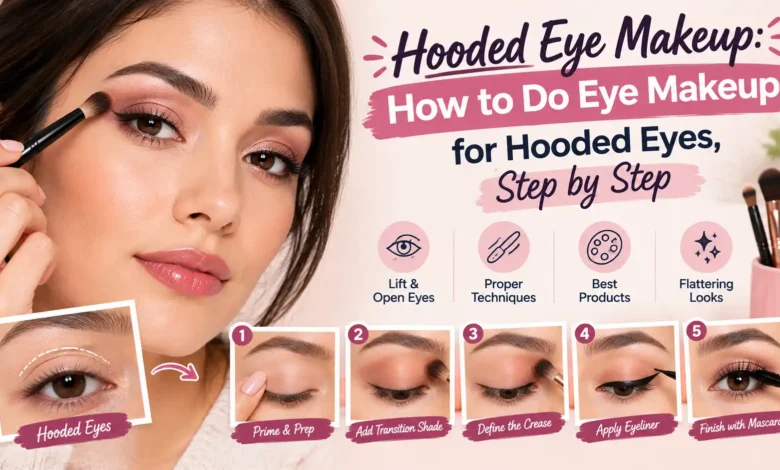
Hooded eye makeup comes down to one idea: do it with your eyes open. Place your crease color above the fold of skin, not in your natural crease. Keep eyeliner thin and close to the lashes, use matte shades on the hood and a touch of shimmer on the center of the lid, then curl your lashes. That way, everything you apply stays visible when you look straight ahead.
Hooded eyes are a common eye shape, not a flaw, and makeup for hooded eyes isn’t harder than any other eye makeup. It just follows different placement rules. This guide covers how to tell if you have hooded eyes, a placement chart, a step-by-step routine and easy looks. The steps follow the order you apply your eye makeup in any routine: brows, eyeshadow, liner, then mascara.
- Work with your eyes open: what you see with your eyes closed isn’t what shows.
- Go above the fold: your crease color needs to sit higher than your natural crease.
- Matte on the hood, shimmer on the lid: shine on the hood draws attention to it.
- Keep liner thin: a thick line disappears under the hood or smudges onto it.
What are hooded eyes (and do you have them)?
According to All About Vision, in a medically reviewed article, “Hooded eyes are a common facial feature that owe their appearance to a small flap of excess skin under each eyebrow.” That skin folds down over the crease and part of the moving lid, so there’s less visible lid space for makeup.
Hooded eyes are often genetic, like the rest of your eye shape. They can also appear or deepen over time. All About Vision notes that “Hooded eyes tend to develop, or become more pronounced, as people age.”
A quick mirror test:
- Stand in front of a mirror in good light, relax your face and look straight ahead. Don’t raise your eyebrows.
- Look for your crease. If you can’t see it, or a fold of skin covers most of your lid, you likely have hooded eyes.
- Close your eyes, sweep a light shadow over your lid, then open them. If most of the color disappears, that confirms it.
Both checks come from L’Oréal’s guide, which says that not seeing most of your eye makeup when your eyes are open is another sign. Its description of hooded lids: “If, when your eyes are open, you don’t notice a crease and the skin beneath your brows droops towards your lash line, you likely have hooded eyelids.”
Hooding varies from person to person, and some people only have it at the outer corners, so adjust the rules below to how much lid you can see.
Hooded eyes vs monolids, deep-set eyes and droopy eyelids
| Eye type | What it looks like | What it means for makeup |
|---|---|---|
| Hooded eyes | A fold of skin under the brow hangs over the crease and part of the lid | Place color above the fold and keep liner thin |
| Monolids | No visible crease; the upper lid is smooth from the inner corner to the brow | A different shape with its own techniques; the rules here are for hooded lids |
| Deep-set eyes | The eyes sit further back, so the brow bone looks more prominent | Also a different shape; some people have both, so use what matches your lids |
| Droopy eyelid (ptosis) | The eyelid itself droops over the eye, not the skin near the brow | A medical issue, not a makeup one, if it affects your vision |
The monolid description comes from Cleveland Clinic: “the skin of your upper eyelid is smooth from the inner corner of your eye to the part of your eyebrow nearest to your nose.” All About Vision explains the ptosis difference: “the skin covering the eye droops; not the skin near the brow.”
A safety note: hooded eyes on their own don’t need medical attention. But All About Vision advises: “If you notice one or both of your eyelids starting to droop suddenly, or the ‘hood’ or droopiness of your eyelids make it difficult to see clearly, schedule an eye exam.”
The 5 rules of makeup for hooded eyes
These makeup tips for hooded eyes come up again and again from professional makeup artists. As Trinny London’s chief makeup artist, John Corcoran, puts it: “When working with hooded lids, the aim is to use your eye makeup to make your eyes look bigger, brighter and more open.”
- Apply with your eyes open. L’Oréal puts it simply: “If you apply your makeup with your eyes open, there won’t be any surprises.” Charlotte Tilbury adds: “Keep the eyes naturally rested without raising your eyebrows or stretching your skin.” Makeup artist Monika Blunder told Woman & Home: “With hooded eyes, you want to create something that works with your eyes open and your eyes closed.”
- Put your crease color above the fold. Celebrity makeup artist Mally Roncal told Parade that the trick is simple: “you want to make sure that the color comes above the fold.”
- Keep shimmer off the hood. Dior Pro international makeup artist Jamie Coombes told Who What Wear: “Avoid using bright and reflective eye shadows on the prominent part of the lid.” Save them for the part of the lid that moves.
- Keep liner thin. Makeup artist Ruby Hammer’s advice to Woman & Home: “Keep the liner close to your lash line and in between the hairs and skin—no need for dramatic wings.”
- Lift with lashes and brows. Curling your lashes is a step makeup artists say people often skip, and Coombes recommends brushing brow hairs upward. Both make the eye look more open without taking up any lid space.
Hooded eyes makeup chart: where each product goes
Use this hooded eyes makeup chart as a map. Each zone is described with your eyes open and looking straight ahead.
| Zone | What to use | Why |
|---|---|---|
| Brows | A light brow product; brush the hairs upward | Overdrawn brows look heavy; brushed-up hairs lift the eye (Coombes) |
| Brow bone | Nothing, or a matte shade close to your skin tone | Shimmer here highlights the hood |
| Above the fold (your “new crease”) | A matte mid-tone transition shade | It stays visible when your eyes are open (Roncal) |
| Outer corner | A deeper matte shade, blended upward and outward | Adds depth and lift without closing the eye (Hardie, Coombes) |
| Center of the moving lid | A satin or shimmer shade, skin tone or one shade lighter | Creates the look of more lid space (Skinner) |
| Inner corner | A light, bright shade | Makes eyes look brighter and more open (Charlotte Tilbury) |
| Upper lash line | A thin line of liner pressed into the roots of the lashes | Defines without taking up lid space (Hammer) |
| Lower lash line | Optional: a soft line of the same deep shadow | Balances the top and adds definition (Charlotte Tilbury) |
| Lashes | Curl, then mascara | Lifts lashes up and out from under the hood |
The biggest difference between hooded eye makeup and standard eye makeup is the “new crease.” On most eyes, the crease color goes in the natural crease. On hooded eyes, that spot is hidden when your eyes are open, so the color moves up to sit just above the fold.
How to do eye makeup for hooded eyes, step by step
Here’s how to do makeup for hooded eyes from start to finish. If you’re new to eye makeup, our guide to makeup basics for beginners covers the tools first. Look straight ahead with a relaxed face for every placement step.
- Prep the lid. Start with clean, dry lids. An eyeshadow primer is optional, but it can help shadow stay put if yours tends to crease or transfer onto the hood.
- Do your brows. Fill gaps lightly and brush the hairs upward. Coombes told Who What Wear: “Try not to overdraw brows, as this gives a heavier look and closes the eye.”
- Sweep on a base shade. Apply a light matte shade close to your skin tone from the lash line up to the brow to even out the lid.
- Map your new crease. With your eyes open, blend a matte mid-tone shade in a band just above the fold. MAC global senior makeup artist Dominic Skinner told Who What Wear: “Look straight ahead in the mirror and imagine where that shadow should go. Then, tip your head back, and you’ll see that actually where you want it to go is where your brow bone is.”
- Deepen the outer corner. Press a deeper matte shade into the outer corner and blend it up and out. For a lifted shape, Coombes suggests “blending your eye shadow in a straight horizontal line and not blending out too far.” His tip: “place the edge of a sheet of paper from the corner of the nose to the end of your brow and keep the blend within that space.”
- Add light to the lid. Pat a satin or shimmer shade onto the center of the moving lid. Skinner suggests a shade “the same shade as your skin tone or even one shade lighter,” applied “just above the iris in the center of your lid.”
- Line thinly. Press liner into the roots of the upper lashes rather than drawing a thick line on top of them. Hammer’s method: “hold an eyeliner pen flat along the upper lash line and tilt it upwards as you reach the outer corner.”
- Curl, then mascara. Curl your lashes, then wiggle mascara up from the roots. Finish with a touch of the deep shade under the outer lower lashes if you like.
The likely reason the head tilt in step 4 works: when you tip your head back, you see your lid the way other people see it when your eyes are open, so it shows you where color will stay visible.
Eyeliner for hooded eyes
Eyeliner is where hooded eye makeup needs the most adjustment, because a thick line either disappears into the fold or prints onto it.
A thin line close to the lashes
The simplest option is also the most reliable: a thin line pressed into the lash line. NARS lead artist Rachel Hardie told Woman & Home: “My biggest tip is to really intensify that lash line with a deep black or dark brown, this will draw the eye to that focus point and enhance the whites of the eyes, making them sparkle.”
Winged eyeliner on hooded eyes
A wing is possible, but draw it with your eyes open. Hardie’s advice: “Just ensure you place the flick slightly over the crease at the edge of the eye and connect back to the line. Do this with the eye open to really see how the look lifts the eye area.”
Drawn this way, the wing may look slightly bent when your eyes are closed but straight and lifted when they’re open, which is the view that counts. Keep the wing short and angled toward the end of your brow.
Tightlining: what the research says
Tightlining means lining the upper waterline, right at the roots of the lashes. It’s popular for hooded eyes because it defines the eye without using any lid space, and Skinner recommends it to Who What Wear.
There is a trade-off. In a University of Waterloo study, between 15 and 30 percent more eyeliner particles moved into the eye’s tear film within five minutes when liner was applied inside the lash line rather than outside it. According to the university, makeup that enters the tear film may cause discomfort for people with sensitive or dry eyes, and deposits can make contact lenses cloudier.
Our practical advice: if your eyes are dry or sensitive, or you wear contact lenses, keep liner on the outside of the lash line. If you do tightline, sharpen your pencil before each use, as the study’s author, Dr. Alison Ng, advised, and remove all eye makeup before bed.
More recent research points the same way. A 2023 review of cosmetics and eye health in the journal The Ocular Surface notes that a pencil or brush touching the lid margin “would be expected to be contaminated with any pathogens in or around the eye.” That’s another reason to keep eye pencils sharpened and never share them.
Soft brown liner
If precise lines are hard to get right on your lids, a softer shade is more forgiving. Roncal told Parade that brown liner is “not as harsh as a black, so if it isn’t so perfectly lined, it’s okay, it’s going to look more smudgy.”
Eyeshadow for hooded eyes: finishes, formulas and colors
The best eyeshadow for hooded eyes is less about a particular color and more about finish, formula and placement.
- Finish: matte on the hood and in the new crease, shimmer only on the center of the moving lid. Coombes says bright, reflective shades belong on “the mobile parts of the lid, as this will provide flashes of color when you blink.”
- Formula: Blunder told Woman & Home: “I find that matte products tend to stay the best on hooded eyes since product tends to move around more, but a nice cream product is really easy to blend out on the go if it starts to crease.”
- Depth: Hardie suggests “a wash of a matte-toned deep nude on the outer bridge at the most prominent part of the lid.” Deeper shades work best at the outer corner; lighter shades on the lid help it look more open.
- Color: any color can work. Bright or bold shades look best on the moving lid, where they flash when you blink, with a neutral matte above the fold to anchor them.
Creams and powders both work. Cream shadows blend easily with a fingertip, and Trinny London’s guide to hooded lids favors them. If yours creases, set it with a matching powder shadow or switch to a long-wear formula.
Makeup looks for hooded eyes
These makeup looks for hooded eyes use the same rules, from everyday to evening. Build each one looking straight into the mirror.
Everyday natural look
For natural makeup for hooded eyes, sweep one matte, soft-brown shade just above the fold, pat a skin-tone satin shade on the center of the lid, and press a brown pencil into the upper lash line. Curl your lashes and add one coat of mascara for a polished look that doesn’t look done.
Soft smoky eye
Blend a matte mid-tone above the fold, then build a deeper shade at the outer corner using the straight-line technique so the smoke lifts instead of dragging down. Smudge the same deep shade along the upper and outer lower lash lines, keep the center of the lid a shade lighter, and finish with two coats of mascara.
Winged liner look
Keep the shadow simple: one matte transition shade above the fold. Draw a thin line along the lashes, then add a short flick with your eyes open, angled toward the end of your brow, as Hardie describes. A little shimmer in the inner corner balances the look.
Makeup for hooded eyes over 50
Hooding often becomes more noticeable with age, so the same hooded eye makeup rules matter even more. Matte formulas, color above the fold, a soft brown liner, curled lashes and brushed-up brows do most of the work. Roncal’s reminder to Parade: “It’s just makeup. You’re not too old, it’s not too late and your best days are ahead of you.”
For more on adapting your whole routine as your skin changes, see our guide to makeup for older women.
Common hooded eye makeup mistakes (and how to stop smudging)
| Mistake | Do this instead |
|---|---|
| Applying shadow with your eyes closed | Place every shade with your eyes open, looking straight ahead |
| Putting crease color in your natural crease | Move it up to sit just above the fold |
| Shimmer or bright shades on the hood | Keep them on the center of the moving lid |
| Thick eyeliner | A thin line pressed into the lash roots |
| Heavy, dense false lashes | Thinner lashes on the outer corner only |
| Overdrawn brows | Light definition, hairs brushed upward |
| Skipping the lash curler | Curl before mascara to lift lashes out from under the hood |
Smudging and transfer are common because the hood presses against the lid. L’Oréal notes: “When you have hooded eyes, it’s not uncommon for makeup to smudge and transfer onto your upper lid.” Its fix is to switch to smudge-resistant and waterproof eye makeup formulas. An eyeshadow primer and setting cream shadow with a matching powder also help.
A few safety habits apply to all eye makeup. The FDA’s eye cosmetic safety guidance says not to share eye cosmetics, never to apply or remove them in a moving vehicle, and to avoid eye makeup if you have an eye infection or the skin around your eyes is inflamed.
Frequently Asked Questions
Should people with hooded eyes wear eyeliner?
Yes, eyeliner works well on hooded eyes when it’s thin. A fine line pressed into the roots of the upper lashes defines the eye without using lid space, and it won’t disappear into the fold the way a thick line can. Deep black or dark brown both work; brown is more forgiving if your line isn’t perfectly even.
Can you do winged eyeliner on hooded eyes?
Yes. The trick is to draw the wing with your eyes open, so it sits where it will be seen. NARS lead artist Rachel Hardie suggests placing the flick slightly over the crease at the outer edge, then connecting it back to the lash line. Keep the wing short and angled toward the end of your brow for lift.
What eyeshadow is best for hooded eyes?
Matte shades are the most reliable on the hood and above the fold, because they stay put and don’t highlight the extra skin. Save shimmer for the center of the moving lid. Cream shadows are easy to blend, and long-wear or waterproof formulas help if your shadow transfers onto the hood during the day.
Should you wear false lashes with hooded eyes?
You can, but choose them carefully. L’Oréal advises avoiding “thick, densely packed false eyelashes as they can completely obscure any visible lid space,” and suggests “longer, thinner lashes” instead. It also recommends cutting a strip to half the length of your natural lash line and applying it to the outer corner only.
Can you wear bold colors on hooded eyes?
Yes. Bold and bright shades work best on the moving part of the lid, where they show every time you blink. Keep a neutral matte shade above the fold so the color has a soft edge, and avoid putting bright or reflective shades on the hood itself, which draws attention to it.
How do you make hooded eyes look bigger with makeup?
Focus on light and lift. Put a lighter satin shade on the center of the lid and a bright shade in the inner corner, place your crease color above the fold, and keep liner thin. Then curl your lashes and brush your brows upward. Together, these make the eye look more open without covering it.
Do hooded eyes get worse with age?
They can become more noticeable. All About Vision notes that hooded eyes tend to develop or become more pronounced with age, possibly due to a decrease in elastin and collagen. That’s normal. If an eyelid starts drooping suddenly, or the hood makes it hard to see clearly, book an eye exam.
The short version
Hooded eye makeup works best when you plan for what shows with your eyes open. Place your crease color just above the fold, keep matte shades on the hood and a little shimmer on the center of the lid, and press a thin line of liner into your lash roots.
Brush your brows up, curl your lashes, and use smudge-resistant formulas if your makeup transfers. If you tightline and your eyes are dry or sensitive, or you wear contacts, keep liner outside the lash line instead. Hooded eyes are a common shape. Once you know where to place things, any look you like can work.