
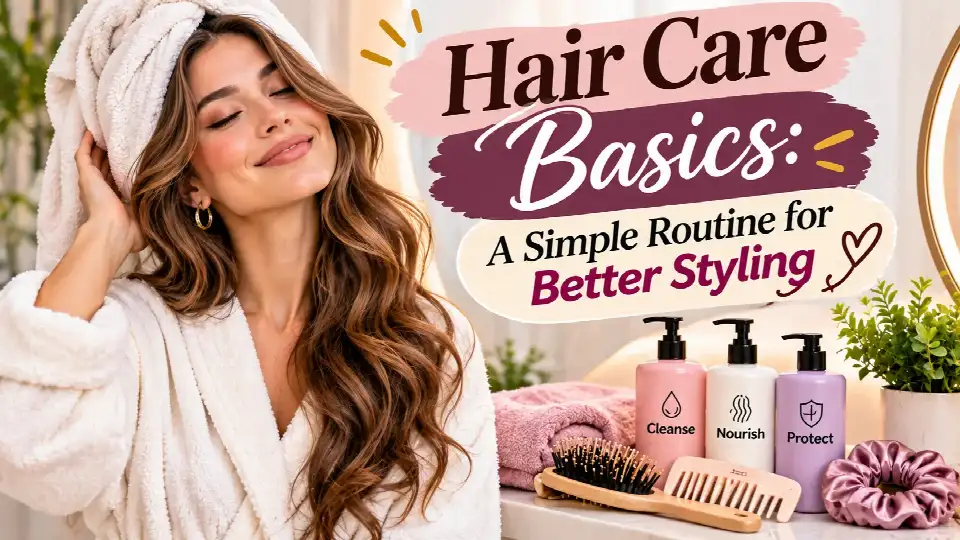
Hair Care Basics: A Simple Routine for Better Styling

Hair care basics come down to five habits: wash your scalp as often as it needs, condition after every shampoo, dry and detangle gently, keep heat low and occasional, and avoid styles that pull. Healthy hair holds styles longer, frizzes less and needs fewer fixes.
This is a styling guide, not medical advice: it's about caring for your hair so it styles well. Everything here follows advice from board-certified dermatologists at the American Academy of Dermatology (AAD), with my styling notes on top. Good hair care is what makes easy hairstyles to do yourself actually easy, and it's why the looks in our hairstyles for every occasion guide last all day.
Know your hair type first
Every product label and routine tip makes more sense once you know three things about your hair:
- Texture: straight, wavy, curly or coily. The AAD notes that hair types are often labeled with numbers and letters, from fine, straight hair to thick, tightly coiled hair.
- Thickness: fine, medium or coarse strands, and whether you have a lot or a little hair.
- Porosity: how easily your hair takes in and holds moisture. Our hair porosity guide shows how to test yours at home.
Choose shampoo and conditioner made for your type. Our guide to hairstyles by hair type shows how texture changes which styles hold best, and if your strands are fine, these hairstyles for thin hair add volume without damage.
How to wash your hair
How often you wash depends on your scalp, not a fixed rule. The AAD says people with straight hair and an oily scalp may need to shampoo daily, while dry, textured, curly or thick hair should be washed when needed, at least once every two to three weeks.
The technique matters as much as the schedule:
- Shampoo your scalp, not your lengths. Massage shampoo into your scalp and let it rinse down through your hair. The AAD warns that rubbing shampoo into the length of your hair can leave it dry and damaged.
- Rinse well. Leftover product weighs hair down and makes it look greasy sooner.
- Condition every time. More on that below.
Our full guide on how often you should wash your hair breaks it down by hair type. Between washes, dry shampoo used the right way soaks up oil without leaving grit, and these hairstyles for greasy hair carry you from day two to day four.
Conditioning and moisture
The AAD recommends using conditioner after every shampoo. Where you put it depends on your hair: fine or straight hair needs conditioner on the ends only, while dry or curly hair needs it along the full length.
For extra moisture, add one step at a time and see how your hair responds:
- Leave-in conditioner helps with detangling and frizz between washes. See how to use leave-in conditioner for your hair type.
- A hair mask once a week gives dry or color-treated hair a deeper treatment. Here's how to use a hair mask, wet or dry.
- Hair oil seals in moisture and adds shine on the ends. Our guide on how to use hair oil explains before and after the shower.
The AAD also suggests that curly and coily hair benefits from a thick conditioner after washing, followed by an oil or leave-in to help hold moisture.
Drying and detangling without breakage
Wet hair is at its most fragile, so this is where a lot of damage happens.
- Don't rub with a towel. The AAD recommends wrapping hair in a towel or a cotton T-shirt to absorb water instead of rubbing it.
- Use a wide-tooth comb on wet hair. For straight hair, let it dry a little first. For thick, curly hair, comb while the conditioner is still in.
- Start at the ends. Work out knots from the bottom up, never from the roots down.
- Skip the "100 strokes" myth. The AAD says hair doesn't need 100 brush strokes a day; brush and comb only to style.
Our guide on how to detangle hair without breakage walks through it for wet and dry hair, and types of hair brushes explains which brush to use for each job.
Heat styling without the damage
Heat is the fastest way to a sleek finish and the fastest way to dry, brittle ends. The AAD's advice is to let hair air dry when you can, use the lowest heat setting that works, limit how long the tool touches your hair, and use blow dryers, curling irons and flat irons about once a week or less. Its healthy hair tips also recommend a heat-protectant product.
My styling rule: one heat style a week, done well, beats a quick pass every morning.
- Protect first. Here's how to use heat protectant: when, where and how much.
- Know the signs. If your ends feel straw-like or snap easily, read heat damaged hair: signs, what helps and what doesn't.
- Deal with split ends honestly. Trimming is the only real fix. See how to get rid of split ends and how to stop new ones.
Everyday fixes
Most bad hair days come from one of four problems, and each has a simple fix:
- Frizz: moisture, a gentle drying method and the right product. See how to tame frizz.
- Static: common in winter and with dry heat. Here's how to get rid of static hair.
- Dullness: shine comes from smooth cuticles and light products. Read how to make hair shiny without the grease.
- Flat roots: the right drying technique and a light product give lift. See how to get volume at the roots.
Protect your hair day and night
A few situations need extra care.
Swimming. The AAD advises wearing a swim cap, rinsing your hair right after swimming, then using a swimmer's shampoo followed by a deep conditioner. Our guide on protecting hair from chlorine covers what to do before and after the pool.
Tight styles. The AAD lists tight ponytails, buns, cornrows, braids and extensions among the styles that can lead to traction alopecia, a type of hair loss caused by constant pulling. Wear your hair loosely pulled back, use covered elastics and change styles often. Learn the signs in our guide to traction alopecia.
Sleep. Going to bed with soaking wet hair and rough fabrics can leave you with tangles and frizz. Read is it bad to sleep with wet hair, what a silk pillowcase can and can't do for hair, and these protective hairstyles for sleeping.
A simple weekly routine
Here's how the basics fit into a week. Adjust the wash days to your scalp and hair type.
| When | What to do |
|---|---|
| Wash days | Shampoo the scalp, condition, wrap in a towel or T-shirt, detangle with a wide-tooth comb |
| Once a week | Hair mask, and your one heat-styled look if you use heat |
| Between washes | Dry shampoo at the roots if needed, a little oil or leave-in on the ends |
| Every night | Loose braid or bun, soft scrunchie, dry hair before bed when possible |
| Every few months | Trim the ends to keep split ends from traveling up the hair |
FAQ
What is a good basic hair care routine?
Shampoo your scalp as often as it needs, use conditioner after every shampoo, wrap hair in a towel instead of rubbing it, and detangle gently with a wide-tooth comb. Keep heat styling low and occasional, protect hair before swimming, and trim your ends every few months.
Should I put conditioner on my scalp?
It depends on your hair. The AAD says fine or straight hair only needs conditioner on the ends, because it can make fine hair look limp. Dry or curly hair benefits from conditioner along the full length. If your scalp gets oily fast, keep conditioner below your ears.
How do I make my hair healthier for styling?
Start with gentler habits rather than more products: less heat, no towel rubbing, wide-tooth combs on wet hair and loose styles that don't pull. Add a weekly mask if your hair is dry. Healthy, moisturized hair holds curls and updos better and needs less hairspray.
Is it bad to brush your hair 100 times a day?
Yes, there's no benefit. The AAD calls the 100 strokes a day idea a myth and recommends brushing and combing only to style your hair. Extra brushing just adds friction and can lead to breakage, especially on dry or curly hair.
Sources
- Tips for Healthy Hair, American Academy of Dermatology (accessed Nov 17, 2026)
- 10 Hair Care Habits That Can Damage Your Hair, American Academy of Dermatology (accessed Nov 17, 2026)
- How to Care for Curly Hair, American Academy of Dermatology (accessed Nov 17, 2026)
- Hairstyles That Pull Can Lead to Hair Loss, American Academy of Dermatology (accessed Nov 17, 2026)
Spotted a mistake or something out of date? Email contact@stylifyo.com and we will check it.