
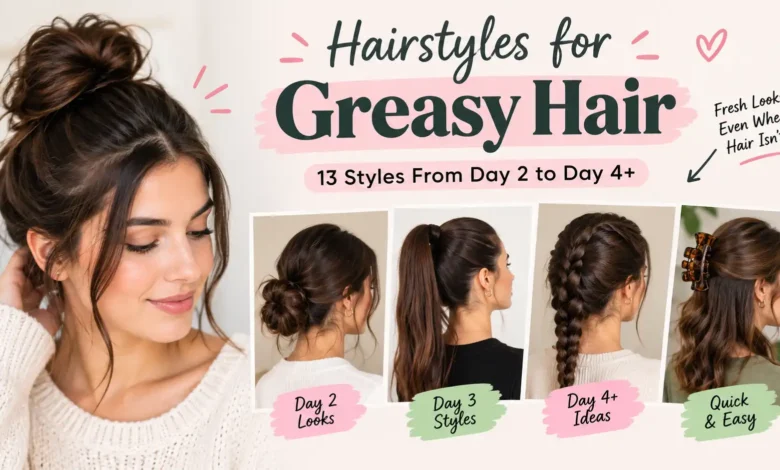
The best hairstyles for greasy hair do one of two things: they move attention away from your roots, or they make the shine look deliberate. High buns, braids across your part, headbands and scarves hide oily roots. Slicked-back buns and ponytails turn the same oil into a polished, sleek finish.
Which one works depends on how greasy your hair is right now, so this guide sorts 13 styles by what your roots look like, from a little shine to flat, clumped strands, with notes for straight, wavy, curly and coily hair. Each style has steps and a note on why it hides oil. They also make good hairstyles for dirty hair days when you just don’t have time to wash.
For everyday looks on clean hair, see our full guide to easy hairstyles to do yourself.
- A little shine: add lift and texture at the roots.
- Visible oil at the part: braid or twist over the part so it disappears.
- Flat and clumped: slick it back on purpose.
- Any day: cover it with a headband, scarf or cap.
Why greasy roots show (and how a hairstyle hides them)
Oil on your scalp is normal. According to Cleveland Clinic, “Sebum is a substance that provides a protective coating for your skin to help it retain moisture,” and “You have the most sebaceous glands on your face and scalp.” That helps explain why oil shows at the roots first.
Oil shows up in three places: flat roots at the crown, a shiny line along your part, and clumped strands around your face. Every style below fixes at least one of them by lifting the roots, hiding the part, going sleek or covering up.
How greasy is it? Match hairstyles for greasy hair to your roots
Go by what your roots look like, not by how many days it’s been, because hair types differ a lot here.
The American Academy of Dermatology (AAD) says in its tips for healthy hair: “If you have straight hair and an oily scalp, you may want to shampoo every day.” For dry, textured, curly or thick hair, it suggests you “shampoo when needed — at least once every 2 to 3 weeks as needed.” So one person’s day 2 can look like someone else’s day 5.
| Stage | What you see | What to do | Styles to try |
|---|---|---|---|
| 1: A little shine | Roots look slightly flat; a faint shine at the part | Add lift and texture | Flipped part, teased half-up, high messy bun |
| 2: Visible oil | A shiny part line; oily pieces around your face | Hide the part and hairline | Dutch braids, braided headband, twisted crown, claw clip French twist |
| 3: Flat and clumped | Roots stuck to the scalp; strands separating | Slick it back on purpose | Slicked-back low bun, sleek high ponytail, middle-part low ponytail |
| Any stage | You want the quickest fix | Cover the roots | Wide headband and low bun, silk scarf headwrap, cap and low braid |
First, use dry shampoo the right way
Dry shampoo is the go-to fix for greasy hair, but it doesn’t wash anything. In the AAD’s guide to dry shampoo, asked whether it cleans hair, board-certified dermatologist Paradi Mirmirani, MD, FAAD, answers: “No, it just absorbs the oil. Dry shampoo shouldn’t replace regular shampooing.”
Dermatologist Zoe Draelos, MD, FAAD, explains why: “Dry shampoo contains little particles that absorb oil, but it doesn’t clean hair. You need regular shampoo and water to cleanse your hair.”
The AAD’s method, in order:
- Choose a dry shampoo made for your hair color and type.
- Apply a small amount only where you need it, usually the roots at your part, crown and hairline. Dr. Draelos advises: “Start on your scalp, applying the product a little at a time will help you get the look you want.”
- Spread it evenly over your scalp.
- Leave it on for as long as the label says.
- Brush or comb it out.
The AAD recommends washing your hair after one or two dry shampoos, so treat it as a bridge between washes, not a replacement. Lifting the top layer of hair before you spray lets the product reach the roots instead of sitting on top.
Stage 1: A little shine at the roots
This is typical second-day hair: it mostly needs lift. These three styles raise the roots and add texture, so the flat, shiny look disappears.
Flipped part
- Apply a little dry shampoo along your usual part.
- Use the tail of a comb to move your part to the other side, or zigzag it.
- Lift the roots along the new part with your fingertips.
- Smooth the top layer so it falls naturally.
Why it hides oil: your usual part is the line that shows the most shine. Flipping it lays a fresh, lifted section of hair over that line.
Works best on: straight and wavy hair at any length, including bobs and short cuts.
Teased half-up
- Section the top half of your hair, from temple to temple.
- Mist the roots with texture spray or dry shampoo. Hold a small piece up and gently backcomb the roots two or three times with a fine comb.
- Smooth the very top layer back over the teased part.
- Gather the section at the crown and secure it with an elastic or a small claw clip.
Why it hides oil: the teasing lifts the roots off your scalp, and the smooth top layer covers any shine underneath.
Works best on: fine and straight hair that goes flat quickly. Be gentle; backcombing too hard can snarl hair.
High messy bun
- Flip your head forward and spray a little dry shampoo at the roots.
- Gather your hair at the crown and loop an elastic around it.
- On the final wrap through the elastic, stop halfway and don’t pull the ends all the way through. The loop of hair left sticking out is your bun.
- Wrap the ends around the base, pin them, and loosen the bun with your fingertips.
Why it hides oil: pulling everything up takes oily pieces away from your face, and the lift at the crown hides flat roots.
Works best on: shoulder-length and longer hair of any texture. For a neater top knot, twist the ponytail before you wrap it. Space buns work the same way, but their center part shows oil, so zigzag it.
Stage 2: Hairstyles to hide greasy hair at the part
When the part line looks shiny and the pieces around your face are oily, cover them. Braids and twists work well here, and oily hair holds a braid better than freshly washed, slippery hair.
Two Dutch braids
This one takes the most practice on the list. If you’ve never Dutch-braided, try one side first.
- Part your hair down the middle and clip one side out of the way.
- At the front of the other side, split a small section into three strands.
- Cross the outer strands under the middle strand, one side at a time.
- Before each cross, add a little loose hair to the outer strand. Keep going to the nape, then finish with a regular braid and tie the end.
- Repeat on the other side, then gently pull the edges of each braid to widen it.
Why it hides oil: the braids lie on top of your head, so they cover the roots on each side, and the part turns into a clean, deliberate line.
Works best on: shoulder-length and longer hair, from straight to curly.
Braided headband
- Take a 2-inch section of hair from behind one ear.
- Braid it from root to end with a simple three-strand braid and tie it with a small elastic.
- Lift the braid over the top of your head, about an inch behind your hairline.
- Pin the end behind your other ear, crossing two pins in an X.
Why it hides oil: the braid covers the front of your part and hairline, where oil usually shows most.
Works best on: hair long enough for a braid to reach across the head. Wear the rest down or in a low bun.
Twisted crown into a low bun
- Take a 1-inch section at one temple and twist it back, away from your face.
- Keep twisting and add a little hair as you move toward the back of your head.
- Repeat on the other side.
- Join both twists with the rest of your hair at the nape and make a low bun. Pin it in place.
Why it hides oil: the twists pull the oily front pieces back and wrap the hairline in smooth, textured sections.
Works best on: shoulder-length and longer hair, including wavy and curly hair.
Claw clip French twist
- Brush your hair back and gather it at the nape.
- Twist the length upward against the back of your head.
- Tuck the ends into the twist.
- Hold the open clip with its teeth facing your head and close it over the twist.
Why it hides oil: all your lengths are tucked away, so only the smooth back of your hair shows.
Works best on: shoulder-length and longer hair. Thick hair needs a larger clip.
Stage 3: Slick it back on purpose
When your roots are flat and your strands have started to clump, stop fighting the oil. Sleek styles give you a deliberate wet look, and the same oil that makes hair look limp helps it lie smooth. A little gel or smoothing cream is optional. On coily or tightly curled hair, smooth with your fingers or a wide-tooth comb instead of a brush.
Slicked-back low bun
- Brush your hair straight back with a smoothing brush.
- If you like, smooth a small amount of gel or cream over the top.
- Secure a low ponytail at the nape, snug but not tight.
- Twist the ponytail, coil it into a bun, and pin around the edge.
- Smooth any flyaways with your palms.
Why it hides oil: a slicked-back bun is meant to look glossy, so the shine reads as a finish, not as dirty hair.
Works best on: shoulder-length and longer hair, any texture.
Sleek high ponytail
- Brush your hair up toward the crown, smoothing the sides as you go.
- Secure it with an elastic.
- Take a small section from underneath and wrap it around the elastic.
- Pin the end of the wrapped section underneath the ponytail.
Why it hides oil: the smooth, shiny sides look polished, and the length hangs away from your face and neck.
Works best on: straight and wavy hair, shoulder-length and longer.
Middle-part low ponytail
- Make a precise middle part with the tail of a comb.
- Brush each side back behind your ears.
- Tie a low ponytail at the nape.
- Smooth the top with your palms.
Why it hides oil: a sharp, deliberate part and smooth sides make the whole style look planned.
Works best on: most lengths from the shoulders down. It’s one of the neatest options for the office.
Sleek doesn’t mean tight. The AAD warns that hairstyles that pull, including tight buns and ponytails, can lead to hair loss. Get the smooth finish from brushing, not from tension. If your scalp hurts or stings, loosen the style.
Cover-ups: cute hairstyles for greasy hair with a headband, scarf or cap
When you don’t have time for anything else, cover the roots. These three work at any stage.
Wide headband and low bun
- Brush your hair back and tie a low bun or ponytail.
- Place a wide fabric headband about an inch behind your hairline.
- Push it back until it covers the front of your part.
- Pull a few soft pieces loose at your temples if you like.
Why it hides oil: the band covers the front of your part, which is the shiniest spot.
Works best on: most lengths, including chin-length hair worn down.
Silk scarf headwrap
- Fold a square scarf into a triangle, then fold it into a band about 2 inches wide.
- Place the middle of the band at your hairline or just behind it.
- Tie it at the nape under your hair, or on top of your head for a bow.
- Tuck in the ends or let them hang.
Why it hides oil: the scarf covers the front roots completely and adds color, so it looks like a choice.
Works best on: every hair type and length, including coily hair.
Cap and low braid
- Spray a little dry shampoo at the hairline and brush it out.
- Braid your hair loosely at the nape, or tie a low ponytail.
- Put on a baseball cap.
- Pull a few pieces loose in front of your ears.
Why it hides oil: the cap covers your crown and part, and the low braid keeps the lengths tidy.
Works best on: shoulder-length and longer hair, for errands and weekends.
Hairstyles for oily hair by hair type
Oil shows up differently depending on your texture, so some styles suit certain hair better.
| Your hair | How oil tends to show | Try first |
|---|---|---|
| Fine or straight | Roots often go flat and shiny early | Flipped part, teased half-up, high messy bun |
| Thick | The crown can look flat while the lengths still look fine | Dutch braids, claw clip French twist, slicked-back low bun |
| Wavy or curly | Roots can look heavy, and waves may lose shape near the scalp | Twisted crown, braided headband, silk scarf headwrap |
| Coily or tightly curled | Oil often builds up at the scalp before it shows as shine on the lengths | Silk scarf headwrap, wide headband and low bun, twisted crown |
If your roots get oily fast, two AAD habits help: wash based on how quickly your hair gets oily, and “Apply shampoo to your scalp, instead of the entire length of your hair.” Sweat adds to it, too. Before a workout, braids and pinned buns hold up best because nothing hangs loose, and our gym hairstyles go further. For nights, see protective hairstyles for sleeping.
Greasy hair myths, checked
A lot of advice about oily hair gets repeated without a source. Here’s what the official guidance says.
| Myth | What the sources say |
|---|---|
| “Wash less and your scalp will learn to make less oil.” | None of the dermatology sources cited here support this. The AAD’s advice points the other way for some people: with straight hair and an oily scalp, “you may want to shampoo every day.” |
| “Dry shampoo cleans your hair.” | It doesn’t. AAD dermatologists say it absorbs oil and shouldn’t replace regular shampooing. |
| “Oily hair means your hair is unhealthy.” | Not by itself. Sebum is a normal protective coating for your skin (Cleveland Clinic, quoted above). |
When greasy hair is a scalp problem
Most greasy hair is just oil between washes. But if the oil comes with flakes, itching or a rash, something else may be going on. The AAD describes seborrheic dermatitis as “a common skin condition that causes a scaly rash on oily areas of the body like the scalp and face.” Its scale can be dry or greasy, and itchy.
A hairstyle won’t fix that. If your scalp stays itchy, flaky, red or sore, see a board-certified dermatologist, who can tell you what’s causing it. The same goes for dry shampoo: the AAD advises stopping if your scalp becomes irritated, and seeing a dermatologist if the irritation doesn’t clear up after a few weeks.
Frequently Asked Questions
What is the best hairstyle for greasy hair?
It depends on how greasy your roots are. For a little shine, a high messy bun or a flipped part adds lift. For visible oil at the part, two Dutch braids or a braided headband hide it. For flat, clumped roots, a slicked-back low bun makes the shine look deliberate. A headband or scarf works at any stage.
How can I hide greasy hair without washing it?
The fastest fixes need no skill: a wide headband, a silk scarf or a cap covers the roots in a minute. With a few more minutes, a high messy bun or two Dutch braids hide oil at the crown and part. On very oily days, a slicked-back low bun makes the shine look intentional.
Why is my hair greasy after one day?
Some scalps make more oil than others, and it often shows quickly on straight hair. The AAD says: “If you have straight hair and an oily scalp, you may want to shampoo every day.” That’s normal, not a sign that something is wrong. If the oil comes with flaking, itching or a rash, see a board-certified dermatologist.
Can I use dry shampoo every day?
Not in place of washing. The AAD recommends washing your hair after one or two dry shampoos, because dry shampoo left on the hair or scalp can cause breakage and shedding. If you want a fresh look every day, alternate: dry shampoo the morning after a wash, a cover-up or sleek style the next day, then wash again.
Is dry shampoo safe?
The AAD notes that most people use it without problems. Follow the label, use it only between washes, and stop if your scalp gets irritated. In 2022, some aerosol dry shampoos made before October 2021 were recalled over possible benzene. The recall notice said daily exposure at the levels found “would not be expected to cause adverse health consequences.” If you still have an old can, check it.
The short version
The best hairstyles for greasy hair match how oily your roots look. Add lift when there’s just a little shine, braid or twist over your part when oil is visible, and slick everything back when your roots are flat. When you’re short on time, a headband, scarf or cap covers it all. Whatever you choose, keep it snug, not tight.
Use dry shampoo sparingly at the roots, remember it doesn’t clean, and wash after one or two uses. On workdays, the slicked-back bun and middle-part ponytail double as easy hairstyles for work. And if oil comes with flakes or an itchy scalp, see a dermatologist.