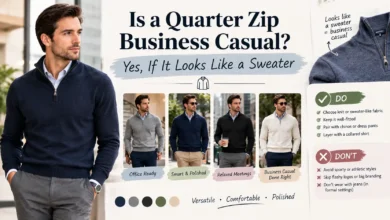


Is a sweater business casual? Yes, under most business casual dress codes. A fine-knit sweater in a solid color that fits well, worn over a collared shirt or blouse with trousers, chinos or a skirt, is standard business casual. Sweatshirts and hoodies are not. Chunky, loud or worn-out knits sit closer to weekend wear, and on its own a sweater isn’t business professional. In the UK, a sweater is a jumper.
This guide draws on the published dress codes of U.S. public employers and a Canadian school board, checked in September 2026, plus a university career center (how we check sources). Private employers write their own rules, so treat these as a benchmark, not a guarantee.
- Safe choices: a crewneck, V-neck, cardigan or fine turtleneck in merino, cotton or cashmere. A plain sweater vest usually works too.
- Colors: navy, gray, black, charcoal, camel, cream or another muted solid.
- Underneath: a collared shirt, blouse or plain shell. A plain tee works in relaxed offices.
- Fit: skims the body without clinging or ballooning, with sleeves that end at the wrist.
- Skip it: sweatshirts, hoodies, fleece, holiday prints, big logos, and anything pilled or stretched out.
- Jeans and sweater dresses: jeans depend on your employer. A sweater dress usually works if it’s opaque, easy-fitting and near knee length.
Is a sweater business casual? What dress codes say
Yes. In every employer dress code checked for this guide that mentions sweaters, they’re allowed for business casual, and sweatshirts are the usual exclusion. Here’s how five public employers handle them:
| Employer | Sweaters | Sweatshirts |
|---|---|---|
| Chesterfield County, VA (2025) | “Sweaters, long or short sleeve” and “Turtlenecks” | Inappropriate |
| Georgia Dept. of Human Services (2025) | Sweaters and turtlenecks allowed | Inappropriate |
| Texas A&M University System offices (HR) | Allowed | Not permitted |
| City of Gulfport, MS (2023) | “sweaters, cardigans” | Casual tier only; “No Hoodies” |
| Former Cape Breton-Victoria school board, NS (2011) | Sweaters and turtlenecks acceptable | Inappropriate |
The Indiana State Police non-uniform standards go further for classroom training, listing a “cardigan, or V-neck sweater with shirt and tie” and allowing turtlenecks “when a tie is not required.”
Chesterfield County’s definition of business casual sums up the pattern: it “includes slacks or khakis; dresses or skirts; dress shirts or blouses; open-collar, knit or polo shirts; blazers or sweaters; and loafers or dress shoes that cover all or most of the foot.”
So, are sweaters business casual? By these policies, yes: sweaters are accepted and sweatshirts are not. Where policies differ is jeans (see below). For how business casual fits among other dress codes, see our guide to types of dress codes.
Formal, standard and relaxed offices
These are public-sector policies, and private employers vary. In a formal or client-facing office, such as some banks or law firms, choose a fine V-neck or crewneck over a collared shirt, and keep a blazer close for meetings.
In a standard office, any sweater in the “Yes” rows below works. In a relaxed or creative office, a crewneck over a plain tee may be fine. When the handbook is silent, match the most polished person on your team for your first few weeks.
Writing a dress code that covers sweaters
For HR teams, the policies above share a pattern: they name sweaters, cardigans or turtlenecks as acceptable and list sweatshirts separately as inappropriate or casual-only. None of them defines the difference, so a clear policy spells it out, for example knit sweaters in, heavy cotton or fleece sweatshirts and hoodies out, and says whether logo pullovers count. Have HR or legal review the final wording.
Which sweaters are business casual?
Can a sweater be business casual in any style? Not every one. Neckline, weight and pattern all change how formal a sweater looks. Here’s a quick guide by type:
| Sweater type | Business casual? | Why |
|---|---|---|
| Fine-knit crewneck | Yes | The easiest choice over a collared shirt, blouse or plain tee |
| V-neck | Yes | Shows a shirt collar neatly and works with a tie |
| Cardigan | Yes | Named by Gulfport and the Indiana State Police; opens up for warm rooms |
| Turtleneck or mock neck | Yes, in a fine knit | Named by Chesterfield, Georgia and Cape Breton; works alone or under a blazer |
| Sweater vest | Usually | Best in a plain, dark color over a button-down |
| Knit quarter zip | Usually | A little sportier; fabric decides (see below) |
| Chunky, cable, fisherman or ski-style knit | Depends | Reads more casual; best in relaxed offices |
| Sweater dress | Usually | Needs an opaque knit, an easy cut and a hem near the knee |
| Holiday, novelty or loud patterns | No, except themed days | Draws attention and reads as party wear |
| Sweatshirt, hoodie or fleece | No | Sweatshirts are ruled out in four of the five policies above, and Gulfport says “No Hoodies”; fleece reads the same way |
A quarter zip counts as a sweater when it’s a fine knit, but fleece and sweatshirt versions don’t. Our quarter zip guide covers that style in detail.
Weight, fabric and pattern
A thin, fine-gauge knit sits smoothly over a shirt and under a blazer, while a thick, chunky knit can look more like outdoor wear. Cable, fisherman and ski sweaters are traditional outdoor knits, and their raised texture and bulk tend to read as weekend clothes. Fair Isle and other bold patterns draw the eye in the same way. Solid colors and small, quiet textures such as fine ribbing look most polished.
You don’t need cashmere, and none of the policies above mentions a fiber. What matters is how the knit looks: fine, smooth, plain, well fitted and free of pills.
What to check before you buy
- Hold it up to the light. If you can see through it, wear something under it or choose a thicker knit.
- Look for an even, smooth knit without loose or snagged loops.
- Stretch the cuffs and hem gently; they should spring back.
- Read the fiber and care label, so you know whether it’s hand-wash only.
If you only own chunky knits and hoodies
One fine-knit crewneck or cardigan in navy or gray is the most useful first buy, because it fits every outfit formula in this guide. Until then, wear your smoothest, plainest, darkest chunky sweater over a collared shirt in a relaxed office, and leave the hoodie at home on business casual days. In a formal or client-facing office, a chunky knit is riskier; add a fine-knit cardigan or a blazer instead.
Fit: sleeves, length and comfort at any size
A work sweater should skim the body rather than cling or balloon. Choose a knit thick enough that nothing shows through in bright office light, and a neckline that stays in place when you lean forward.
If a sweater clings at the hips or belly, try the next size up, a medium-weight or ribbed knit, a longer cardigan, or a half-tuck. If you’re tall or have long arms, compare the listed sleeve length with your own arm measurement instead of trusting S, M or L, and check whether the brand offers tall sizes. Cuffs that cover your hands or stop above the wristbone look like the wrong size.
If you’re on your feet all day, check that the hem stays put and the neckline doesn’t gape when you bend or reach. The men’s and women’s outfit formulas below work on anyone, so mix them freely.
What to wear under a sweater for work
What’s underneath does as much as the sweater itself. Georgia’s policy rules out T-shirts “unless worn under another blouse, shirt, jacket, or dress.” Sweaters aren’t in that list, so a tee under a sweater is a judgment call: fine in relaxed offices, riskier in stricter ones.
- Collared shirt: the classic business casual layer, especially under a crewneck or V-neck. A button-down or dress shirt with a collar that holds its shape looks neatest.
- Blouse: a plain blouse, or a sleeveless blouse under a cardigan. Texas A&M Forest Service’s dress code says “Sleeveless dresses or blouses may be worn with cardigan or jacket.”
- Plain T-shirt: fine in relaxed offices, such as some creative or tech workplaces. Choose a thin one so it doesn’t add bulk, and make sure its collar doesn’t peek above a crewneck or its hem hang below the sweater. This look sits closer to smart casual than strict business casual.
- Polo: a thin knit polo can sit under a crewneck, but its soft collar lies less neatly than a shirt collar. More in our guide to polos at work.
Collar, cuffs and tucking
Collar points can sit either outside or inside a crewneck. Laid flat and even on the outside, they look relaxed; tucked under, they give a cleaner neckline. Either works if the collar is pressed. A little shirt cuff showing at the wrist is a common styling choice, and a tucked-in shirt stops the hem from hanging below the sweater.
Business casual sweater outfits for men
Business casual sweaters work best in simple formulas. Five that suit most offices, with leather loafers, derbies, oxfords or plain boots:
- Crewneck over an oxford: a navy or gray fine-knit crewneck over a light blue button-down, with chinos.
- V-neck with a tie: a charcoal V-neck over a white dress shirt and a plain tie, with wool trousers. It’s the combination the Indiana State Police list for classroom days.
- Turtleneck under a blazer: a thin black or camel turtleneck, a navy blazer and gray trousers. Neat, and warm in a cold office.
- Sweater vest over a shirt: a solid navy or gray vest over a button-down, with chinos. Keep the rest of the outfit plain.
- Cardigan over a shirt: a fine button-front cardigan over a collared shirt, with trousers.
Keep the sweater hem at or just below the belt. Much longer and it bunches when you sit; much shorter and the shirt hangs out underneath.
Business casual sweater outfits for women
Simple formulas work here too. Five that suit most offices:
- Cardigan and trousers: a fine cardigan over a blouse or shell, with tailored trousers and loafers or low heels.
- Crewneck and skirt: a crewneck tucked or half-tucked into a knee-length or midi skirt, with tights and boots in cold weather.
- Turtleneck under a blazer: a thin turtleneck with a blazer and straight trousers, a sharp option for meetings.
- Sweater over a collared shirt: a V-neck or crewneck over a button-up shirt, with trousers or a pencil skirt.
- A sweater dress: an opaque, easy-fitting knit dress near knee length, with tights and a belt or blazer if you like.
Can you wear a sweater with jeans for business casual?
It depends on your employer. Chesterfield County’s casual tier includes dark jeans, and its attire list allows “Jeans (clean and free of rips, tears, fraying; not excessively tight or revealing).” Texas A&M’s system offices say “Nice jeans may be worn to the office when an employee is not meeting with the public.” Georgia’s business casual rules, by contrast, exclude “Jeans, or denim of any kind” outside approved casual days.
The University of Kansas business career center draws the line by tier. Its business casual list includes a “Tailored sweater or cardigan,” while “Dark and non-distressed jeans” appear under the more relaxed smart casual. Where denim is allowed, a fine sweater with dark, clean jeans and leather shoes looks dressed up. For a full breakdown, see can jeans be business casual.
Can you wear a sweater to a business casual interview?
Usually, when the employer has said business casual or has a relaxed dress code. The University of Kansas describes business casual as a look that “may be appropriate for interviews at companies that have a relaxed dress code or at a networking event.” A fine-knit sweater over a collared shirt or blouse, with trousers or a skirt, fits that description.
An easy combination: a navy or gray fine-knit crewneck or V-neck over a pressed collared shirt or blouse, trousers, leather shoes and a blazer you can take off if everyone is dressed down. Check the sweater for pills and lint the night before.
If the invitation doesn’t name a dress code, ask the recruiter what people wear. If it says business professional, a sweater on its own won’t meet that level; our guide to business casual vs business professional explains the difference.
Sweaters for cold and warm offices
For a cold office, layer thin pieces rather than one bulky one: a turtleneck or shirt, a fine sweater and a blazer or cardigan you can add. A cardigan that stays at your desk is an easy fix that usually fits a business casual dress code.
For a warm office or hot commute, choose cotton or a lightweight merino, or a short-sleeved sweater, which Chesterfield County lists alongside long sleeves. A cardigan over a sleeveless blouse can come off at your desk. If a hoodie or fleece is your only warm layer, swap it for a plain cardigan before a business casual day.
How to keep work sweaters looking sharp
A sweater only reads as office wear while it looks fresh. The Woolmark Company defines pilling as “the formation of fuzzy balls on the surface of wool clothing” and says it “is caused by rubbing during wear.” It adds that pills can be removed by hand, with a gentle comb, or with a fabric shaver.
- Fold, don’t hang: the American Cleaning Institute says “Sweaters should be folded for storage. Hanging a sweater can stretch it out of shape.”
- Wash gently: it also advises, “When in doubt about water temperature, choose a cold water wash. Use a detergent formulated for delicates.”
- Dry flat: Woolmark warns that drying on hangers “can cause knitted garments to stretch,” so lay knits flat.
- Follow the label: some sweaters are hand-wash only, and some can go in the machine or dryer on a gentle setting.
Sweaters (jumpers) at work in the UK and Canada
In the UK, “jumper” is the everyday word for a sweater, and UK workplaces often use the term “smart casual,” which can be looser than U.S. business casual. A YouGov survey of the British public, published in November 2023, reported that “Covering your t-shirt entirely with a jumper converts it to a smart casual outfit for 70% of people.” A jumper over a collared shirt is usually read as a step up.
UK terms differ, too: a turtleneck is often called a roll neck or polo neck, and a sweater vest a knitted vest or tank top. In Canada, the former Cape Breton-Victoria Regional School Board’s 2011 policy says “Casual shirts, dress shirts, sweaters, tops, golf-type shirts, and turtlenecks are acceptable attire for work,” the same pattern as the U.S. policies above.
Business casual sweater FAQ
Do cardigans and turtlenecks count as business casual sweaters?
Generally yes, when they’re fine-knit. A fitted cardigan works over a blouse, shell or collared shirt, and a thin turtleneck or mock neck works alone or under a blazer. Both are named in several of the policies above. Skip anything sheer, slouchy or thick enough to look like loungewear.
Can a sweater replace a blazer?
For everyday business casual, yes. The dress codes above list sweaters and blazers as separate options, and a fine sweater over a collared shirt is complete on its own. For client meetings, interviews or anything closer to business professional, wear the blazer as well, over or instead of the sweater.
Is a sweater vest business casual?
Usually, when it’s plain and fine-knit. None of the policies we checked names sweater vests, but they’re a knit layer like any other sweater. Wear one over a collared shirt with trousers or chinos, in navy, gray, black or another dark solid. Busy argyle or oversized vests read more casual, so save those for relaxed days.
Is a sweater dress business casual?
Usually. Choose an opaque knit that skims rather than clings, a hem near the knee, and tights in cold weather. Sit down in it before you leave: the hem shouldn’t ride up and the neckline shouldn’t gape. A blazer or long cardigan adds structure for meetings. Georgia’s policy mentions sweater dresses in its leggings rule, allowing leggings under one of appropriate length.
Can you wear a sweater without a shirt underneath?
Yes, if the sweater is opaque and soft enough to wear alone, such as a fine crewneck or turtleneck. A thin, plain tee underneath protects the knit from sweat, but some dress codes are strict about T-shirts, so a blouse or collared shirt is the safest layer.
Is a sweatshirt business casual?
Usually not. Four of the five dress codes in the table above list sweatshirts as inappropriate, and Gulfport allows them only in its casual tier, with “No Hoodies” in its business casual jacket rule. Casual Fridays or relaxed offices may be different, but a knit sweater is the safer choice.
The bottom line on sweaters at work
So, is a sweater business casual? Yes, when it’s a fine knit in a solid color that fits well and sits over a collared shirt, blouse or shell with trousers, chinos or a skirt. Sweatshirts, hoodies and worn-out knits don’t count.
Jeans depend on your employer, and a blazer on top helps a sweater outfit work for a meeting or interview. If your handbook says something different, follow the handbook. If you don’t have one, match what your manager and teammates wear.