

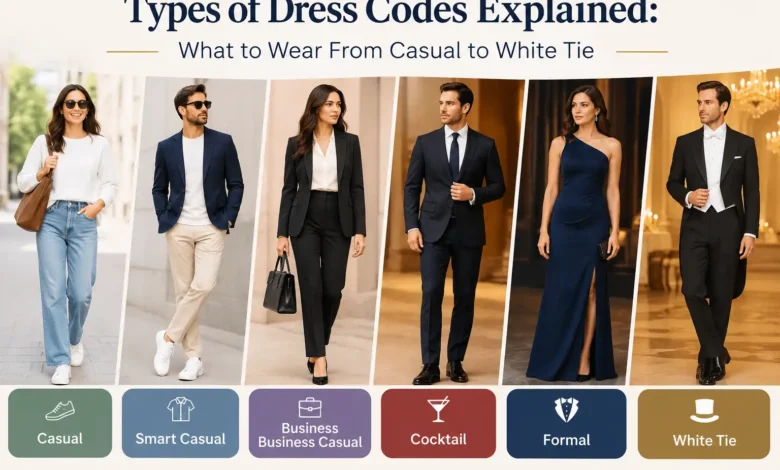
The main types of dress codes, from most relaxed to most formal, are casual, smart casual, business casual, business professional, cocktail, semi-formal, black tie optional, black tie and white tie, with morning dress as the formal daytime code. As you move up, clothes get more tailored: first more polish, then a full suit, then evening wear, and at the very top, the tailcoats and floor-length gowns of white tie.
The same words can mean different things depending on the host, the country and the time of day. Below is a quick table of dress code types, then each code with outfits for men and women, the themed codes on modern invitations, the U.S. and UK differences, and a five-step way to read any invitation.
- Everyday and work: casual, smart casual, business casual and business professional.
- Evening and formal events: cocktail, semi-formal, black tie optional, black tie and white tie; morning dress for formal daytime events.
- Themed codes like garden party, festive or resort casual are variations on those levels.
- When in doubt: dress slightly up, not down.
Types of dress codes at a glance
This table sums up each level with a typical outfit. The men’s and women’s columns show traditional choices, not strict rules; tailored alternatives, like an evening pantsuit, are accepted at many events.
| Dress code | Men | Women |
|---|---|---|
| Casual | Jeans or chinos, plain tee or casual shirt, clean sneakers | Jeans, skirts, sundresses, casual tops |
| Smart casual | Chinos or dark jeans, collared shirt or fine knit, optional blazer | Tailored trousers, midi skirt or simple dress, blouse or knit |
| Business casual | Trousers or chinos, button-down, knitwear, loafers | Trousers, skirts, dresses, blouses, flats or low heels |
| Business professional | Dark suit, dress shirt, often a tie | Pantsuit, skirt suit or dress with jacket |
| Lounge suit (UK) | Dark or gray suit and tie | Skirt or trouser suit, or dress and jacket |
| Cocktail | Dark suit, usually with a tie | Cocktail dress or dressy separates |
| Semi-formal (U.S.) | Dark suit and tie | Cocktail dress or elegant separates |
| Black tie optional | Tuxedo, or dark suit and tie | Long gown or dressy cocktail dress |
| Black tie | Tuxedo (dinner jacket) and black bow tie | Evening gown or formal cocktail dress |
| White tie | Tailcoat, white waistcoat, wing collar, white bow tie | Full-length evening gown |
| Morning dress (daytime) | Morning coat, waistcoat, striped trousers, tie | Formal day dress, often with a hat |
How dress code levels are ranked, and why they get confusing
Dress codes form a ladder of formality. Casual sits at the bottom, where almost anything clean and appropriate works. White tie sits at the top, with precise rules down to the collar. Two things matter as much as the level itself: time of day, since black tie and white tie are evening codes and morning dress is the daytime counterpart to white tie, and setting, since work codes and event codes follow different logic.
That second point explains an apparent oddity. Cocktail and semi-formal rank above business professional, yet a man may wear a similar dark suit to all three. The difference is the mode: event codes call for evening polish, meaning darker and dressier fabrics, more elegant shoes, and dresses rather than suits for many women.
The ladder has also shifted over time. Wikipedia’s overview of Western dress codes notes that the lounge suit, now standard business wear, “was originally considered (as its name suggests) casual wear,” and that black tie was “initially described as informal wear.” In that traditional classification, black tie counts as “half dress,” which is why it’s still often called semi-formal; modern U.S. invitations, by contrast, use semi-formal for a dark suit or a cocktail dress. The U.S. vs UK table further down covers the differences.
Everyday and work dress codes
These four codes cover most days: weekends, offices, casual events and job interviews. What separates them is how much polish and tailoring each one asks for.
Casual
Casual means everyday clothes that are clean, fit well and suit the occasion: jeans, chinos, plain T-shirts, casual shirts, sundresses and skirts. The Emily Post Institute’s attire guide sets two useful limits even here: jeans should be clean with no holes, and T-shirts plain, with no slogans. Clean sneakers fit right in, and some of them can dress up further; our guide on whether sneakers are business casual explains which pairs cross over.
Smart casual
Smart casual is polished but relaxed: one or two clearly smart pieces, like a blazer, a crisp shirt or tailored trousers, with the rest easygoing. Men often wear chinos or dark jeans with a collared shirt or fine knit and loafers or boots; women might choose tailored trousers, a midi skirt or a simple dress. Because the term is so loosely defined, it has its own full guide: what smart casual means, with outfit ideas for men and women.
Business casual
Business casual is office wear without a suit: trousers or chinos, button-down shirts, blouses, knitwear, skirts and dresses, with loafers, flats or low heels, and a blazer if you like. A tie is optional. Items at the relaxed edge depend on the workplace. Denim and polos are the usual gray areas: see whether jeans can be business casual and when a polo is business casual.
Business professional (business formal)
Business professional is the suit level: a matching suit in a dark color, a dress shirt or blouse, polished dress shoes and, in more traditional fields, a tie. Women wear pantsuits, skirt suits or a dress with a matching jacket. Many people use “business formal” to mean the same thing, though some reserve it for dressier corporate evenings. It remains the default for interviews in conservative fields and formal client meetings. Our side-by-side guide to business casual vs business professional shows exactly what changes between the two.
Evening and formal event dress codes
Invitations to weddings, parties, galas and formal dinners use these codes. They’re about the occasion rather than the office, so evening polish replaces work clothes as you move up. The one exception is the UK’s lounge suit, a social code that borrows business wear.
Lounge suit
Common on UK invitations, “lounge suit” is, in the words of Debrett’s, a leading British etiquette authority, a “misleadingly named dress code” that “refers to business attire.” For men, that means a “dark or grey suit, collar and tie and formal, polished, black shoes”; for women, a “skirt or trouser suit or a dress and jacket, with mid-heel shoes.” In the U.S., the same event would more likely say semi-formal or simply suit and tie.
Cocktail
Cocktail attire is dressy but not formal. For men, that means a dark suit, usually with a tie; relaxed or summer events may let you skip it. For women, it means a cocktail dress, typically knee to midi length, or dressy separates such as silk trousers with an elegant top. The cocktail dress code also shifts with the hour: lighter colors and fabrics suit an afternoon party, while darker shades, richer fabrics and dressier shoes suit an evening one. Floor-length gowns tend to belong to formal and black tie codes.
Semi-formal
On modern U.S. invitations, semi-formal sits close to cocktail but a little more traditional. The Emily Post guide lists a dark business suit, dress shirt and tie for men, and a short afternoon or cocktail dress, including the classic little black dress, for women. The semi-formal dress code for women also includes dressy jumpsuits and elegant separates, which suit guests who’d rather not wear a dress.
Black tie optional and formal
Black tie optional means black tie is welcome and encouraged, but a dark suit and tie is also acceptable. Women can wear a floor-length gown or a dressy cocktail dress. Read it as an invitation to dress up rather than as permission to dress down.
Many U.S. invitations, especially for weddings, simply say “formal.” That formal dress code sits just below black tie optional and isn’t the same as black tie: a tuxedo is welcome but not expected, a dark suit and tie is standard for men, and women usually wear a floor-length gown or a sleek jumpsuit. If the hosts want tuxedos, they’ll normally write black tie.
Black tie
Black tie is formal evening wear. For men, it means a dinner jacket, which Americans call a tuxedo, with matching trousers, a white formal shirt and a black bow tie. Debrett’s specifies a black single-breasted dinner jacket with silk lapels and “a soft-collared white or cream shirt and a bow tie.” For women, U.S. guides like Emily Post lead with floor-length evening gowns, while Debrett’s says “knee length cocktail dresses are the most popular choice, though floor-length evening dresses can also be worn.”
Knowing what not to wear to a black tie event heads off two common mistakes: a regular business suit with a long necktie, and a daytime or casual dress.
White tie
White tie is the most formal dress code and the rarest. Men wear a black tailcoat, cut to be worn open, matching trousers with two lines of braid, a stiff-fronted white shirt fastened with studs, a detachable wing collar, a white waistcoat and a thin white bow tie. Women wear a full-length evening dress or ball gown; Debrett’s notes that “long gloves may be worn with sleeveless dresses.” It mostly appears at state dinners, certain balls and very formal ceremonies.
Morning dress
Morning dress is formal daywear, the daytime counterpart to white tie, most often seen at traditional British weddings and some formal daytime events. Men wear a morning coat, a waistcoat, striped trousers and a tie. Women wear formal day dresses, often with a hat or fascinator. Outside those settings, you’re unlikely to see it on an invitation.
Themed dress codes you’ll see on invitations
Hosts often use descriptive or playful dress codes to set a mood. Almost all of them are variations on the levels above, so work out which level each is closest to, then add the theme.
- Garden party: daytime and outdoors, usually smart casual to cocktail. Think light colors, linen or cotton suits, sundresses or floral midi dresses, and shoes that won’t sink into grass, such as block heels, wedges or loafers.
- Festive attire: common for holiday parties. Dress to the level of the event, usually cocktail or smart casual, and add seasonal color, velvet or a little sparkle.
- Creative black tie: black tie with personality. A colored or patterned dinner jacket, a bold bow tie, a statement gown or an elegant jumpsuit can all work, as long as the overall look stays formal.
- Gala: often black tie or black tie optional. Check the invitation, and if it doesn’t say, dress at least at cocktail level.
- Casual chic, dressy casual or elevated casual: all close to smart casual. Casual pieces styled with care, such as dark jeans or tailored trousers with a nice top, a blazer and polished shoes.
- Beach formal: formal intent in a beach setting. Light suits in linen or cotton, with a tie optional, for men; flowing maxi or midi dresses with flat or wedge sandals for women.
- Resort casual: vacation dressing with polish, common on cruises and at destination events: linen shirts, chinos, sundresses, and loafers or sandals. The resort casual dress code often gets dressier for dinners and evening events.
U.S. vs UK: same words, different rules
Most terms are shared across the Atlantic, but a few carry different weight. If you’re traveling or invited by a host from another country, these are worth knowing:
| Term | Usual U.S. meaning | UK or traditional meaning |
|---|---|---|
| Semi-formal | Dark suit or cocktail dress | Traditionally black tie in the evening; uncommon on UK invitations |
| Smart casual | Relaxed tailoring; dark jeans often accepted | Debrett’s suggests a jacket with “quite possibly a tie” or an open-necked shirt for men, and calls denim “probably too casual” for women at social events |
| Black tie, women | Floor-length gown is the classic choice | Knee-length cocktail dresses are the most popular choice, per Debrett’s |
| Lounge suit | Rarely used; “suit and tie” instead | Dark or gray suit and tie; skirt or trouser suit, or dress and jacket |
| Tuxedo / sneakers | Standard words | Usually “dinner jacket” and “trainers” |
Everyday practice is often looser than traditional etiquette. Work guidance such as Virginia Tech’s dress code guide says “dark jeans are often considered acceptable” for smart casual, and a 2023 YouGov survey found that most Britons accept jeans as smart casual: 74% for men, as long as they aren’t ripped or skinny, and 65% for women. Canadian usage mostly follows the U.S., though many Canadians say “runners” rather than sneakers.
Dress codes at weddings
Weddings are where many people meet these codes, and couples often use their own wording. Here’s how the common phrases typically translate for guests:
| Invitation says | Usually means |
|---|---|
| Casual or beach casual | Smart casual: sundresses, linen, chinos, no tie needed |
| Dressy casual or garden party | Smart casual to cocktail, in daytime colors |
| Cocktail or semi-formal | Dark suit (tie expected; cocktail can go open-collar only when the event is clearly relaxed); cocktail dress or dressy jumpsuit |
| Formal or black tie optional | Tuxedo or dark suit and tie; long gown or dressy cocktail dress |
| Black tie | Tuxedo and bow tie; evening gown or formal cocktail dress |
Two guest rules apply almost everywhere: avoid white, cream and ivory unless the couple asks for them, and check the venue before choosing shoes, since grass, sand and cobblestones all rule out certain heels.
Matching shoes to the dress code
Shoes often give an outfit away, so it helps to know where each style sits on the ladder:
- Casual: clean sneakers, canvas shoes, sandals where appropriate.
- Smart casual: loafers, desert or Chelsea boots, minimal leather sneakers, flats and block heels.
- Business casual: loafers, derbies, low boots, flats, low pumps.
- Business professional: polished oxfords or derbies, closed-toe pumps or elegant flats.
- Cocktail and semi-formal: polished dress shoes or leather loafers; heels, dressy flats or elegant sandals.
- Black tie and white tie: black patent leather shoes, with highly polished plain black oxfords also accepted at black tie; evening heels or dressy flats that suit the gown.
How to decode any dress code on an invitation
When an invitation uses a term you don’t recognize, or none at all, these steps will get you to the right outfit:
- Find the closest standard level. Most themed codes map onto smart casual, cocktail or black tie. Start there.
- Check the time. Evening events run dressier and darker than daytime ones at the same dress code.
- Look at the venue. A hotel ballroom, a rooftop bar and a lawn call for different fabrics and shoes, even under the same dress code.
- Consider the host and occasion. Weddings, milestone birthdays and work events often run more formal than the wording suggests.
- Ask if you’re unsure. A quick message to the host or organizer is normal and better than guessing. If you can’t ask, choose the slightly smarter option.
Frequently Asked Questions
What is the most formal dress code?
White tie is the most formal dress code. Men wear a black tailcoat, a stiff-fronted white shirt with a wing collar, a white waistcoat and a white bow tie; women wear full-length evening gowns, sometimes with long gloves. It’s rare today and mostly appears at state dinners, formal balls and some ceremonial events.
What’s the difference between semi-formal and cocktail?
On U.S. invitations, the two are close, and guides disagree on which is dressier: Emily Post lists the cocktail dress under semi-formal, while many wedding guides put cocktail a notch higher. Both call for a dark suit or a cocktail-length dress. If you can’t tell which way the host leans, wear the tie.
How many types of dress codes are there?
There’s no official number. Guides list anywhere from five to ten main codes, depending on whether they include work codes and in-between levels like black tie optional. This guide covers eleven standard levels, from casual to white tie, including morning dress and the UK’s lounge suit, plus the themed codes built on them.
What should you wear if there’s no dress code?
Match the event rather than defaulting to casual. For daytime gatherings, smart casual is a safe starting point. For evening events at a restaurant or someone’s home, smart casual to cocktail usually works. For weddings and formal venues, assume at least cocktail. If you’re unsure, ask the host or lean a little dressier.
Can women wear trousers to formal events?
Yes. A tailored pantsuit or an elegant jumpsuit works for business professional, cocktail and semi-formal events, and dressy trousers in evening fabrics can work at black tie in many settings, particularly under creative black tie. At white tie, a full-length gown remains the traditional expectation.
The short version
The types of dress codes work like a ladder. Work codes run from casual through smart casual and business casual to the business professional suit. Event codes then add evening polish, from cocktail and semi-formal up to black tie and, rarely, white tie, with morning dress covering formal daytime occasions. Themed codes are variations on those levels, so map them to the nearest one first, then adjust for the time of day and the venue. Watch the words that shift between the U.S. and the UK, such as semi-formal, smart casual and lounge suit. And when the invitation still leaves you unsure, ask the host.

9 Comments