
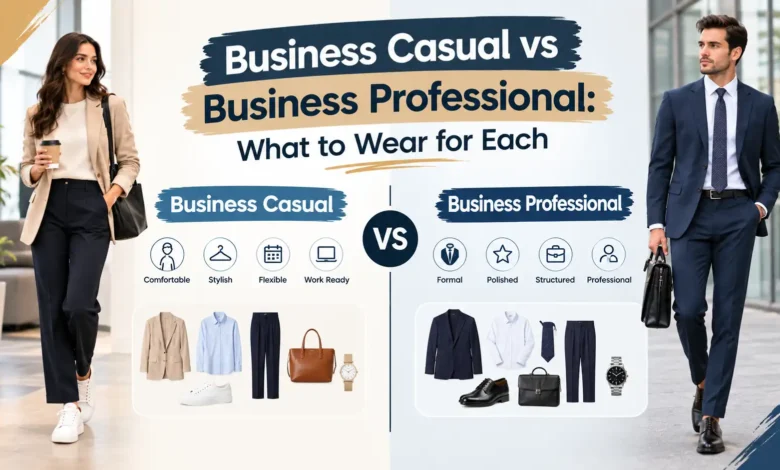
Business casual vs business professional is really a question about the suit. Business professional means a matching suit, or suit separates in one fabric, in dark, understated colors, with a dress shirt or blouse, closed-toe dress shoes and, especially in conservative fields, a tie for men. Business casual drops the suit in favor of separates like chinos or trousers, collared shirts, blouses, knitwear and loafers, with a tie optional.
If an offer letter, an interview invite or a new manager has just used one of these terms, the practical worry is usually whether you need to buy a suit. Here’s what each dress code includes for men and women, what survey data says about how people dress now, and how to move one outfit between the two.
- Business professional: a suit or suit separates, a dress shirt or blouse, dark colors and polished dress shoes.
- Business casual: no suit required, tie optional, more color and texture, loafers and flats welcome.
- Day to day: in U.S. surveys, business casual is far more common at work than business professional.
- Still business professional: interviews in conservative fields, career fairs, and formal client or board meetings.
Business casual vs business professional at a glance
Penn State Engineering’s career guide sums up both levels in a sentence each. Business professional is “what most people think of as traditional interview clothing—conservative in style and usually dark in color.” Business casual “blends the formality of traditional business wear with a more comfortable—but still professional—style.” Both sit on a longer ladder that runs from casual up to white tie, and our guide to the types of dress codes lays out every level.
A quick note on wording if you’re in the UK: you may see “smart” or “smart casual” used for everyday office dress, often for what U.S. offices call business casual, and “lounge suit” on formal invitations, which Debrett’s defines for men as “a suit worn with a shirt and tie” and for women as formal business attire. Canadian usage mostly follows the U.S. terms used here.
What business professional attire looks like
Business professional means a coordinated, tailored outfit in dark or neutral colors. For most people that’s a suit, or suit separates: a jacket and trousers or skirt cut from the same fabric but sold separately so each piece can fit properly. Everything is pressed and well fitted, and accessories stay minimal.
For men
- A matching suit in navy, charcoal, gray or black.
- A white or light-colored long-sleeve dress shirt.
- A tie in a solid color, small pattern or simple stripe, expected in conservative settings and increasingly optional elsewhere.
- A leather belt, polished dark oxfords or derbies, and dark socks.
For women
- A pantsuit or skirt suit in navy, gray or black, or a tailored sheath dress with a matching jacket.
- A blouse or fitted top that isn’t tight, sheer or low-cut.
- Closed-toe pumps, flats or low heels. Penn State’s business professional list advises avoiding peep-toe styles and heels higher than 2 inches.
- Neutral or light-colored hosiery, which Penn State lists; expected in some traditional workplaces, optional in many others.
- A structured bag and simple jewelry.
Penn State also lists a gender-neutral version: a matching jacket and slacks in navy, dark gray or black, a lighter-colored shirt or top, dark socks or stockings, and polished closed-toe dark shoes.
Is business formal the same thing?
Often, yes, but not always. Many guides use “business formal” as another name for business professional. Others treat it as the dressiest workplace level, used for galas, award ceremonies or major evening events, where black or dark suits and formal dresses are the norm. If a tuxedo is expected, the invitation will usually say black tie. So treat business formal as at least business professional: for a daytime meeting, a suit is right; for an evening event, go a notch dressier.
What business casual looks like
Business casual keeps the neatness but drops the suit. It’s the everyday dress code in many offices, and it leaves more room for color, texture and comfort. What’s allowed at the relaxed edge, like jeans, polos and sneakers, varies a lot from one workplace to the next.
For men
- Bottoms: chinos or dress trousers in navy, gray, stone or olive. Dark jeans only where the workplace allows them; our guide on whether jeans can be business casual covers which pairs pass.
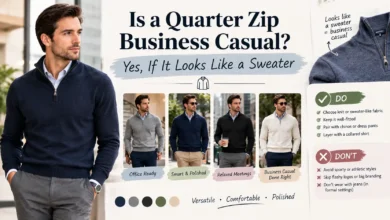
- Tops: oxford or poplin button-down shirts and fine-knit sweaters or cardigans.
- Layers: an optional blazer or sport coat, with a tie if you like but no need for one.
- Shoes: loafers, derbies, chukka or Chelsea boots.
For women
- Bottoms: tailored trousers, midi or knee-length skirts, and dresses such as shirt dresses or knit sheaths.
- Tops: blouses, shells, fine knits and cardigans, with or without a blazer.
- Shoes: loafers, flats, block heels, low pumps and ankle boots.
- Details: simple jewelry and a structured tote or bag.
Polos are a common gray area. A structured knit or piqué polo can be business casual in many offices, while a shiny golf polo usually isn’t, and our guide explains when a polo is business casual. If in doubt, a button-down is the safer pick.
What doesn’t count as business casual
Whatever your office’s exact rules, a few things fall outside business casual almost everywhere:
- Gym and athletic wear: joggers, gym leggings, hoodies and running shoes.
- Graphic or slogan T-shirts and tank tops.
- Ripped, faded or heavily distressed denim.
- Shorts, flip-flops and beach sandals, unless your workplace explicitly allows them.
- Anything wrinkled, stained, see-through or very revealing.
Business casual vs business professional, piece by piece
Side by side, the fastest way to tell them apart is the jacket and trousers: matching in business professional, mix-and-match or optional in business casual.
| Piece | Business professional | Business casual |
|---|---|---|
| Jacket | Matching suit jacket, or suit separates in one fabric | Optional blazer, sport coat or cardigan |
| Trousers and skirts | Suit trousers or suit skirt | Chinos, dress trousers, skirts, dresses |
| Shirts and tops | Dress shirt or blouse | Button-downs, blouses, knitwear |
| Tie (men) | Expected in conservative settings | Optional |
| Shoes | Polished dark dress shoes, pumps, closed-toe flats | Loafers, flats, boots, low heels |
| Colors | Navy, charcoal, gray, black | Wider range, including lighter colors and patterns |
| Jeans, polos, sneakers | No | Depends on the workplace |
| Typical settings | Interviews, career fairs, formal client meetings, client-facing roles at traditional firms | Everyday office work in many industries |
How often people actually dress business professional
Among U.S. workers, business professional has become the exception on ordinary workdays. Two surveys, from 2023 and 2025, show the picture:
- Gallup (August 2023): in a telephone poll of 396 employed U.S. adults, 41% said business casual was their usual work attire, 31% said street clothes and 23% said uniforms. Just 3% said business professional, “such as suits or suit separates.” In Gallup’s 2019 poll, business casual was 34% and business professional 7%. Workers who had ever telecommuted were far more likely to wear business casual (58%, vs. 24% of those who never had).
- Monster (January 2025): in a survey of 1,300+ U.S. workers, 43% said they hadn’t worked in an office with a dress code in the past year. Among those who had one, 63% described it as business casual and only 6% as business formal, the survey’s closest category to business professional.
So for a regular office day, business casual is the likelier expectation, at least in the U.S. Suits are now mostly kept for the moments where formality matters most, like interviews, career fairs, court appearances, formal client meetings and senior presentations. On hybrid or remote days, the same logic applies on camera: dress for the most formal call on your calendar.
Which one should you wear?
Which one you need usually depends on who you’ll meet and how much is riding on it. One rule covers most cases: at work, match the most senior people you’ll be with; for interviews, dress one level above the company’s everyday dress code.
| Situation | Usually | Why |
|---|---|---|
| Job interview in finance, law or consulting | Business professional | These fields commonly expect a suit; in finance, a tie too |
| Job interview at a tech, creative or startup company | Polished business casual, often with a blazer | One level above the team’s everyday clothes |
| Career fair | Business professional | Penn State calls it “always appropriate” here |
| First day at a new job | Ask beforehand, then match it | Written and unwritten rules often differ |
| Regular office day | Whatever the policy says | Most often business casual in U.S. surveys |
| Formal client or board meeting | Business professional | Match the most senior people in the room |
| Video interview | The same as in person, head to toe | No surprises if you need to stand up |
For interviews, being slightly overdressed is easier to recover from than looking underdressed. If a recruiter tells you the company is business casual, take that at face value, but aim for the smarter end: a blazer, pressed trousers or a skirt, and leather shoes.
How to move the same outfit up or down a level
Most wardrobes can cover both dress codes with a few swaps.
From business professional to business casual
- Take off the tie and open the top button.
- Wear the suit jacket with chinos or contrasting trousers. This works best with plain navy or gray jackets; pinstripes and shiny fabrics look odd on their own.
- Replace a crisp dress shirt with an oxford shirt or a fine-knit sweater.
- Wear the suit jacket over a knit midi dress instead of the matching skirt, or swap the whole suit for a blouse, tailored trousers and a cardigan.
- Trade oxfords or pumps for loafers, flats or block heels, or for clean minimal sneakers where your office accepts them. Our guide on whether sneakers are business casual explains which pairs pass.
From business casual to business professional
- Swap chinos or contrasting trousers for a full suit, or suit separates in one fabric.
- Switch to a crisp dress shirt or plain blouse, and add a tie for men in traditional settings.
- Replace a cardigan with a jacket that matches your trousers or skirt.
- Swap loafers, boots or flats for polished oxfords, derbies or closed-toe pumps.
- Move toward darker colors: navy, charcoal, gray or black.
Frequently Asked Questions
Does business professional require a tie?
Not always anymore. Brandeis International Business School’s career team notes that from interviews to the workplace, a tie is now “more the exception rather than the rule.” It still recommends a suit and tie for every finance interview, even virtual ones, and says a tie is rarely wrong at an interview, though tech companies may find one too formal.
Can women wear pants for business professional?
Yes. A well-fitted pantsuit (a trouser suit, in UK terms) is fully business professional, and Penn State’s business professional list for women includes a dark suit with a knee-length skirt or pants. Choose dark or neutral colors, a coordinated blouse and closed-toe shoes. A tailored dress with a matching jacket works too.
Is a blazer with chinos business professional?
No, that’s classic business casual. Business professional calls for a matching suit or suit separates, meaning a jacket and trousers or skirt made from the same fabric. Chinos, knitwear and contrasting blazers belong to business casual, however neat and well fitted they are.
What should I wear to an interview if the company is business casual?
Dress one level above the everyday dress code. For a business casual company, that usually means tailored trousers or a skirt, a pressed shirt or blouse, a blazer and leather shoes, without needing a full suit. In conservative fields such as finance or law, wear a suit regardless.
Is business attire the same as business professional?
Usually. “Business attire” on an invitation or in a policy normally points to business professional: a suit or suit separates in dark, understated colors. If it’s paired with the word “casual,” as in “casual business attire,” it means business casual. When in doubt, ask the organizer or HR which one they mean.
The short version
Business professional means a matching suit or suit separates in dark colors, a dress shirt or blouse, polished dress shoes and, for men in more formal fields, a tie. Business casual keeps the neatness but swaps the suit for separates such as chinos, trousers, skirts, knitwear and loafers, with the tie optional. In U.S. surveys, business casual is far more common day to day, while interviews, career fairs and formal meetings still call for business professional. When you’re unsure, dress for the most senior person you’ll meet. And if your workplace or event leans even more relaxed, our guide to what smart casual means covers the next level down.

8 Comments