
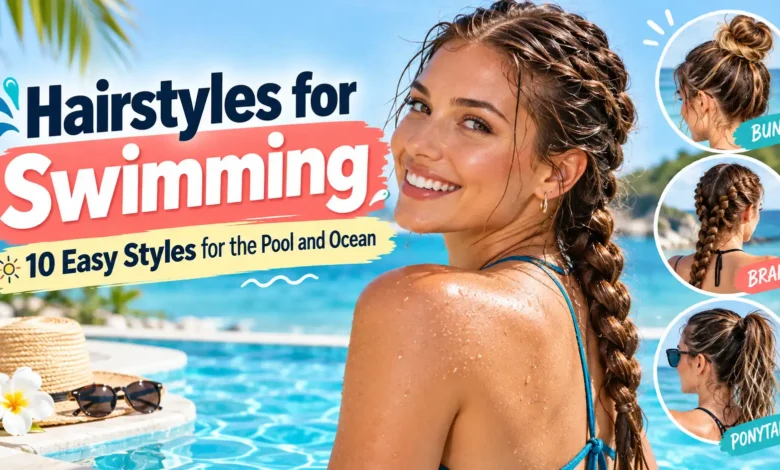
The best hairstyles for swimming keep your hair tied back, tangle-free and easy to fit under a swim cap: two braids, a single braid, a low bun or a braided ponytail. Before you get in, wet your hair with clean water and smooth on a little leave-in conditioner or oil. After you get out, rinse right away. The routine matters as much as the style, because chlorine and salt water both dry hair out.
Below are 10 swimming hairstyles with steps for laps, pool days, the ocean and kids, plus textured-hair care, swim caps for long hair, and why pool water can turn hair green. For more everyday styles, see our guide to easy hairstyles to do yourself.
- Best overall: two Dutch or French braids. They stay put, don’t tangle and fit under a cap.
- Under a swim cap: a single braid or a low bun at the nape of your neck.
- Pool day, head above water: a high bun, space buns or a half-up top knot.
- Before you swim: wet your hair, add leave-in conditioner or oil, and tie it back firmly but comfortably.
- After you swim: rinse right away, then use a swimmers’ shampoo and a conditioner.
- Kids: keep long hair tied back and away from pool drains. A bubble ponytail needs no braiding skills.
- Extensions and wigs: take out clip-ins; for tape-ins, sew-ins or wigs, follow your stylist’s or maker’s care advice, since attachments differ.
Best hairstyles for swimming at a glance
The right style depends on what you’ll be doing in the water. Braids are the most secure for swimming laps or playing in waves. Buns sit flat under a cap. Higher styles work when you’re mostly lounging or keeping your head above water.
| Style | Best for | Under a cap? |
|---|---|---|
| Two Dutch or French braids | Laps, ocean, active play | Yes |
| Single low braid | Laps, lessons | Yes |
| Low bun | Laps, swim caps | Yes |
| High bun or top knot | Pool days, head above water | No |
| Braided or bubble ponytail | Pool play, kids | No |
| Space buns | Pool days, lounging | No |
| Half-up top knot | Lounging, short dips | No |
| Twisted-back sides (short hair) | Any swim | Yes |
| Flat twists or cornrows | Textured hair, several swims | Yes |
| Low bun for locs or box braids | Locs and braids, laps | Yes, with a larger cap |
10 easy hairstyles for swimming (with steps)
Do each of these on damp hair with a little leave-in conditioner or oil already worked through. That makes braiding easier and gives your hair some protection before it meets pool or sea water. Use fabric-covered elastics rather than bare rubber bands, and make every style firm enough to stay in place but never painful.
1. Two Dutch or French braids
- Part your hair down the middle and clip one side out of the way.
- At your hairline, take three small sections and start a braid.
- Each time you cross a side section over (French) or under (Dutch) the middle, add a little loose hair to it.
- Keep adding hair until you reach the nape of your neck, then braid the rest normally and secure it with an elastic.
- Repeat on the other side.
Why it works: the hair is locked into the braid from the scalp down, so waves, flip turns and a cap can’t pull it loose. In the ocean, it tends to tangle far less than loose hair.
2. Single low braid
- Brush your hair back and gather it at the nape of your neck.
- Braid it all the way down and secure the end with an elastic.
- For a swim cap, coil the braid into a flat loop at the back of your head, or tuck it up inside the cap as you put it on.
Good for: laps and lessons. It takes a minute, keeps lengths from knotting together, and folds neatly under a cap.
3. Low bun at the nape
- Make a low ponytail at the nape of your neck.
- Twist the ponytail until it starts to coil, then wrap it around its base.
- Secure it with a second elastic or a few bobby pins pushed toward the base.
Why it works: a low bun sits flat against your head, which is why it’s the easiest shape to fit under a swim cap. A high bun is much harder to fit a cap over.
4. High bun or top knot
- Gather your hair into a high ponytail on the crown of your head.
- Twist and wrap it into a bun, and secure it with a second elastic.
Worth knowing: if you’re mostly keeping your head above water, a high bun keeps your lengths out of the pool. It isn’t a good choice for going underwater or wearing a cap.
5. Braided or bubble ponytail
- Make a ponytail at the height you like.
- Braid the ponytail, or add elastics every few inches down its length and gently loosen each section for a bubble ponytail.
Why it works: plain ponytails swirl and knot in the water. Braiding or banding the length keeps it together, and it’s quick to do on kids.
6. Space buns
- Part your hair down the middle.
- Make a high ponytail on each side.
- Twist each ponytail and wrap it into a bun, then secure it with an elastic.
Good for: pool days. Space buns keep all your hair off your neck and shoulders, and they’re one of the cutest options for a day at the pool.
7. Half-up top knot
- Take the top section of your hair, from temple to temple.
- Twist it into a small bun on your crown and secure it.
- Leave the rest down, or braid it if you’re getting in.
The tradeoff: it keeps hair out of your face while you lounge, but the loose half isn’t protected. For real swimming, braid the lower half so it doesn’t tangle.
8. Twisted-back sides for short hair
- Take a section at one temple and twist it back toward the crown.
- Pin it flat with two crossed bobby pins.
- Repeat on the other side. Slick the rest back with leave-in conditioner.
Good for: short hair, which can’t be tied back but can be kept off your face. More ideas are in our guide to easy hairstyles for short hair.
9. Flat twists or cornrows
- On clean, conditioned hair, part a section from front to back.
- Twist (flat twists) or braid (cornrows) it close to the scalp, adding hair as you go.
- Repeat across your head and secure the ends.
Why it works: the style holds through several swims, keeps textured hair from tangling and sits flat under a cap. Keep the tension comfortable, especially at the hairline.
10. Low bun for locs or box braids
- Gather your locs or braids at the nape of your neck.
- Wrap them loosely into a bun and secure it with a large covered elastic or a fabric scrunchie.
- Put on a swim cap made with extra room at the back, if you’re wearing one.
Why it works: it keeps the weight of locs or braids contained and off your neck. A loose bun avoids pulling on the roots.
Pool hairstyles: cute, easy styles for a pool day
Hairstyles for the pool don’t need to be as secure as hairstyles for swimming laps if you’re mostly sitting on the edge or floating. Use this simple rule: if you’ll go under the water, braid it; if you’ll keep your head above water, put it up.
- Lounging and short dips: space buns, a half-up top knot, or a claw clip holding a twist.
- Playing in the pool: a bubble ponytail or two braids, which hold up to splashing and jumping.
- Pool hairstyles for long hair: two braids, which keep long lengths from knotting when they get wet.
Protect a pool-day style the same way as a swim style: wet it and add leave-in first, and rinse after.
Hairstyles for swimming for Black, curly and textured hair
Curly, coily and textured hair usually needs extra moisture care, so preparing it before you swim matters even more. Saturate your hair with clean water, then seal it with a leave-in conditioner or oil so it takes in less pool or sea water.
- Choose a protective style: flat twists, cornrows or a low bun, ideally done the day before so it’s set.
- Too short to twist or braid? Skip the styling step. Saturate your hair with water, smooth on leave-in or oil, and let a well-fitting cap do the rest.
- Keep the tension comfortable: the American Academy of Dermatology’s hair care tips for Black hair warn: “Make sure braids, cornrows or weaves are not too tight. If it hurts while your hair is being styled, ask the stylist to stop and redo it. Pain equals damage.”
- Box braids and locs: rinse them well after swimming, gently squeeze out water with a towel, and let them dry fully before tying them up tightly or going to bed.
- Wigs and extensions: take out clip-ins before you swim. For wigs and installed extensions, follow the care advice from your stylist or wig maker, since materials and attachments differ.
- Fresh silk press or blowout? Water will revert it, and no cap guarantees it stays dry. A well-fitting cap and keeping your head above water is the most you can do, so plan the press for after pool days if you can.
- Condition after: the AAD’s advice to “Use conditioner every time you wash your hair” applies after swim days too.
An extra-large swim cap, sold for long, thick or textured hair, can fit over locs, braids and full natural hair. It limits how much water reaches your hair, but no cap should be relied on to keep it fully dry.
How to protect your hair from chlorine and salt water
These steps take a few extra minutes and work with every style above.
- Shower first. The CDC’s healthy swimming advice is to “Shower for at least 1 minute before you get into the water to remove dirt or anything else on your body.” It also gets your hair wet.
- Soak your hair with clean water. Rachel Falkner, M.D., a dermatologist at the University of Alabama at Birmingham, explains in a UAB News article: “Wetting the hair before entering the water will stop hair from absorbing as much chlorine or salt water.”
- Add a barrier. Smooth leave-in conditioner or a little oil over your lengths. Board-certified dermatologist Farah Moustafa, MD, recommends this in the AAD’s summer hair care guide, explaining that it “creates a physical barrier between your hair and the harmful chlorine.”
- Style and cap. Braid or bun your hair, and add a swim cap if you’re swimming laps.
- Rinse right away. The AAD’s recommendations for swimmers are: “Wear a swim cap. Rinse hair immediately after swimming. After rinsing your hair, wash your hair with a specially formulated swimmers’ shampoo and follow with a deep conditioner.”
- Clarify if you swim often. The UAB article recommends a weekly clarifying shampoo for regular swimmers, followed by a gentle conditioner to replenish moisture.
- Detangle gently. Take braids out slowly and work through knots from the ends up with a wide-tooth comb and conditioner.
| Water or sun | What it does to hair | What helps |
|---|---|---|
| Pool chlorine | Dissolves the natural fats that coat hair; makes hair rougher and more porous | Pre-wet, leave-in or oil, cap, rinse, swimmers’ shampoo |
| Salt water | Tangles hair as salt dries on the strands | Braids, pre-wet, rinse with fresh water soon after |
| Sun | UV breaks down hair proteins and changes color | A hat when you’re out of the water |
In the AAD guide, Dr. Moustafa explains that chlorine dissolves the lipids, or fats, that coat and protect the hair shaft, and that UV damage breaks down hair proteins and changes hair color. The UAB article notes that salt water can cause tangling as salt dries on the strands. When you’re out of the water, a hat also shields your hair and the parts in your braids from the sun.
Swim caps and long or thick hair
A swim cap is the most direct way to limit how much pool water reaches your hair, and Dr. Moustafa recommends one in the AAD’s summer guide.
It helps to know what a cap can and can’t do, though. UK swimwear retailer Simply Swim puts it plainly: “It’s a big misconception that caps are designed to keep your hair dry.” Most caps reduce water contact rather than seal it out completely, which is why the pre-wet and rinse steps still matter.
- Silicone: generally thicker, more durable and less likely to pull at hair.
- Latex: thin and inexpensive, but it can pull at hair when you take it off. Skip it if you have a latex allergy.
- Fabric: comfortable and easy to put on, but lets water through. Good for keeping hair contained, not dry.
- Long-hair and extra-volume caps: made with more room at the back for long hair, thick hair, locs and braids.
To put a cap on over long hair, a method Speedo’s own FAQ also describes:
- Put your hair in a braid or low bun first, so it’s gathered in one place. Use soft elastics rather than bobby pins or clips, which can tear the cap.
- Dampen your hair so the cap slides on more easily.
- Stretch the cap open with both hands.
- Set the front edge on your forehead, then pull the cap back and down over your hair.
- Tuck in any loose strands and smooth the edges.
Why hair turns green in the pool (and how to prevent it)
Green hair after swimming isn’t caused by chlorine alone. According to Dr. Falkner, the green tint that can appear in light or blond hair comes from copper deposits in the pool, not from chlorine itself. UC Santa Barbara’s ScienceLine puts it the same way: “The green color is caused by certain heavy metals, mostly copper, that lodge in cracks in the scaly outer covering of your hair shaft.”
Chlorine plays a supporting role. Dr. Falkner explains that chlorine makes hair more porous, which lets metals in pool water absorb more easily. The UAB article adds that blond, bleached, gray and white hair are the most likely to show a green tint.
Prevention is the same routine as above: wet your hair first, add a barrier, wear a cap, and rinse straight away, plus the weekly clarifying wash if you swim a lot. If your hair is color-treated or already green, a colorist is the safest person to ask about fixing it.
Kids’ swimming hairstyles and pool safety
For children, the easiest hairstyles for swimming are the simplest: two braids, a single braid or a low bun, done before you leave home. Bubble ponytails need only elastics, no braiding, and they hold up to jumping and splashing. If they wear goggles, low, flat braids sit more comfortably under the strap than a high bun.
Keeping long hair tied back is also a safety habit. The U.S. Consumer Product Safety Commission’s Pool Safely campaign lists hair entanglement as one type of drain entrapment: “Hair entanglement: hair can get caught in a faulty drain cover.” Its advice for parents is to “ensure that they stay away from drains and filters.” Tied-back hair and staying clear of drains go together.
One more myth worth clearing up: pool water doesn’t kill lice. The CDC’s page on preventing lice at the pool says “Chlorine levels used at pools, hot tubs, or splash pads do not kill head lice,” and advises: “Do not share towels, brushes, or other items that come into contact with someone else’s hair.” Give each child their own towel, brush and swim cap.
Swimming hairstyle questions
Should you wet your hair before swimming?
Yes. Soaking your hair with clean water first means it takes in less pool or sea water, as the UAB dermatologist quoted above explains. It’s the easiest step in the whole routine, and it also makes braiding easier. Follow it with a little leave-in conditioner or oil, then braid or bun your hair and add a cap if you use one.
Is it better to swim with your hair up or down?
Up, or braided. Loose hair swirls in the water and tangles, especially in waves, and it gets in your eyes. A braid or low bun keeps it together and fits under a cap. A high bun works for keeping your head above water, but it’s hard to fit a cap over and doesn’t hold as well underwater.
Does braiding your hair protect it when swimming?
Braids protect hair from tangling, which is one of the main problems with salt water and waves, and they hold up under a cap. They don’t stop chlorine or salt from reaching your hair, though. For that, pre-wet your hair, add leave-in conditioner or oil, wear a cap if you can, and rinse as soon as you get out.
Can you keep your hair dry while swimming?
Not reliably. Swim caps reduce how much water reaches your hair, but they aren’t designed as watertight seals, and most swimmers find some water gets in. If you need to keep hair mostly dry, pick a well-fitting silicone cap, tuck every strand in, and keep your head above water when you can.
Can you swim with box braids or locs?
Yes. A loose low bun and an extra-large cap work well, and the rinse-and-dry steps in the textured hair section above keep them fresh. Braids that were installed recently, or that include added hair, are worth checking with your stylist first, since they may have their own care instructions. Keep the bun loose enough that it never pulls at the roots.
How often should you wash your hair if you swim every day?
Rinse after every swim. Beyond that, the AAD recommends a swimmers’ shampoo and a deep conditioner after swimming, and a UAB dermatologist suggests a weekly clarifying shampoo for regular swimmers. Very dry or textured hair may do better with gentler washing on some days and conditioner every time. Adjust to how your hair feels.
Before your next swim
Hairstyles for swimming work best when the prep is done before you leave home. The night before, set any twists or braids you plan to wear, and pack a small kit.
Pack a leave-in conditioner or oil, covered elastics, a cap and a wide-tooth comb. Wet your hair before you get in, rinse as soon as you get out, and let braids dry fully before bed. Our guide to protective hairstyles for sleeping covers the night after, and our gym hairstyles guide has styles for the rest of your workouts.