

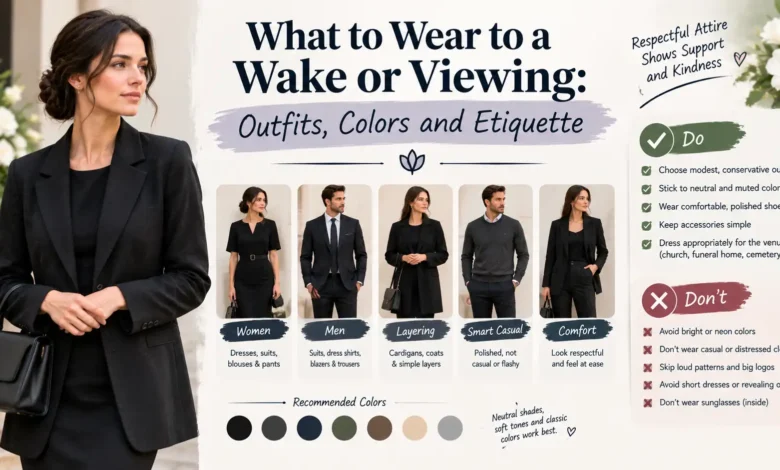
What to wear to a wake: dark or muted, tidy clothes, usually a notch below funeral wear, such as dark pants (trousers) or a knee-length skirt with a plain shirt, blouse or sweater, a blazer or cardigan, and closed-toe shoes. A suit is welcome but not required, and black is a safe choice but not required. Skip anything flashy, revealing or very casual, and follow any dress request in the family’s notice.
The same guidance answers what to wear to a viewing and what to wear to a visitation. Below you’ll find outfits for women and men, what not to wear, jeans, coming straight from work, kids, the family, weather and faith traditions.
In the UK, a “wake” usually means the gathering after the funeral, and in Ireland it’s often held at the family’s home before the funeral. Both have their own sections, listed in the table of contents.
- Safe outfit: dark pants or a skirt, a plain top, a blazer or cardigan, and closed-toe shoes.
- Black? A safe default, never required. Navy, charcoal, gray, dark green and brown all work.
- Only jeans and sneakers? Go anyway. Wear your darkest, cleanest jeans with no rips, a plain top with no logo, and your cleanest shoes.
- From work: go anyway. You don’t need to go home and change first.
- Kids: clean, tidy dressy clothes; color matters less than comfort.
- Family: dark and simple, with the most comfortable shoes you own.
What to wear to a wake: the short answer
What do you wear to a wake if you’ve never been to one? Usually business casual in quiet colors, or a little dressier. Evergreen Funeral Service puts it simply: “Business casual is almost always appropriate. Dark or muted colors are traditional, though many modern families are relaxed about color choices.”
- Top: a plain shirt, blouse or fine sweater with sleeves. Nothing low-cut, sheer or printed with words.
- Bottoms: dark pants, chinos, or a skirt or dress that stays at the knee or below when you sit.
- Layer: a dark blazer, cardigan or plain jacket. Rooms and evening air can both be cool.
- Shoes: clean, closed-toe and comfortable enough to stand in a line.
- Extras: small jewelry, a plain bag, little or no fragrance, and tissues in a pocket.
If the obituary, invitation or funeral home notice mentions a dress code or a color, that request comes first. Our guide to business casual vs business professional explains that dress level, and our overview of types of dress codes shows where it sits among the others.
Wake vs viewing vs visitation vs funeral: what to wear to each
These words overlap, and funeral homes don’t all use them the same way. In general, a wake, viewing or visitation is a gathering before the funeral where people pay their respects to the family, often at the funeral home. The table sums up how the terms are commonly used in the U.S. and Canada, plus one UK term, with our dress suggestions in the last column:
| Event | What usually happens | What to wear |
|---|---|---|
| Wake | A gathering before the funeral, often at the funeral home | Dark business casual, sometimes dressier |
| Viewing | Guests come and go to see the person in an open casket and greet the family | Dark business casual |
| Visitation | Much like a viewing, but the person may not be present | Dark business casual |
| Funeral | A formal service | The dressiest: dark suit, dress or pantsuit |
| Chapel of rest (UK) | A private room for family and close friends before the funeral | Modest everyday clothes |
The details differ from place to place. Wujek Calcaterra & Sons describes a wake as “a formal event that typically occurs right before the funeral” that can “last anywhere from two to six hours,” and calls a viewing “a much less formal event.”
Meanwhile, Cornwell Colonial Funeral Home describes viewings as come-and-go events with no set arrival time, a visitation as almost the same but without the person present, and a wake as a time when guests stay and watch over the person. When in doubt, read the notice or call the funeral home.
What to wear to a wake vs funeral
A viewing or visitation is usually a notch less formal than the funeral, and the same is often true of a wake, though at least one funeral home describes wakes as formal. A blazer and dark pants work at both, but a suit or a dark dress is more expected at the funeral itself.
If you’re going to both on the same day, wear your funeral outfit to both, or change just one piece, such as swapping a cardigan for a blazer. For the service itself, see our guide to what to wear to a funeral.
Colors: do you have to wear black to a wake?
No. Black is a safe choice at most wakes, but dark and muted colors are just as appropriate: navy, charcoal, gray, dark green, deep brown or burgundy. A soft neutral such as taupe or cream can work as one part of an outfit. What stands out at most wakes is anything bright, shiny or busy, such as neon, sequins, large logos or loud prints.
If you don’t own much black, a navy or gray outfit you already have is better than a rushed purchase. What matters most is that you came, not the exact shade you wore.
When the family asks for color
Some families ask guests to wear a favorite color or a team jersey, or to skip black. Treat it as a warm invitation, not a test. You can follow it fully, or wear dark clothes with one piece in the requested color, such as a scarf, tie, cardigan or pocket square.
If you’re unsure how far to go, ask a relative or the funeral director. Color requests may be more common at a celebration of life.
If you don’t own black or dress clothes
You don’t need to buy anything new. Start with the darkest pants or skirt you own, a plain top with sleeves, and a sweater, cardigan or jacket. Borrowing a blazer from a friend or relative can be a good option, and thrift stores often have dark pants, shirts and cardigans. Clean, pressed, dark clothes that fit are all you need.
What to wear to a wake or funeral viewing as a woman
These outfit ideas aren’t gender rules, so mix any pieces you’re comfortable in. The same principles apply to every option: dark or muted, modest and comfortable. Five outfits that work at most wakes and viewings:
- Dress and cardigan: a plain navy, black or charcoal dress at knee length or longer, with a cardigan or blazer and flats or low heels.
- Pants and blouse: dark tailored pants, a plain blouse and a blazer. The easiest outfit to pull from a work wardrobe.
- Skirt and sweater: a knee-length or midi skirt with a fine sweater, plus tights and ankle boots in cold weather.
- Dark jumpsuit: a plain, modest jumpsuit with a jacket or cardigan over it.
- Maternity or extra comfort: a dark wrap or maternity dress, or dark pants with a long top and a cardigan. Choose breathable fabric, a supportive fit and shoes you can stand in.
Accessories: keep jewelry small and quiet, choose a plain bag in black, gray or navy, and skip bangles that clink. In cold weather, tights or plain hosiery under a skirt are an easy choice, and a dark scarf or wrap helps if the room is cool. Before you leave, sit down in the outfit to check that it’s comfortable and stays put.
What to wear to a wake as a man
A suit is welcome but often not required at a wake or viewing. If you own a dark suit, it’s always appropriate. Four options, from dressiest to simplest:
- Dark suit: navy, charcoal or black, with a white or light blue shirt and a plain, dark tie.
- Blazer and pants: a navy or gray blazer, a collared shirt and dark pants. A tie is optional.
- No suit or blazer: dark pants or chinos, a collared shirt and a dark sweater or cardigan. A tie is optional here too.
- Warm weather: dark chinos and a plain long- or short-sleeved collared shirt, tucked in.
Accessories: a plain watch, a simple leather belt that matches your shoes, dark socks that cover the ankle, and a tie in a solid color or subtle pattern. Skip novelty ties and bold pocket squares. Take off a hat or cap indoors unless you wear it for religious reasons. If you’re unsure about a tie, bring one; you can always take it off in the car.
Can you wear jeans to a wake or viewing?
Sometimes, but it’s the riskiest choice. Some families are relaxed about dress, and dark, clean jeans with a blazer or nice sweater may not stand out. At a more traditional wake, or if you’re a pallbearer or close family member, choose pants if you have them. Ripped or faded jeans are best avoided.
If you own dark pants or chinos and can’t tell how formal the gathering will be, choose those. If jeans are all you have, that’s fine too.
Wear your darkest, cleanest pair with a plain sweater or collared shirt and your cleanest, darkest shoes. If a hoodie is your only warm top, pick a plain dark one with no logo and put a jacket over it if you can borrow one. For the general rule on denim, see can jeans be business casual.
What not to wear to a wake or viewing
These are the choices most likely to draw attention or leave you uncomfortable:
- Very casual wear: shorts, gym clothes, leggings worn as pants, flip-flops and beach sandals.
- Loud clothing: neon, sequins, shiny fabrics, large logos, slogans and busy prints.
- Revealing cuts: low necklines, sheer fabric, backless tops and very short hems.
- Worn-out clothes: ripped, stained or heavily wrinkled pieces.
- Strong scents: heavy perfume or cologne, since rooms can be small and crowded.
- Party looks: club wear, sparkly cocktail dresses and novelty accessories.
- Hard-to-stand-in shoes: stilettos, tall platforms and brand-new shoes that pinch.
If what you have is on this list, go anyway and add a plain dark layer if you can.
Going to a wake straight from work
Many people come straight from work, and some visitations run into the evening. Go anyway. Evergreen says: “If you are coming straight from work and are wearing business clothes, that is perfectly fine.” Keyser Funeral Service adds that at a visitation, “friends and family will come and go during the prescribed calling hours as they choose.”
- Office clothes: fine as they are. Take off a bright scarf or tie if you can.
- Scrubs or a uniform: if you can’t change, come as you are. Take off your ID badge, lanyard and anything clipped on, and put a dark jacket or cardigan over bright or printed scrubs if you have one.
- Sneakers: if sneakers are what you have on, clean, plain, dark ones are the quietest choice. Wipe them off first.
- Work boots or safety gear: leave high-visibility vests and hard hats in the car, and wipe your boots.
- A car kit: if you often go straight from work, keep a dark cardigan or blazer and plain dark shoes in your car or locker.
After a long shift, a short visit is enough. Greet the family, say a few words, and go home to rest.
What kids and teens should wear to a wake
Children don’t need to wear black. Clean, tidy clothes they’d wear to a special occasion are enough: a plain dress or skirt, or pants with a collared shirt or sweater. Comfort matters, because a wake can feel long to a child.
Teens without dress clothes can wear dark pants, chinos or their darkest clean jeans, with a plain collared shirt or sweater and their cleanest dark shoes or sneakers. Skip flip-flops, slogan tees and ripped jeans.
Preparing a child for a wake or funeral
What they’ll see and hear can matter more than what they wear. VITAS Healthcare says that “As a general guideline, children should be allowed to attend a wake, funeral and burial if they want to,” and that “Children should NEVER be forced to view or touch the body of someone who has died.” It also advises that children should never be forced to attend.
Before you go, tell children what the room will look like, that people may cry, and that they can step outside with you at any time. For a young child, keep the visit short, bring a second adult who can take them outside, and pack a quiet book, water or a snack. Let each child choose to look at the casket, stand back or sit with you.
If the casket will be open, Kelly Goldin, a certified child life specialist writing for Children’s Hospital of Philadelphia, advises: “Prepare the child that at one point, the casket lid will shut and will not be re-opened.” In the UK, Winston’s Wish says “It helps to give your child enough information about the funeral so that they can decide whether they want to attend or not.”
What the family and pallbearers wear
If you’re the one standing in the receiving line, wear whatever helps you get through the hours: your funeral outfit, or something a little more relaxed if your family agrees. There’s no single rule for this.
- Shoes: broken-in, cushioned and dark. A second pair in the car can help.
- Layers: a jacket or cardigan you can take off as the room warms up.
- In your pocket: tissues, water, mints or a small snack, and your phone on silent.
- Breaks: it’s OK to sit, step outside or ask a relative to stand in for a few minutes. The funeral director can tell you if there’s a quiet room.
- Color or theme: if the family chose one, wear it. If not, dark and simple is fine.
Some pallbearers and close family choose more formal clothes than guests, such as dark suits or dark dresses, and some don’t. If you’re a pallbearer, ask the family or funeral director if they’d like a particular outfit.
Wake etiquette in five steps
- Sign the guest book if there is one, and include your full name so the family knows who came.
- Greet the family. Evergreen explains that “In many visitations, the immediate family stands near the casket or at the front of the room to greet visitors. This is called a receiving line.” If the line is long, British Columbia’s Martin Brothers Funeral Services suggests: “If there is a line to speak with the bereaved and view the casket, be conscious of keeping the line moving.”
- Keep it short and kind. Devlin Funeral Home reassures guests: “There is no need to find perfect words.” A simple “I’m so sorry,” or a line such as “I worked with Sam,” is enough.
- Viewing is optional. You can pause at the casket, say a quiet goodbye or kneel if that’s your tradition, or skip it and sit down. No one should pressure you.
- Stay as long as feels right. Evergreen says “Most people stay between 15 minutes and an hour, depending on their relationship with the family and how crowded the room is.” If standing is hard, take a seat when you can.
If you can only go to one event, any of them can be a meaningful way to show support. A visitation or viewing can be easier to fit around work because people come and go.
Weather, shoes and comfort
- Evening wakes: bring a layer. Rooms can be cool, and you may wait outside or in a hallway.
- Summer: choose breathable dark fabrics such as cotton or linen blends, with short sleeves or a light cardigan. Sleeveless tops work better with a layer over them.
- Winter: a plain dark coat looks right over any outfit. Swap snow boots for dry shoes at the door if you can.
- Shoes: you may stand in line for a long time. Choose closed-toe shoes with a low, stable heel, and skip anything that clicks loudly or pinches.
- Going on to the burial: if you’ll attend the funeral and burial afterward, heels can sink into grass, so bring flats.
Irish wakes, faith traditions and cultural differences
Traditions change what happens at a wake, and sometimes what people wear. These notes are general; the family or funeral home can tell you what to expect.
Irish wakes
In Ireland, a wake usually comes before the funeral and is often held at home. RIP.ie explains that “A wake is usually held in the deceased’s home or the home of a close relative,” advises “Dress conservatively and avoid bright colours,” and notes that “If you’re not a close relative or friend, the usual time to attend is between 5pm and 8pm.”
The same guide describes shaking hands and offering condolences, tea and sandwiches, and visits that last from about 10 minutes to several hours, depending on how close you are to the family.
Catholic and Hispanic traditions
For Catholics, a prayer service called the Vigil usually takes place during the visitation. The U.S. Conference of Catholic Bishops explains that “The Vigil Service usually takes place during the period of visitation and viewing at the funeral home.”
Rose Hills says of Hispanic funeral traditions that “A visitation is usually held at the funeral home and typically starts in the afternoon and lasts into the evening,” and that prayers are common. Neither sets a dress code for guests; a dark suit or dark, modest clothes fit well.
Black church homegoing weekends
If the family holds a viewing on one day and a homegoing on another, dress for each. For the viewing, dark business casual works. A homegoing is the funeral service itself, not a wake, and it calls for your church clothes.
Evan W. Smith Funeral Services notes that “Funeral fashion at a homegoing service often involves formal church wear,” often with hats and boutonnieres, and that bright colors are often worn as well as black. Follow the family’s notice.
Jewish and Latter-day Saints traditions
- Jewish: there is usually no open-casket viewing. 18Doors notes that “It’s very rare for Jewish funerals to have an open casket.” Dress expectations vary by community, so ask the family or synagogue what they prefer.
- Latter-day Saints: Horan & McConaty says “Before the funeral, there will usually be a community visitation or viewing,” so guests can say goodbye. For the funeral itself, it describes a dark, mid-length dress with covered shoulders for women (and notes pants are also acceptable) and a shirt and tie with slacks as the standard for men.
Wakes and viewings in the UK, and dress in Canada
If a family in the UK asks you to “come back to the house for the wake” after a funeral or cremation, they mean the gathering after the service. Wear what you wore to the funeral. You don’t need to change, and it’s normal to take off a jacket or tie once you’re there if others do.
A guide on Funeral Directory, credited to the National Association of Funeral Directors’ editorial team, defines it this way: “A wake is an informal gathering of family and friends held after a funeral or cremation service.” It can be held at a home, pub, hotel or hall.
A private viewing in the UK usually takes place at a chapel of rest. Best Funerals describes it as “a private, peaceful room at a funeral home where family and close friends may spend time with the person who has died before the funeral,” and adds: “You do not have to visit if it does not feel right for you.” Your funeral director can tell you what to expect.
In Canada, Martin Brothers Funeral Services suggests “dark and subdued colors, such as dark blues, grays, browns, and black” for memorial services and funerals, and the same palette suits a visitation.
Wake and viewing clothing questions
Is a wake more casual than a funeral?
Usually, a little. A viewing or visitation is less structured and people come and go, so dark business casual is typical. Some sources describe wakes as formal events, though, so if the notice mentions a dress code, follow it. If you’re unsure, a blazer or cardigan over dark pants or a dress covers both possibilities.
Can you wear red or a bright color to a wake?
Usually it’s better not to. Most wakes lean toward dark, muted clothes, and bright red or neon can stand out in a quiet room. A small touch, such as a scarf, tie or pin in a deeper shade, is fine. The exception is a family request for a favorite color, or a tradition where bright colors are worn; then follow it.
Can you wear shorts or sandals to a wake in summer?
Shorts are best left at home, even in hot weather. Choose lightweight dark pants, chinos or a knee-length skirt or dress instead. Closed-toe shoes are the safer choice; if you wear a plain, dressy sandal, keep it clean and comfortable for standing. Beach sandals and flip-flops are too casual.
Can you wear a hat to a wake?
Take off baseball caps and casual hats indoors. Religious head coverings are appropriate, and at some services, such as Black church homegoing services, church hats are often part of the dress. A warm hat for the walk in is fine; remove it when you enter the room.
Is it OK to wear white to a wake?
A white shirt or blouse under a dark jacket or cardigan is common and appropriate. An all-white outfit may stand out at some wakes, so save it for when the family asks for it or when white is part of the family’s own tradition. If you’re unsure, keep white to one layer.
What should you wear to a livestreamed or virtual viewing?
If you’re watching privately, wear whatever is comfortable. If your camera is on or you’re speaking, dress as you would in person, at least from the waist up: a plain dark top or shirt, and a tidy background. Mute yourself when you’re not speaking.
Before you head to the wake
- Read the obituary or notice for a dress request or color.
- Check that your shoes are comfortable to stand in.
- Put tissues in a pocket and your phone on silent.
- Plan a short, kind sentence for the family.
Still unsure what to wear to a wake? Dark, tidy and simple is a safe choice at most wakes. Being there matters far more than the outfit.
How this guide was written: we read guidance from funeral homes, bereavement organizations and religious bodies, quote it only where the wording is exact, and link every source; customs vary by family and region, so the notice or the funeral director comes first. Last checked September 2026. See our editorial policy.