
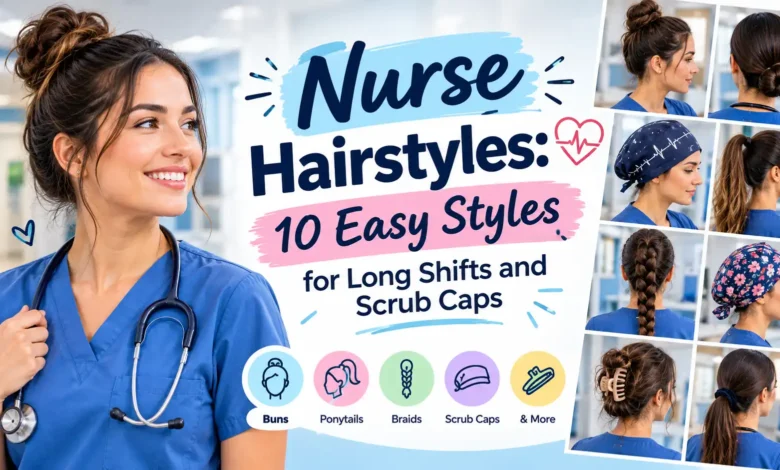
The best nurse hairstyles are secure, off the collar and comfortable enough to last a 12-hour shift: a low bun, a braid wrapped into a bun, two tucked Dutch braids or a claw-clip twist. Above all, nursing hairstyles have to do one job well: keep hair out of the way of patients, equipment and PPE. Washington State University’s College of Nursing puts the standard in one line: “Hair must be off the collar, pulled back, and secured.”
This guide covers 10 easy nurse hairstyles with steps, what real hospital and nursing school dress codes say, and how to handle scrub caps, N95s, natural hair, head coverings, short hair and beards. The same styles work for CNAs and other healthcare roles. Rules vary by employer, so your hospital’s or school’s policy always comes first. For everyday styles off shift, see our guide to easy hairstyles to do yourself.
- Best everyday styles: a low bun, a braid-into-bun or tucked braids.
- The rule: hair longer than your collar should be pulled back and secured.
- Under a cap: keep it low and flat, and pull it back loosely.
- N95s: keep hair and facial hair out of the mask’s sealing area.
- Comfort: firm enough to stay put, never painful. Change the position on a long shift.
- Always: your employer’s or school’s policy wins over any general guide.
Nurse hairstyles at a glance
| Style | Best for | Under a cap? |
|---|---|---|
| Low bun | Any shift, any unit | Yes |
| Braid-into-bun | 12-hour shifts | Yes |
| Two Dutch braids, tucked | Long shifts, active units | Yes |
| Looped braided ponytail | Longer hair, no cap | No |
| High bun | Quick shifts, no cap | No |
| Claw-clip French twist | Where clips are allowed | No |
| Twisted low chignon | A polished look | Yes |
| Twisted-back sides | Short hair | Yes |
| Flat twists or cornrows | Textured hair, several shifts | Yes |
| Loose low bun for locs or braids | Locs and box braids | Yes, with a larger cap |
Practice a new style on a day off before you wear it to work.
10 easy nurse hairstyles (with steps)
Use fabric-covered elastics and a few bobby pins, and keep every style firm enough to stay in place but never painful. The American Academy of Dermatology’s advice on hairstyles that can cause hair loss is to “Avoid frequently wearing hairstyles that pull on your hair.” That matters when you wear your hair up for 12 hours at a time, several days a week.
1. Low bun
- Brush your hair back and gather it at the nape of your neck.
- Secure it with an elastic, then twist the length and wrap it around the base.
- Secure it with a second elastic or three or four bobby pins pushed toward the base.
Why it works: it’s fast, keeps hair above your collar, sits flat under a scrub cap and won’t catch on a chair back on break.
2. Braid-into-bun
- French or Dutch braid from your hairline straight back to the nape.
- Keep braiding the length, then secure the end.
- Coil the braid into a bun at the nape and pin it in place.
Why it works: the braid holds shorter layers and flyaways that slip out of a plain bun, which helps on long, busy shifts.
3. Two Dutch braids, tucked
- Part your hair down the middle.
- Dutch braid each side from the hairline to the nape, adding hair as you go, and secure the ends.
- Cross the ends at the nape and pin each one under the opposite braid, or coil each into a small bun.
Good for: long shifts on active units. Tucking the ends keeps them off the collar, which loose pigtail braids wouldn’t do.
4. Looped braided ponytail
- Make a ponytail at the middle or back of your head.
- Braid the length and secure the end.
- Fold the braid up and secure it back at the base, so the loop sits above your collar.
Worth knowing: a regular ponytail can hang past the collar and swing toward patients. Looping it keeps the look and keeps the ends off your collar, which is what the policies quoted below require.
5. High bun
- Gather your hair into a high ponytail on the crown.
- Twist and wrap it into a bun, and secure it with a second elastic.
Good for: short, busy shifts without a cap. It isn’t a good choice under a scrub cap, and it can catch on the back of a break-room chair.
6. Claw-clip French twist
- Gather your hair at the back, twist it upward into a vertical roll, and tuck the ends in.
- Secure it with a medium claw clip placed along the twist.
Worth knowing: check your unit’s policy first. WSU’s dress code, for example, says “Barrettes, ribbons, and other securing devices must be appropriate for a professional environment.” A clip doesn’t fit under a cap, and it can press when you lean back. Our guide to claw clip hairstyles step by step covers sizes and variations.
7. Twisted low chignon
- Split your hair into two sections at the nape.
- Twist each section away from your face, then twist the two around each other.
- Wrap the rope into a low bun and pin it in place.
Good for: a polished look that still sits flat under a cap.
8. Twisted-back sides for short hair
- Take a small section at one temple and twist it back toward the crown.
- Pin it with two crossed bobby pins, and repeat on the other side.
Good for: chin-length hair that doesn’t reach the collar but falls into your eyes when you lean over a patient.
9. Flat twists or cornrows
- On clean, conditioned hair, part a section from front to back.
- Twist or braid it close to the scalp, adding hair as you go.
- Repeat across your head and secure the ends, tucking longer ends into a low bun.
Good for: textured hair across several shifts in a row, with no styling needed each morning.
10. Loose low bun for locs or braids
- Gather locs or box braids at the nape of your neck.
- Wrap them loosely into a bun and secure it with a large covered elastic or wide pins.
Good for: containing the weight of locs or braids for a full shift. Keep it loose at the roots.
Cute nurse hairstyles (and when they’re allowed)
Cute nurse hairstyles still need to stay secure and clear of your collar. These add personality, but each comes with a catch, so read the note under it before wearing it to work.
Bow bun
- Make a high ponytail, and on the last pass of the elastic, leave the hair folded in a loop with the ends pointing forward.
- Split the loop into two halves to form the sides of the bow.
- Bring the loose ends back over the middle of the bow and pin them underneath.
Worth knowing: a bow bun sits high, won’t fit under a scrub cap and can loosen and sag over a long shift. Save it for units without caps, and carry pins to re-secure it.
Braided crown
- Dutch braid a section along each side of your head, from the temple toward the back.
- Bring each braid over the top of your head, just behind the hairline, and pin the ends under the opposite braid.
- Gather any remaining length into a small low bun.
Worth knowing: the braids add bulk on top of the head, so a braided crown usually doesn’t sit well under a standard cap. It works best on non-cap units and on hair long enough to reach across the crown.
Space buns and simple accessories
Two buns on the crown are fun on shifts without a cap. A colored elastic adds a little color, and a plain headband can work, but check the policy on fabric headbands first: they can be hard to clean and may sit under mask straps. Large bows, jewelry and anything that dangles may not be allowed.
One caveat covers every style in this section: some employers treat playful shapes like space buns or a bow bun as too casual for a professional-appearance standard, so check your dress code, not only the infection-control rules, before wearing one on shift.
5-minute nurse hairstyles
When you’re getting ready before a 6 a.m. start, these four are the fastest of the styles above:
- Low bun (style 1): about three minutes and works everywhere.
- High bun (style 5): about two minutes, for shifts without a cap.
- Claw-clip twist (style 6): two minutes, where clips are allowed.
- Looped ponytail (style 4): about five minutes, and it lifts a ponytail above the collar.
To save more time, braid or twist your hair the night before, then wrap it into a bun in the morning.
Hospital and nursing school hair rules: what they actually say
All the hairstyles for nurses above are built around the same few rules. There’s no single national dress code in nursing; each hospital and school sets its own, but the core rule is remarkably consistent. Here’s what a sample of real policies says:
| Source | What it says about hair |
|---|---|
| NHS England (UK) | “Tie long hair back off the collar.” |
| Washington State University (US) | “Hair must be off the collar, pulled back, and secured.” |
| Oregon Health & Science University (US) | “Hair, including facial hair, longer than collar length should be pulled back and secured appropriately.” |
| University of Connecticut (US) | Long hair and long bangs “must be tied or pinned back off the face and up off the neck so as to be tightly pulled back and off shoulders” |
| University of Portland (US) | “Hair must be pulled back and secured if longer than collar length.” |
| University of Calgary (Canada) | Hair must be “pulled back, or in a ponytail” so it doesn’t “interfere with patient care” |
These policies were checked in September 2026; dress codes change, so confirm the current version with your own employer or school.
The reasons behind them are practical. NHS England’s uniform and workwear guidance notes: “Patients prefer to be treated by staff who have tidy hair and are smartly presented.” Loose hair can also fall toward a patient, catch in equipment, or get in the way of PPE. Oregon Health & Science University’s School of Nursing dress code names “safety and infection control purposes” when it explains its rules on headwear.
In the operating room, the rules go further. The Association of periOperative Registered Nurses’ surgical attire guideline says to “Cover the scalp and hair when entering the semi-restricted and restricted areas.”
Hair under a scrub cap or bouffant
Scrub caps sit best over low, flat nurse hairstyles. A low bun, a twisted chignon or tucked braids fit under most caps, while high buns and claw clips don’t.
- Keep it low and loose: the AAD advises, “If you cover your hair, pull it back loosely beneath the covering.” A tight bun under a fitted cap for 12 hours adds pressure.
- Consider the lining: the same AAD page notes, “A head scarf or other covering made of silk or satin is gentler on hair than other materials.” Satin- or silk-lined reusable scrub caps exist, but many units, especially restricted OR areas, only allow facility-issued caps; check before bringing your own.
- Long or thick hair and locs: a bouffant-style cap or an extra-large cap covers more hair without pressing it flat.
- Cover everything the policy asks for: in restricted areas, AORN’s guidance is to cover the scalp and hair. Tuck in stray pieces at the nape and around the ears.
Which caps are allowed, and where, is set by each facility, and it can differ between hospitals in the same city. If you’re a travel nurse or float between units, ask for the unit’s dress code on the first day of each contract or assignment.
Masks, N95s and stethoscopes
Loose hair and PPE don’t mix. For tight-fitting respirators like N95s, what matters is the sealing area around your face. The CDC’s National Institute for Occupational Safety and Health (NIOSH) explains in a bulletin on beards and respirators: “When hair grows into or protrudes into the respirator’s sealing area, it prevents a good seal, which can leave you exposed.”
- Bangs and face-framing pieces: pin them back so they don’t sit under the mask’s edge.
- Facial hair: NIOSH notes that “Even a day or two of stubble can reduce protection.” Follow your fit-testing guidance.
- Ear loops and ties: styles at the nape or crown leave the area around your ears clear. Tuck hair behind your ears so loops and ties don’t tangle in it.
- Stethoscopes: a secured style keeps hair from catching in the tubing or earpieces when you put the stethoscope on and take it off.
The University of Portland’s nursing dress code sums up the priority: “Students must be able to comply with PPE/appropriate mask fitting per clinical site guidelines.”
Natural hair, braids and locs on shift
Braids, locs, twists and other protective styles are well suited to nursing: they stay put, need little daily styling and fit under a cap. Two AAD tips help them stay comfortable on long shifts: “Opt for thicker braids and locs,” and “Keep braids/locs short, because longer hair is heavier and pulls more.” Gather long locs or braids into a loose low bun rather than a tight, high one.
If you wear your curls out off shift, gather them into a low bun or a single twist pinned at the nape for work. Shorter curls that spring loose around the hairline can be pinned back or held with a little of your usual styling cream or gel.
Some U.S. states have laws, often called CROWN Acts, that ban discrimination based on hair texture and protective styles. The CROWN Act campaign describes it as a law that “prohibits race-based hair discrimination.” As of September 2026, the federal CROWN Act has not become law; the 2025 bills were referred to committee in February 2025. Protections vary by state, and our guide to easy hairstyles for work has more on where they apply. This isn’t legal advice.
Head coverings: hijab, turban and kippah
Many healthcare dress codes accommodate religious head coverings, with requirements for safety and hygiene. In short, NHS England allows religious headwear as long as it doesn’t compromise care, safety or infection control. Its guidance says: “Headwear, for example, turbans and kippot, veils (Christian or niqab) and headscarves are permitted on religious grounds, provided that patient care, health and safety, infection control and security and safety of patients or staff is not compromised.”
The same guidance adds: “Headscarves must be worn unadorned and secured neatly.”
In the U.S., OHSU’s policy says “Headwear worn for religious, cultural, or medical purposes must be securely fastened for safety and infection control purposes,” and WSU exempts head coverings worn “for religious reasons.” Pin coverings so no loose ends hang near patients or equipment, and ask your unit how head coverings work with theater caps or other required covers. If your covering isn’t named in a policy, such as a patka, check your trust’s or hospital’s local policy.
Short hair, and long hair and beards for men
If your hair is shorter than your collar, policies like the ones above generally don’t require you to tie it back. OHSU’s rule applies to “Hair, including facial hair, longer than collar length.” Keep it neat and away from your eyes, and pin back longer front pieces when you lean over patients.
The same rules apply to men with longer hair: a low bun, a man bun at the nape or a tucked braid works. For facial hair, WSU says “Beards are to be clean, neat, and well-trimmed, and follow agency requirements,” and the University of Calgary adds that beards and moustaches “if required to wear a N95 mask must meet N95 standards.” If you’re fit-tested for an N95, follow that guidance for how much facial hair is allowed.
Surviving 12-hour and night shifts
A style that feels comfortable at the start of a shift can start to pull several hours in, especially if it’s fastened tightly. A few habits help it last the full shift:
- Switch positions: move a low bun higher, or loosen and redo it on a break, so the same spot isn’t pulled for the whole shift.
- Very long or thick hair: a braid-into-bun, or a bun secured with two elastics and extra pins, spreads the weight better than a single elastic. If your scalp aches, loosen it.
- Fine or thinning hair: a loose low bun with a soft, fabric-covered elastic puts less strain on one spot than a tight high style, and changing where you secure it helps too.
- Keep a small kit: spare elastics, a few pins and a mini brush in your locker or bag.
- Plan for day two: a braid-into-bun or tucked braids often look neat for a second shift, which saves time on back-to-back days. If your hair got sweaty under a cap, or your unit expects a fresh style each shift, wash and redo it instead.
- After a night shift: let your hair down and sleep in a loose style. Our guide to protective hairstyles for sleeping has options that protect your hair during the day.
If a style causes pain, soreness or bumps on your scalp, take it down and wear it looser. See a board-certified dermatologist if the problem doesn’t settle.
Nurse hair questions
Can nurses wear their hair down?
Usually only if it’s shorter than the collar. The policies quoted above all require hair longer than collar length to be pulled back and secured, and NHS England says to tie long hair back off the collar. Short hair can be worn down if it stays out of your face and doesn’t fall forward when you lean over a patient.
Can nurses have colored hair?
It depends on the employer. Some policies restrict it: the University of Connecticut’s nursing dress code, for example, says “only natural hair dyed colors are acceptable.” Others don’t mention hair color at all. Check your school’s or hospital’s policy before a big color change, especially before clinical placements.
Are claw clips allowed for nurses?
Often, but not everywhere. Many policies only require hair to be pulled back and secured, and WSU’s code allows securing devices that are “appropriate for a professional environment.” In operating rooms and other areas where caps are required, a clip isn’t practical, so a low bun or braid is the usual choice. Ask your unit if you’re unsure.
Can male nurses have long hair?
Yes. The policies quoted above apply to everyone: hair longer than the collar needs to be pulled back and secured. A low bun, man bun or tucked braid meets that rule. Facial hair must be neat and trimmed, and if you’re fit-tested for an N95, your facial hair has to allow a proper seal.
Can nurses wear hair accessories?
Simple ones, usually. Plain headbands, colored elastics and small clips are common, while large bows, dangling pieces and anything hard to clean may not be allowed. Fabric headbands deserve a second look, since they can sit under mask straps and are harder to keep clean than a plain elastic. In operating rooms and restricted areas, follow the cap policy; accessories usually need to fit fully under the cover.
What’s the best hairstyle for a 12-hour shift?
A braid-into-bun or two tucked Dutch braids. Both hold flyaways, stay off the collar and tend to sit flatter under a cap through a shift of leaning and bending than a single-elastic ponytail; check yours in the mirror partway through. A plain low bun is the fastest alternative. Whichever you choose, keep it comfortable, and change its position on a break if your scalp starts to ache.
Before your next shift
Start with one style you can do half-asleep, like the low bun, and learn one braid-based option on a day off for your longest or busiest shifts. Then read your own dress code once, start to finish, for what it says about length, accessories, hair color, caps and head coverings, so nothing surprises you on the unit.
Keep spare elastics and pins where you can reach them on a break, and take your hair down when you get home so your scalp gets a rest before the next shift.