
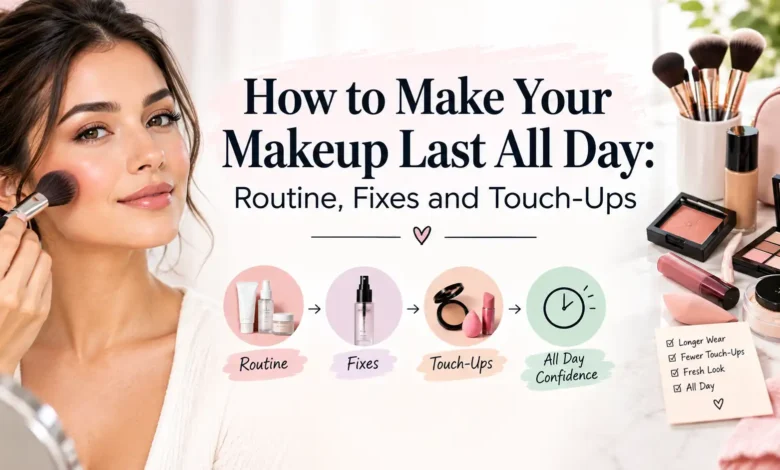
How to make your makeup last all day: let skincare and sunscreen absorb first, apply thin layers of long-wear formulas, set oily or creasing areas with a little powder, finish with setting spray, and blot at midday instead of adding more powder.
Below is how to make makeup last all day step by step, with fixes for oily and dry skin, a problem-by-problem table, and what to do in heat, on long shifts, behind glasses and at emotional events. If you’re still learning the basic order, start with our guide to makeup steps in order.
- A common mistake: thick layers. Thin, pressed-in layers grip the skin; heavy ones slide and crease.
- Oily skin: oil-free prep, powder on the T-zone, blotting papers in your bag.
- Dry skin: hydrate first, go light on powder, and let setting spray do more of the work.
- Touch-ups: blot first, then add a little product only where it has worn off.
- Heat and sweat: less product, not more, and don’t leave makeup in a hot car.
- Sunscreen: it goes on before makeup, and a powder sunscreen can help with midday top-ups.
Why makeup wears off (and what you can control)
Before changing products, it helps to know why makeup fails. It rarely just fades. It gets broken down or moved. The main causes are skin oil, sweat, rubbing, facial movement and layers that don’t suit each other or the skin underneath.
- Oil: skin keeps producing oil all day, and it loosens foundation, especially on the nose, forehead and chin. Researchers have also studied how skin oil can darken liquid foundation, which may explain why a base sometimes looks deeper by afternoon.
- Sweat and humidity: moisture sitting on the skin lifts product and makes it slide.
- Rubbing: glasses, masks, phones, collars, hands and tissues physically move makeup off the skin.
- Movement: smiling, squinting and talking fold the skin, so product collects in lines under the eyes and around the mouth.
- Heavy or clashing layers: a rich moisturizer or thick sunscreen that hasn’t settled can make foundation slip, pill or separate.
- Too much product: thick layers have more to break down and crease more easily.
Your hands matter too. The American Academy of Dermatology’s advice on how to control oily skin notes that touching your face “can spread dirt, oil, and bacteria from your hands to your face.” Every touch also wipes away a little makeup.
How to make your makeup last all day: step by step
This routine works on most skin types. Adjust the amount of each product using the skin-type guide further down.
1. Cleanse and moisturize, then wait
Start with clean skin and a moisturizer that suits your skin type. Oily skin still needs one; the AAD says, “Although you have oily skin, it is still important to apply moisturizer to keep your skin hydrated.” Choose a lightweight, oil-free formula if you get shiny. Give it a few minutes to absorb before the next layer, because a slick surface is a common reason foundation slides.
2. Apply sunscreen before makeup
The Skin Cancer Foundation’s guide to making sunscreen work with your makeup advises: “After cleansing your face in the morning, apply your moisturizer or facial sunscreen.” If you use a separate sunscreen, let it settle until it no longer feels wet. A moisturizer with SPF saves a layer, which also means less for foundation to slide on.
3. Use primer only where you need it
Primer can help makeup grip, blur pores or control shine, but it isn’t required everywhere. Use a mattifying one on oily areas, a hydrating one on dry patches, or skip it if your base already lasts. Our guide to what primer does for makeup explains the types and how to match them to your foundation.
4. Apply foundation and concealer in thin layers
Use a small amount of a long-wear or transfer-resistant foundation and press it in with a damp sponge or brush rather than wiping it across. Build a second thin layer only where you need more coverage. Use concealer only where needed, and set each layer before it has time to crease.
Cream blush pressed on with a fingertip and set with a light dusting of powder tends to hold well, and a clear brow gel keeps brows in place.
5. Set with powder where you need it
Press a small amount of translucent powder onto the areas that get oily or crease: usually the sides of the nose, the forehead, the chin and under the eyes. Pressing with a puff or a damp sponge often holds better than sweeping. If your skin is dry, use very little or skip it.
6. Prime your eyes and line your lips
An eyeshadow primer or a thin layer of concealer on the lids helps shadow grip. For lips, line and fill in with a lip pencil before lipstick. There’s more detail on both in the eyes and lips section below.
7. Finish with setting spray and let it dry
Mist setting spray over your face to soften any powdery look and help the layers hold together. Makeup artist Brielle Pollara, quoted in a Today.com guide to setting products, advises: “Let it air dry naturally instead of touching your face.” Touching or fanning while it’s wet can smudge everything you just set.
Setting powder vs setting spray: which lasts longer?
They do different jobs. Setting powder absorbs oil and stops creamy products from moving, which makes it the stronger choice for shine. Setting spray melts the layers together, takes away a powdery finish and can add grip. For long days, many people use both.
Which to lean on depends on your skin. In the same Today.com guide, Pollara explains: “If you have dry or mature skin, you can often skip powder and rely on setting spray to keep your makeup looking fresh without adding extra product.” For the opposite skin type, she adds: “If you’re oily, I usually recommend using a small amount of powder in areas like the T-zone first, then finishing with setting spray.”
Some makeup artists also mist before foundation as well as after, sometimes called a setting spray “sandwich.” It’s optional; try it only if your makeup needs extra grip.
Setting sprays come as pump mists or aerosols. For aerosol cans, the FDA’s advice on using cosmetics safely applies: “Use aerosols or sprays cans in well-ventilated areas. Do not use them while you are smoking or near an open flame.”
With any spray, close your eyes, hold it at the distance on the label and avoid breathing in the mist. If some gets in your eyes, rinse with clean water, and stop using the product if irritation continues.
Long lasting makeup for your skin type
The same steps apply to everyone, but the amounts change:
- Oily: oil-free moisturizer, a mattifying primer on the T-zone if needed and an oil-free foundation. Powder the T-zone, then mist. During the day, blot, then add a little powder.
- Dry: a richer moisturizer given time to absorb, a hydrating primer if needed and a satin or dewy base. Use little or no powder and finish with a mist. On dry patches later, press in a very small amount of a light hydrating product.
- Combination: hydrate everywhere and mattify only the T-zone. Powder where you get shiny, mist all over, and blot the center only.
- Mature: hydrating prep, a thin base and cream products on cheeks and lips. A light mist, powder only where needed, and press rather than drag when you touch up.
- Acne-prone: non-comedogenic, oil-free products, and concealer on blemishes rather than full coverage everywhere. A thin layer of powder where oily, and blot with clean papers.
The AAD’s oily-skin advice backs the oil-free approach: “DO choose oil-free, water-based makeup.” It adds that “products labeled ‘matte’ can help reduce shine from oily skin.”
Wearing as little as possible? Sunscreen, concealer only on blemishes and marks, a little powder on the T-zone, lip color and a blot at lunch. Fewer layers means less to break down. Wash sponges and brushes regularly, since dirty tools can move oil and old product back onto your skin.
If a product stings, itches or causes breakouts, stop using it. The FDA also advises stopping any eye cosmetic that causes irritation and seeing a doctor if it doesn’t clear up. For skin reactions that don’t settle, see a board-certified dermatologist.
Why your makeup isn’t lasting: fixes by problem
If one spot always fails first, the cause is usually specific. Find your problem below:
| Problem | Likely cause | Fix |
|---|---|---|
| Foundation disappears on the nose | Oil, rubbing (glasses, tissues), too much product | Thin layer, press powder on the nose, blot during the day |
| T-zone shiny and sliding by noon | Oil breaking down the base | Oil-free prep, mattifying primer, powder on the T-zone |
| Foundation separates or looks patchy | Skincare not absorbed, or products that clash | Wait longer between layers; use fewer, lighter layers |
| Foundation looks darker later | Skin oil can change how the base looks, and some formulas shift shade | Oil control; test shades after a few hours of wear |
| Concealer creases under the eyes | Too much concealer, heavy eye cream, not set | Tiny dots pressed in with a fingertip; let eye cream absorb first; skip powder if the area is dry |
| Eyeshadow creases | Oily lids, no base | Eyeshadow primer or a thin concealer base, set with a neutral powder |
| Liner smudges onto the lower lid | Oil, watery eyes, lids touching the lash line | Waterproof or long-wear liner, set with a matching shadow |
| Lipstick fades from the center | Eating, drinking, one thick coat | Line and fill, thin layers blotted between coats |
| Makeup transfers to collars and phones | Product not set, or not a transfer-resistant formula | Set well, let spray dry fully, then dress |
| Touch-ups look cakey | Powder piled onto oil and old makeup | Blot first, then use very little product |
If cakiness is your main problem, our guide to cakey makeup walks through the causes and a five-step fix without starting over.
Eyes and lips that stay put
Eyeshadow: apply primer or a very thin layer of concealer, let it set, then press shadow on with a flat brush before blending. Setting a cream shadow or base with a matching powder shadow usually holds better than leaving the cream on its own, especially on oily lids.
Eyeliner and mascara: waterproof formulas are made to resist water, so they tend to hold up against tears and humidity. “Long-wear” has no set definition, so check what each product says it resists.
Waterproof products are harder to remove, so take them off gently at night instead of rubbing. If your liner transfers onto the upper lid, the fold may be touching the lash line; our guide to hooded eye makeup covers liner shapes and placement for that eye shape.
Lips: exfoliate gently only if lips are flaky, then line and fill in the whole lip with a pencil. Apply lipstick in two thin coats, blotting on a tissue between them. Matte and stain formulas usually outlast glosses. Drinking through a straw helps keep the center intact.
Heat, humidity and sweat
Heat is the hardest test for any makeup. The instinct is to add more product. Usually the opposite works better: lighter layers have less to melt.
- Cool down first: apply makeup after your skin has stopped sweating, not straight out of a hot shower or a hot car.
- Swap heavy for light: a lightweight or tinted base, cream blush set with a little powder, and waterproof mascara.
- Blot rather than wipe: sweat and oil lift makeup, and wiping them away takes the makeup with them.
- Cleanse after sweating: the AAD’s first tip for oily skin is “DO cleanse your face up to twice daily and after sweating.”
- Store products away from heat: the FDA’s page on eye cosmetic safety says: “Don’t store cosmetics at temperatures above 85 degrees F. Cosmetics held for long periods in hot cars, for example, are more susceptible to deterioration of the preservative.”
In very humid weather, set your makeup well and keep blotting papers with you. Some shine by the end of a humid day is normal, even with a good routine.
How to keep makeup on all day on long shifts and big days
- 12-hour shifts: wear less base and focus on concealer where you need it. Keep a small touch-up kit in your locker or bag. At your break, wash your hands first, then blot the T-zone and refresh.
- Glasses: the nose pads will always rub a little. Use a thin layer on the bridge, press powder there, and blot the area during the day. You can reduce the wear, but not stop it completely.
- Masks and N95s: a close-fitting mask rubs off base wherever it sits, so skip foundation under the mask line and put your effort into concealer, eyes and brows. Use lip balm rather than lipstick under a mask, and let every layer dry before the mask goes on. Follow your workplace’s rules on makeup and mask or respirator fit.
- Weddings and emotional events: do a trial run first and wear waterproof mascara and liner. When tears come, press a tissue flat under the eye and lift instead of wiping. Some powders look white in flash, so take a flash photo of your trial. Outdoors, ask a friend to carry blotting papers. If you’re also doing your hair, see our guide on whether to do hair or makeup first.
- Workouts: skip a full face where you can, since sweat will break it down. Cleanse soon after exercise.
How to touch up makeup midday without it looking cakey
Even a well-set face may need a quick refresh. A good touch-up removes before it adds, so start with blotting papers.
The AAD advises: “Gently press the paper against your face and leave it on for a few seconds to absorb the oil. Don’t rub the paper on your face, as this will spread the oil to other areas.”
- Blot the shiny areas with a blotting paper or a clean tissue.
- Fix spots: dab a little concealer where the base has worn off, and press it in with a clean fingertip or a small sponge.
- Powder only where needed: a light press on the nose or forehead, not all over.
- Reapply lips and, if needed, a little blush.
- Top up sun protection with a powder sunscreen, following its label, if you’re spending time outdoors.
A powder sunscreen is one way to top up over makeup. In the Skin Cancer Foundation’s Ask the Expert column, board-certified dermatologist Dr. Blair Murphy-Rose answers: “Powder sunscreens can be useful for layering over makeup and for convenient touch-ups throughout the day. While they shouldn’t be relied upon as your sole form of protection, they can be a helpful addition to your sun protection strategy.”
A small touch-up kit: blotting papers, a pressed powder or powder sunscreen, a concealer, your lip color and lip pencil, and a few cotton swabs for smudged liner. Keep the kit personal; the FDA advises against sharing cosmetics, because another person’s bacteria can cause problems.
Tricks to skip, and what “24-hour wear” really means
- Hairspray on your face: it’s made for hair, not skin. It can irritate eyes and skin, it’s flammable, and it shouldn’t be breathed in at close range. Use a setting spray made for the face instead.
- Milk of magnesia as a primer: it’s sold as an antacid and laxative, not a cosmetic, so it isn’t made or tested for use under makeup. A mattifying primer is designed for the job.
- Heavy “baking” under dry or mature eyes: a thick layer of powder left to sit can emphasize lines and dryness. A thin, pressed layer is enough for most people.
You’ll often see labels promising 16, 24 or even more hours of wear. Treat these as the brand’s own claims.
The FDA’s page on cosmetics labeling claims says “information on cosmetic labeling, including claims, must be truthful and not misleading,” but also that “FDA does not have a list of approved or accepted claims for cosmetics.” How long a product lasts on your face depends on your skin, the weather and how you apply it.
Taking long-wear makeup off at night
The formulas that last all day are designed to resist water and oil, so they take a little more effort to remove. The AAD is clear on the basics: “Always remove all makeup before going to sleep.”
Use a makeup remover or cleansing balm suited to long-wear and waterproof products, let it sit for a few seconds to dissolve the makeup, then wipe or rinse gently. Follow with your usual cleanser.
Keep balms and oily removers out of your eyes, and use a remover made for the eye area around your lashes. Avoid scrubbing; as the AAD puts it, “resist the temptation to scrub your skin, even to remove makeup. Scrubbing irritates your skin, which can make it look worse.”
All-day makeup questions
How long does makeup last on your face?
There’s no standard number. On oily skin or in heat, foundation often starts breaking down on the nose and forehead within a few hours, while on dry or normal skin it may look fresh much longer. Wear-time claims on packaging are the brand’s own. Thin layers, setting and blotting are what extend it in real conditions.
Does setting spray actually make makeup last longer?
It can help, especially on dry skin and when layers look powdery, because it helps them hold together. On oily skin, a mist alone usually isn’t enough; powder on the T-zone does more to control shine. Many people get the best results with a little powder where they’re oily, followed by a mist.
How do you keep makeup on all day without touching it up?
Preparation does most of the work. Use thin layers, set oily areas with powder, finish with a mist and let it dry fully. Choose long-wear or transfer-resistant formulas, and waterproof mascara if your eyes water. Keep your hands off your face. Even then, a quick blot at midday is realistic for oily skin or hot weather.
Why does my foundation disappear on my nose?
The nose sits in the oily T-zone and gets rubbed often, by glasses, tissues and hands. Use a thin layer there, press powder over it, and blot instead of wiping during the day. If the skin on your nose is flaky, hydrate first, because foundation can cling to dry patches and lift.
Can drugstore makeup last all day?
Yes. Technique often matters as much as price. Thin layers, powder where you get oily and blotting hold up well at any price point. If you can buy only two things, make them a translucent powder and blotting papers; a clean tissue works too. Add a primer only if your base slides.
Should I wear sunscreen under makeup if I want it to last?
Yes. Sunscreen goes on before makeup, and a light, fast-absorbing formula or a moisturizer with SPF usually won’t shorten your makeup’s wear if you let it settle first. Later in the day, a powder sunscreen can be layered over makeup for touch-ups, but it shouldn’t be your only sun protection.
Your all-day makeup checklist
- Let skincare and sunscreen settle before makeup.
- Primer only where your skin needs it.
- Thin, pressed-in layers of long-wear formulas.
- Powder where you get oily; a mist to finish, left to dry.
- Blotting papers in your bag, and hands off your face.
- Everything off before bed, gently.
Those six habits are how to make your makeup last all day, whatever your budget. With them in place, most days need only a quick blot at lunch.