

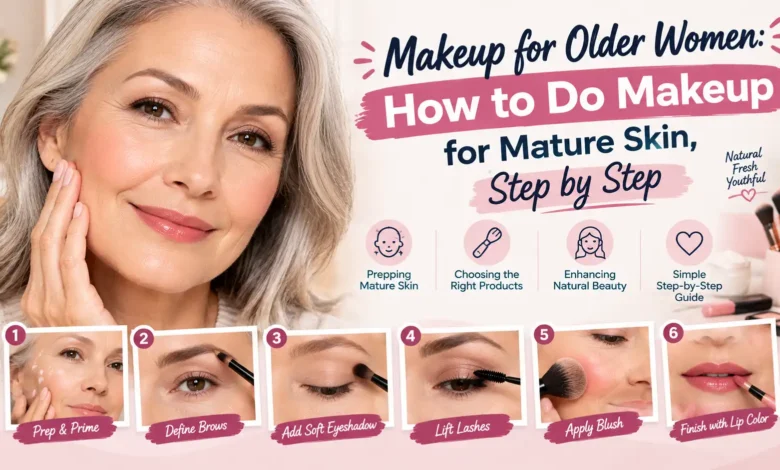
Makeup for older women works best with a few changes: well-hydrated skin, thinner layers, cream or satin textures, less powder, color placed a little higher, and defined brows and lashes. The goal isn’t to hide your age. It’s to make your skin look fresh and your features clear, with makeup that stays comfortable all day.
The steps below follow the same basic order as any routine. In makeup for women over 50, 60 and beyond, what changes is the texture of the products and how you apply them. This guide covers what to use, what to skip, and how to apply makeup for mature skin step by step, with tips from professional makeup artists.
- Hydrate first: well-prepped skin needs less makeup and shows fewer lines.
- Use less, in fewer places: cover only where you need it, and keep powder to shiny areas.
- Choose creamy textures: cream blush and creamy lipstick move with your skin.
- Lift with brows and lashes: soft definition does more than heavy liner.
What changes as skin matures (and why your old makeup stops working)
Many women find that products they wore for years start to look different on their skin. That’s normal, and it’s usually about texture and moisture rather than the products themselves.
Makeup artist Bobbi Brown told Good Morning America: “Our skin is dryer; it loses elasticity, and if we’re not exfoliating, it starts to look dull as we age.” Drier skin makes heavy, matte formulas more noticeable. Licensed esthetician Kristina Kubler told Parade: “Matte, full-coverage formulas often settle into fine lines and emphasize texture.”
Other common changes:
- Lips lose color. Celebrity makeup artist Tim Quinn notes that “we naturally lose color in our lips as we mature.”
- Brows thin or change color. As Brown puts it, “When our hair goes gray, the eyebrows don’t always follow suit.”
- Eyelids may become hooded. A fold of skin can cover more of the lid, which changes where eyeshadow shows.
- Close-up vision changes. According to Cleveland Clinic, “Presbyopia generally starts to develop around age 40 and gets worse until your mid-60s.” That makes precise application harder.
One safety note: the National Institute on Aging advises: “Check your skin often for any changes and visit a dermatologist regularly.” If you notice a new spot, sore or growth, have it checked rather than covering it with makeup.
What to look for in makeup for mature skin (and what to skip)
You don’t need a special “anti-aging” line, and we don’t recommend specific products we haven’t tested. What matters on any label is the formula and finish. This table sums up what professional makeup artists recommend for each step.
| Product | Look for | Skip or go easy on |
|---|---|---|
| Skin prep | A moisturizer pressed into the skin, plus sunscreen in the daytime | Going straight to foundation on dry skin |
| Primer | Optional; a thin layer of a hydrating or smoothing formula | Heavy mattifying primer all over |
| Foundation | Light, buildable coverage with a natural or satin finish, only where needed | Matte, full-coverage formulas all over |
| Concealer | A creamy formula, used in small amounts and pressed in | Thick layers under the eyes, and baking |
| Blush and bronzer | Cream or liquid formulas; blush placed a little higher on the cheek | Heavy powder blush and powder bronzer |
| Powder | A light dusting only where you get shiny, after cream products | Heavy powder around the eyes and over lines |
| Eyeshadow | Sheer powder, or a cream that stays put on your lids | Any formula that creases on your lids by midday |
| Mascara | A formula that’s easy to remove, such as a tubing mascara | Daily waterproof mascara that needs rubbing to take off |
| Lipstick | Creamy, hydrating formulas in a shade a little brighter than your natural lip color | Drying long-wear formulas and very pale nudes |
| Setting spray | Optional; an alcohol-free formula for long days | Alcohol-based sprays every day |
On bronzer, AARP beauty writer Lois Joy Johnson is blunt: “Powder — even powder bronzer — is the last thing dry, uneven, pigmented mature skin needs since it amplifies every textural change and discoloration.” The sections below explain each choice and who recommends it. Where makeup artists disagree, we say so and give you a simple way to decide.
How to apply makeup for older women, step by step
Here’s how to apply makeup for older women from start to finish. Pick the steps you need. Very few people need all nine every day.
- Hydrate and protect. Press in a moisturizer and, in the daytime, a broad-spectrum sunscreen of SPF 30 or higher. Kubler told Parade: “Hydration is everything. A lightweight moisturizer or hydrating primer helps makeup sit smoothly and keeps it from settling into lines.”
- Prime only if you need it. A thin layer of a hydrating or smoothing primer can help makeup sit evenly. Our guide to what primer does explains which type suits which skin.
- Apply foundation only where you need it. Makeup artist James Vincent told Parade: “The mistake I see most often is applying foundation as though the entire face needs the same amount of coverage.” Start around the nose, chin and any redness, and blend outward.
- Buff it in. Emmy-winning makeup artist Nyssa Green told Parade: “For mature skin, the more you’re able to buff that product into your skin and still get coverage, the more natural, beautiful and flawless it’s going to look.”
- Conceal lightly. Use a small amount of creamy concealer only where it’s dark, and press it in. Vincent says: “I don’t paint concealer in a big triangle underneath the eye. That’s a lot of product in an area that moves constantly.” Makeup artist Patricia Longo applies concealer with her fingers: “The warmth of your fingertips helps it blend into the skin much better than a brush or sponge.”
- Add cream blush a little higher. James Vincent places cream blush above the apple of the cheek and blends it up and outward toward the temple, so color lifts rather than sits flat.
- Powder last, only where you’re shiny. Creams go on before powder, so set your base after blush. Quinn explains: “Around fine lines, especially near the eyes, too much powder can make the skin look heavier and drier.” Skip baking under the eyes.
- Define your brows. Fill gaps with light, hair-like strokes. Quinn: “As we mature, brows can lose fullness, and restoring that definition gives structure back to the face.”
- Finish with eyes and lips. Keep eye makeup soft and close to the lashes (details below), then add a creamy lip color that brings back some natural color. Quinn starts with a lip pencil close to the natural lip tone for definition before color.
Green’s shade tip is worth following whenever you buy a new foundation: “Get matched in the store, but then still go outside and check it in the sunlight before you buy it.”
Eye makeup for older women
Eye makeup for older women is about definition without weight. A few adjustments keep it from creasing, smudging or pulling the eye down.
- Prime your lids. AARP beauty writer Lois Joy Johnson recommends a tiny amount of eyelid primer, so shadow and liner last longer.
- Line close to the lashes. A soft pencil in dark brown or black, pressed into the upper lash line, gives definition without a harsh line. Johnson suggests you “gently pull your eye taut (but not tight!) at the outer edge while applying the liner” for a smoother line.
- Go easy under the eyes. Heavy liner on the lower lash line can drag the eye down, according to celebrity lash expert Dionne Phillips. A soft smudge of shadow is gentler.
- Curl, then mascara, focusing on the outer lashes. Apply mascara mainly at the roots and toward the outer lashes. Vincent says: “A little definition at the outer corner creates an immediate lifting effect.” Phillips adds that skipping lashes is a missed opportunity because “lashes lift your whole face.”
If your lids have become hooded, the rules change a little: shadow needs to sit above the fold so it shows with your eyes open. Our guide to hooded eye makeup covers placement step by step.
Waterproof mascara or not?
Makeup artist Carmindy Bowyer, speaking to Parade, advises against it for everyday wear: “Waterproof mascara is almost impossible to get off at night.” She warns that the rubbing it takes to remove can break lashes that are already thinning. Her alternative is a tubing mascara: “It won’t smudge, but it’s easy to wash off at night.”
Our practical rule: if your mascara smudges onto your lids or under your eyes, choose a smudge-resistant or tubing formula. Save true waterproof mascara for days you’ll need it, and remove it gently.
Cream or powder eyeshadow?
Here the experts disagree. Carmindy says: “Our lids don’t look like they once used to, so creams are just going to slip and slide and settle into fine lines and creases.” She prefers a sheer, lightweight powder. Others disagree: Trinny London’s guide to hooded lids favors creams because they blend so easily.
Our practical rule: let your own lids decide. Try a cream shadow on a normal day. If it has creased by midday, switch to a sheer powder over an eyelid primer, or set the cream with a matching powder.
Choosing a liner color
If black liner starts to feel harsh on you, try a color that works with your eyes. Bobbi Brown suggests working with your eye color: “for women with blue eyes, there’s nothing more beautiful than a navy.” Dark brown is a softer everyday alternative to black for many people.
How to keep makeup from settling into fine lines and wrinkles
Most makeup that “shows” lines is simply too much product sitting on the skin. Celebrity makeup artist Ash K. Holm told Parade: “The less excess product sitting on the skin, the less there is to settle into fine lines.”
- Prep first. Moisturize and let it sink in for a minute before base makeup.
- Press, don’t swipe. Kubler warns: “Rubbing or swiping can tug at the skin and create uneven texture.” Pat or buff product in instead.
- Hydrate and prime under concealer. Celebrity makeup artist Neil Scibelli says creasing under the eyes “often happens when we apply product directly onto the skin without really taking the time to hydrate and prime.”
- Blot instead of re-powdering. Blotting paper takes off shine without adding another layer. Phillips’ warning: “Too much powder = dry and dull.”
- Check at arm’s length. Our practical tip: look in a regular mirror, not only a magnifying one, to see what others see.
If your base still looks heavy after these steps, our guide to why makeup looks cakey walks through the other common causes, zone by zone.
Makeup over 40, 50, 60 and 70: go by your skin, not the number
There’s no makeup rule that switches on at a certain birthday. Two women of 60 can have very different skin. It’s more useful to look at what has changed for you, and adjust for that, whether you’re shopping for makeup for mature skin at 45 or at 75.
| If you notice… | Try this |
|---|---|
| Drier, duller skin | More hydration before makeup; creamy or satin formulas; less powder |
| Foundation settling into lines | Less foundation, only where needed; buff or press it in |
| Lips losing color | A creamy lipstick a shade brighter than your natural lips, not a pale nude |
| Thinner or graying brows | Light, hair-like strokes in a shade that suits your hair color |
| Shadow disappearing when your eyes are open | Place color above the fold, as for hooded eyes |
| Trouble seeing close up | Better light and a magnifying mirror (see the tips below) |
What dates a look is sticking with the same routine for decades. Celebrity makeup artist Emily Gray names “getting stuck in a certain makeup decade” among the biggest makeup mistakes that age you. Updating your formulas and colors every few years keeps your makeup working with your skin as it is now.
Glam makeup over 50
Glam doesn’t need to mean heavy. Bobbi Brown’s approach to shimmer: “My general rule of thumb is to choose two places on your face to add sparkle to, and it will add just the right amount of shimmer to complete any makeup look.” For example, a satin shimmer on the center of the eyelid and a glossy lip, with a matte or satin base everywhere else. Deepen your outer-corner shadow and add an extra coat of mascara for evening.
Makeup tips for women with gray hair
Going gray or silver often means your old colors look different next to your hair. Bobbi Brown’s tips for women with gray hair focus on a few simple swaps:
- Brows: they may stay darker than your hair, or fade with it. Fill sparse areas lightly with a brow pencil or powder that matches your brows, using short strokes.
- Color: “You need pops of color, there’s no question.” Brown’s favorite is pink, because “it truly works on everyone.” To find your shade, pinch your cheeks and match the flush you see in your blush and lipstick.
- Liner: “Navy is great for women with white hair,” Brown says.
Doing your makeup when your eyesight changes
Close-up vision often gets harder after 40, which most makeup guides don’t mention. A few practical changes help:
- Upgrade your light. Nyssa Green says: “When you really want to nail that foundation, lighting is key.” She adds: “If your kitchen has the best lighting, set it up so you can put your foundation on in the kitchen.”
- Use a magnifying mirror for detail work, such as liner and brows, then check the overall look in a regular mirror (our practical tip).
- Choose easier tools and formulas, such as a soft pencil liner instead of liquid, and a brow pencil with a fine tip, so small wobbles look soft rather than sharp.
- Steady your hand. AARP’s Johnson suggests resting your elbows on a table while you line your eyes.
If close-up vision has changed quickly or is affecting daily tasks, see an eye doctor. Cleveland Clinic lists signs such as “The need to hold reading material at arm’s length.”
Frequently Asked Questions
Should older women wear foundation?
Only if you like how it looks and feels. Many women over 50 get a fresher result from a light layer used only where they need it, such as around the nose and on redness, rather than full coverage all over. A tinted moisturizer or a dab of concealer may be enough on good skin days.
Is liquid or powder foundation better for mature skin?
The makeup artists quoted in this guide lean toward liquid or cream foundations with a natural or satin finish for mature skin, because they move with the skin and add less texture. Heavy powder can make dry skin look drier. If you prefer powder, use a light layer over well-moisturized skin, and keep it thin around the eyes.
What color lipstick is best for older women?
Choose a creamy shade a little brighter than your natural lip color. Quinn told Parade he avoids anything “too nude” because lips lose color with age. Scibelli warns that very dark shades can emphasize sallow skin. Bobbi Brown’s pinch test works for lips too: match the flush your cheeks turn when pinched.
Should older women wear eyeliner?
Yes, if you enjoy it. A soft pencil in dark brown, black or navy, pressed close to the upper lashes, defines the eyes without looking harsh. Keep lower-lash liner light or use a smudge of shadow instead, and focus a little extra definition on the outer corner for lift.
Does makeup make wrinkles worse?
The dermatology sources we checked don’t list makeup as a cause of wrinkles. The American Academy of Dermatology says: “The sun plays a major role in prematurely aging our skin.” Heavy or drying makeup can settle into lines and make them look deeper, so daily sunscreen plus lighter layers is the practical answer.
Is setting spray bad for mature skin?
It depends on the formula and how often you use it. Nyssa Green told Parade: “No one needs to be using setting spray every day—it’s hairspray for your face.” She notes that most setting sprays contain alcohol, which can make mature skin even drier. Tim Quinn likes a good setting spray for staying power. The middle ground: choose an alcohol-free spray and save it for long days or events.
Should you stop wearing makeup at a certain age?
No. There’s no age limit on makeup, and many women enjoy it well into their 70s, 80s and beyond. What changes is the approach: lighter layers, creamier textures and colors that suit your skin and hair now. Wear as much or as little as makes you feel like yourself.
The short version
Makeup for older women works best with hydrated skin, less product in fewer places, and creamy textures that move with your face. Use foundation only where you need it and buff it in, keep powder to shiny areas, and place cream blush a little higher on the cheek.
For eyes, prime your lids, line close to the lashes, add definition at the outer corner and curl your lashes. Choose a lipstick that brings back natural color, update your routine every few years, and go by your skin, not your age. And keep up the daily sunscreen.