
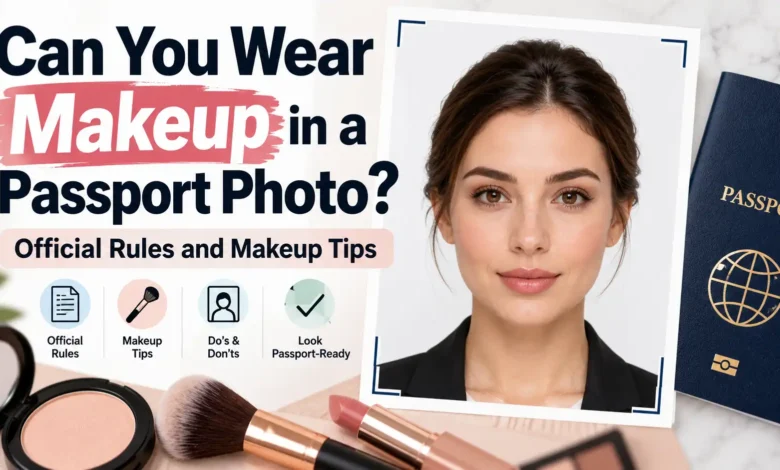
Yes, you can wear makeup in a passport photo. The official photo rules in the U.S., the UK and Canada don’t mention makeup at all. What they do require is a photo that shows your full face and clearly visible eyes, reproduces your skin tone accurately, looks like you, and hasn’t been edited or filtered.
So the best passport photo makeup is your everyday face, a little more polished: a thin base in your true shade, powder for shine, and nothing that changes your features.
This guide quotes what the U.S., UK and Canadian rules actually say, checks the “passport makeup rules” that circulate online, explains the passport makeup trend, and gives a simple routine plus a flash test to do before photo day. For the full order of everyday makeup steps, see our guide to makeup steps in order.
- Makeup: allowed. No U.S., UK or Canadian passport photo rule mentions it.
- Editing: not allowed anywhere. No retouching, filters or AI, so any polish has to come from real makeup.
- Eyes: open and clearly visible, with no hair, heavy shadow or tinted glasses in the way.
- Skin: your true shade. Canada asks for your “natural skin tone.”
- Finish: matte or satin. Shine and glare are what usually make passport photos look bad.
- Test first: a phone photo with the flash on shows white cast, shine and glare before the real photo does.
Can you wear makeup in a passport photo? What the rules say
If you’ve asked yourself “can I wear makeup in my passport photo?”, the official pages answer it by omission: as of September 2026, none of the photo pages for the U.S., the UK or Canada mentions makeup. The U.S. State Department’s passport photo page, the UK’s photo requirements and Canada’s passport photo rules focus on your face, your expression and the photo itself.
| Rule | United States | United Kingdom | Canada |
|---|---|---|---|
| Makeup mentioned? | No | No | No |
| Expression | Neutral or a natural smile, mouth closed | Plain expression, mouth closed | Neutral, mouth closed, not smiling |
| Eyes | Open; colored part of the eyes clearly visible; no hair over them | Open and visible; no hair in front of them | Open and clearly visible |
| Glasses | Take off; medical exception needs a doctor’s note | Only if you have to; never sunglasses or tinted | Allowed if eyes show and there’s no glare; never tinted |
| Head coverings | Religious or medical only, with a signed statement | Religious or medical only | Worn daily for religious or medical reasons only |
| Editing, filters, AI | Not allowed | Not allowed | Not allowed |
| How recent | Last 6 months | Last month | Last 6 months |
The line that matters most for makeup is the ban on editing. The U.S. page says: “Do not change your photo using computer software, phone apps or filters, or artificial intelligence.” The State Department’s internal rulebook, the Foreign Affairs Manual, is even more direct: “The use of beauty filters or other photo filter tools from social media websites and mobile applications (also known as “apps”) are also not acceptable.”
The UK requires photos “unaltered by computer software,” and Canada says a photo must be “an original photo that isn’t altered or edited in any way. This includes photo editing software, filters, and AI tools.” In other words, makeup on your face is fine, while smoothing or slimming it afterward is not.
Two more lines shape what kind of makeup works. The U.S. page wants a photo that “reproduces skin tones accurately,” and Canada says the photo must “reflect or represent your natural skin tone” and “show how you look now.” Makeup that keeps your real shade and features passes both easily.
Passport makeup rules online: myth or official?
Search for passport makeup rules and you’ll find confident lists of don’ts on photo-service and beauty sites. None of the items below appears in the U.S., UK or Canadian rules. Some have a sensible practical reason behind them, and some don’t.
| What you’ll read online | Official rule? | What’s actually true |
|---|---|---|
| “You can’t wear makeup” | No | None of the three countries mentions makeup. |
| “No false lashes” | No | Lashes are fine. Very long or dense ones can shadow your eyes, and the U.S. rule says the colored part of your eyes must be clearly visible. |
| “No SPF” | No | Most SPF products don’t cause white flash cast. Silica-heavy powders are a more common cause (see the flash section). |
| “No lipstick” or “no bright lips” | No | Any shade is allowed. Very glossy lips can catch light, and Canada rejects photos with glare or flash reflections. |
| “No contour” | No | Allowed. Heavy contour can change how your face shape reads in a flat, straight-on photo, which works against looking like yourself. |
| “No colored contacts” | No (in the U.S.) | Tinted lenses are acceptable in the U.S. if they don’t make the iris look larger or smaller. Details below. |
The pattern behind good passport photo makeup advice is simple: nothing should hide your eyes, add glare, or change your features enough that someone comparing you to the photo would hesitate. That’s a practical goal, not a rule, but it’s what the official requirements are built around.
What the “passport makeup” trend means
On social media, “passport makeup” has become a trend in its own right, and it means two different things depending on who’s describing it. Estée Lauder’s guide defines passport makeup as “a lightweight, no-makeup makeup routine that you can wear while taking your passport photo.” Who What Wear’s makeup-artist roundup describes a bolder version: “super-sculpted cheekbones, soft-matte skin that blurs in pictures, a defined and lifted eye with a baby wing, and a really pouty lip.”
Both versions are allowed, because neither breaks a rule. The difference is how far each moves you from your everyday face. A passport photo is used to identify you for years: a U.S. adult passport is valid for 10 years, and Canadian adults can choose 5 or 10. A quick test helps: would someone recognize you from this photo on a day you’re wearing no makeup at all? If the answer is yes, the look works.
If you like the sculpted version, keep the contour soft and blended, skip overlining far past your natural lip edge, and keep the wing thin enough that your eyes stay fully open and visible.
Passport photo makeup, step by step
This routine uses products most people already own. It’s designed for flat, even lighting and a straight-on camera, which is what passport photos use.
- Prep your skin. Cleanse and moisturize. If you use primer, a thin layer smooths texture and helps makeup last through a wait. Our guide on what primer does for makeup explains which type suits your skin.
- Apply a thin base in your true shade. Use a light-to-medium coverage foundation, skin tint or tinted moisturizer that matches your neck, not a shade lighter or darker. Canada’s “natural skin tone” rule is the one to remember here.
- Conceal only where needed. Under-eye darkness, redness around the nose or cheeks, and spots. Blend the edges well, because flat lighting shows lines.
- Powder the shine zones. A light layer of powder on the forehead, nose and chin keeps shine down. Press it in with a puff or brush lightly; thick powder looks dry and heavy in close-up photos. If that’s a problem for you, our guide to cakey makeup covers the fixes.
- Fill in brows softly. Brows frame the eyes in a straight-on photo. Match your natural brow color and shape rather than drawing a new one.
- Keep eyes defined, not hidden. Mascara and a thin line of liner close to the lashes are enough. Skip heavy dark shadow all around the eye, which can make eyes look smaller or shadowed in the photo.
- Add a little warmth. A touch of blush or bronzer stops flat lighting from washing you out. Blend it well and keep contour light.
- Choose a lip close to your natural shade. Satin or matte, not high-shine. Your mouth will be closed, so the lip line shows clearly.
Do men and teens need passport makeup?
Not at all, but the same logic works with less: concealer on dark circles, spots or scarring, a little powder or a blotting paper for shine, and tidy brows. These steps are only for people who want to look rested rather than washed out.
Flash, shine and flashback: why passport photos look washed out
Passport photos are taken with bright, even light pointed straight at your face, because the rules require it. The U.S. page asks for “uniform lighting” with no shadows, and Canada requires “uniform lighting and no shadows, glare or flash reflections.” That flat light removes the natural shadows that give a face shape, so skin can look paler and features flatter than they do in a mirror.
This happens at every skin tone. On deeper skin, matching your undertone matters as much as matching your depth, because a foundation with the wrong undertone is more likely to look gray or ashy under flat, shadow-free light. Match your undertone as well as your depth, and don’t skip the blush or bronzer step.
For passport photo makeup, two things make it worse. The first is shine: oil on the forehead and nose reflects the light and shows as bright patches. Powder or blotting papers just before the photo solve most of it.
The second is flashback, the white cast some makeup shows under camera flash. Chemist Michelle Wong of Lab Muffin Beauty Science explains that silica, common in translucent and “HD” powders, reflects flash back at the camera, and that the mineral sunscreen ingredients titanium dioxide and zinc oxide can add a whitish glow. She also notes: “Most SPF products actually don’t give flashback.” Her main fix is to use those powders sparingly and to test with flash before the big day.
Photo booths and studios don’t all use the same lighting, so testing with your phone’s flash at home covers the harshest case you’re likely to meet.
Lashes, contacts, glasses and more: quick answers
False lashes
Allowed. Choose a natural, wispy style over a thick, dramatic one, and make sure the lashes don’t cast a shadow over your eyes or make them look half-closed. The U.S. rule that “The colored portions of your eyes must be clearly visible” is the one to keep in mind.
Colored or tinted contact lenses
In the U.S., the Foreign Affairs Manual says: “Clear contact lenses are acceptable. Other types of contact lenses, including tinted and novelty contact lenses, that do not obscure the eye, i.e., that do not make the iris appear larger or smaller, are acceptable.” It adds that even if you wear cosmetic lenses all the time, “the natural eye color must be listed” on your application form.
So the photo can show your tinted lenses, as long as they don’t change how large your iris looks, while the form lists your real eye color.
The UK and Canadian photo pages don’t mention contact lenses, so if you’re applying there, clear lenses or none are the simplest choice.
A safety note: only wear colored lenses that an eye-care professional has prescribed and fitted. The U.S. Food and Drug Administration’s guidance on colored and decorative contact lenses is blunt: “But you need a prescription to avoid eye injury.”
Glasses
Glasses rules vary the most. The U.S. says to take them off, and if you can’t for medical reasons, to “include a signed note from your doctor with your application.” The UK allows them only if you have to wear them, and Canada allows clear glasses as long as your eyes show and there’s no glare on the lenses. Without glasses, your eye makeup is more visible, so keep it neat.
Eyeliner and winged liner
Allowed. A thin line or a small wing is fine. Very thick liner all around the eye can make eyes look smaller in a flat photo, so keep it close to the lash line.
Glitter and shimmer
No rule bans them, but shimmer on the eyelids, cheekbones or lips reflects light and can read as shine or glare. A non-shiny finish is the safer choice for this one photo.
Brow gel, tint or microblading
All fine. Brows should look like your normal brows, since they’re a big part of how you’re recognized.
Jewelry and piercings
Allowed in the U.S. as long as nothing hides your face. Large statement earrings can distract, and anything shiny near the face can catch the light, so smaller pieces are easier.
Head coverings
A hijab, turban or other head covering worn for religious or medical reasons is allowed in all three countries, as long as your full face is visible. The U.S. asks for a signed statement with your application, and Canada says the covering “must not create shadows on your face.” Makeup-wise, the same advice applies: a true-shade base, a matte finish and visible eyes.
Hair near your eyes
All three countries require your eyes to be visible with no hair across them. Pin back bangs or side pieces that fall toward your eyes.
Smile or no smile? Expression rules and your lip makeup
Expression rules differ, and they affect how your lips look. The U.S. is the most relaxed: “You can smile in your photo. Just make sure your eyes are open and your mouth is closed.” The Foreign Affairs Manual adds: “Normal, unexaggerated smiles are acceptable, but unusual expressions and squinting are not.” The UK asks for “a plain expression and your mouth closed,” and Canada asks that “you’re not smiling or frowning.”
With your mouth closed and a neutral face, your lip line is on full display. A shade close to your natural lip color with a soft edge looks best. Heavy overlining shows more in a neutral expression than in a smile, and high-shine gloss can catch the light.
Before photo day: a quick test at home
A five-minute test the day before shows how your passport photo makeup reads on camera. It’s worth doing: the State Department says “Unacceptable photos are the number one reason why we put passport applications on hold.”
- Do your full passport makeup the way you plan to wear it.
- Stand in front of a plain white or light wall, facing a window or light so it falls evenly on your face.
- Have someone take a straight-on photo with the flash on, and a second one without flash.
- Zoom in and check: white patches under the eyes or on the forehead (flashback), bright shiny spots, shadows from lashes, and if your skin still looks like your real shade.
- Fix and repeat if needed: less powder, more blotting, a softer liner or a less glossy lip.
This test photo is only for you. Don’t use a home photo for your application unless your country’s rules allow it. Canada, for example, says its passport photos must “be taken in person by a commercial photographer or photo studio” and doesn’t accept “photos printed at home.”
The UK lets you take your own digital photo during an online application, though its guidance notes that “Photos from a booth or shop are more likely to be approved than a photo taken using your own device.” The U.S. accepts a digital photo you upload when renewing online. Check your country’s current photo page before your appointment, because rules and processes change.
Passport photo makeup questions
Will makeup get my passport photo rejected?
Not by itself. The rules check your photo, not your makeup bag. Where makeup can cause trouble is indirectly: heavy shine that reads as glare, lashes or dark shadow that hide your eyes, or a base several shades off your real skin tone. If your test photo shows none of those, your makeup isn’t the problem.
Can I wear foundation in a passport photo?
Yes. Choose a shade that matches your neck and a light-to-medium coverage, so your skin looks even but still like skin. Avoid going lighter or darker than your natural tone, which both the U.S. and Canadian rules care about, and skip a fresh self-tan right before your appointment. Set shiny areas with a thin layer of powder.
Can I wear lipstick in a passport photo?
Yes, any color is allowed. A shade close to your natural lip color keeps the photo looking like you for years, and a soft, low-shine finish avoids glare. Bold colors aren’t banned, but a very bright or glossy lip becomes the first thing people notice in a neutral, mouth-closed photo.
Do I have to look the same as my old passport photo?
No. Your new photo should look like you now, not like your last passport. The U.S. Foreign Affairs Manual says a photo showing “a change in hairstyle or facial hair” is acceptable “if it still is a good likeness,” and Canada’s rule is that your photos “must show how you look now.” Everyday makeup doesn’t change that.
Can I wear makeup in a passport photo for a child?
There’s no need, and the rules focus on the same things for children: eyes open, face visible and no editing. Canada’s rules ask for a child’s natural skin tone. If a child has a visible spot or redness, that’s fine to leave as it is. A clean face and neat hair are all a child’s passport photo needs.
Can you wear makeup for an ID photo?
Generally yes. The same idea applies to most ID photos: look like yourself, keep your eyes visible and avoid shine. Rules for driver’s licenses and other ID cards often vary by issuing office and aren’t set by passport agencies, so check that office’s own photo guidance before you go.
Your photo-day checklist
Passport photo makeup is allowed in the U.S., the UK and Canada, and it works best when it looks like a well-rested version of you. Before you leave, run through this list:
- In your bag: blotting papers, a small powder compact and a couple of bobby pins.
- The night before: the flash test above, and a quick look at your country’s official photo page in case anything has changed.
- At the appointment: ask whether a retake is possible if you don’t like the result. Right before the photo, blot your forehead and nose, pin back hair near your eyes, and take off glasses if your country requires it.
- Your expression: a natural closed-mouth smile is fine in the U.S.; keep a plain expression in the UK and Canada.
That’s all it takes. Once your passport arrives and you’re packing for the trip, our guide on bringing makeup on a plane covers what can go in your carry-on.