
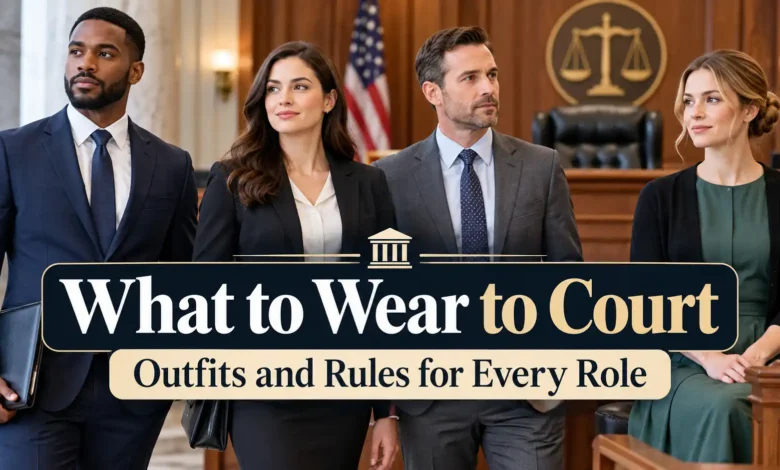
What to wear to court: clean, conservative clothes you’d wear to an office job interview, such as slacks or a knee-length skirt, a collared shirt, blouse or plain sweater, and closed-toe shoes. Skip shorts, tank tops, hats (religious headwear is treated separately), flip-flops and anything ripped or printed with slogans. Rules vary by court, so your own court’s page has the final say.
You don’t need expensive or new clothes. This guide compares the dress rules on 11 official court pages from the U.S., England and Wales, and Canada, checked in September 2026 (how we check sources). It covers clothing only, not legal advice, so if you have a lawyer, follow what they tell you.
Can’t find your court’s rules? Search the court’s name plus “dress code” or “what to expect,” or call the clerk’s office; the number is usually on your court notice. If nobody answers, wear the safe outfit below and arrive early.
- Safe outfit: slacks or chinos, a collared shirt, blouse or fine-knit sweater, closed-toe shoes, and a layer for a cold room.
- Skip: shorts, tank tops, crop tops, caps, flip-flops, ripped clothing, and clothes with words or images that could offend.
- Jeans: some courts allow clean jeans without holes; others ban denim. Chinos or slacks are safer if you can borrow a pair.
- Head coverings: hats come off in the courtroom, but several courts make exceptions for religious headwear. Call ahead if your court’s page doesn’t say.
- Video hearings: dress fully, as if you were standing in the courtroom.
- No suit, dress shoes or new clothes? Most people don’t need them. If all you own is jeans and sneakers, see “If you don’t have court clothes” for the closest safe version.
How to dress for court: the safe formula
Many courts ask for “business attire” or “business casual.” The two aren’t the same, and our guide to business casual vs business professional explains the difference. For most people at most hearings, conservative business casual is a safe baseline. Build the outfit piece by piece:
- Top: a collared shirt, a plain blouse with sleeves, or a fine-knit sweater. Solid colors or a small pattern. Nothing see-through, low-cut or cropped.
- Bottoms: slacks (trousers), chinos, or a skirt or dress that stays at about the knee when you sit.
- Shoes: closed-toe, clean and easy to walk in, such as loafers, flats, low heels, oxfords or plain boots.
- Layer: a cardigan, sweater or blazer. Buildings can run cold or warm, and you may wait for hours.
- Accessories: a plain belt, small jewelry and a small bag. Leave caps and sunglasses at home.
- Care: clean clothes that fit. Wrinkles can distract, so press or steam what you can.
Try the whole outfit on the day before, and sit down in it. You might spend a long time on a hard bench, so a waistband that digs in or a skirt that rides up will bother you all day.
What colors to wear to court
Plain, calm colors are the safest choice: navy, gray, black, brown, white, beige and muted tones. None of the court pages in this guide says color matters, but loud prints, neon shades and anything with words or logos draw attention you don’t need. Solids or a small pattern are the easy default.
Hair, grooming and jewelry
None of the 11 pages compared here sets rules for makeup or hairstyles, though Delaware’s Justice of the Peace Court, quoted below, does list hair curlers. Aim for neat rather than done up: tidy, comfortable hair, simple makeup and nails, and small, quiet jewelry. Go easy on perfume or cologne, since courtrooms can be small and crowded. Fewer metal pieces also mean less to remove at security.
Is there a court dress code? What real courts say
There’s no single court dress code. Each court, and sometimes each judge, sets its own rule, usually as a short list of what not to wear. Some are relaxed, some are strict, and they don’t always agree. Here’s what 11 official court pages say:
| Court | What it asks for | Jeans? |
|---|---|---|
| U.S. District Court, New Mexico (one judge’s notice) | Men: collared shirt, long pants. Women: a dress, or a blouse with a skirt or long pants | Yes: “(Jeans are acceptable)” |
| U.S. District Court, Eastern District of Texas (attire policy) | Business attire for parties; criminal defendants are treated separately. Male jurors, witnesses and spectators wear a coat | No denim for parties, jurors or witnesses |
| Texas Second Court of Appeals (dress code) | Participants: business attire. Visitors: business casual | Visitors: “nice jeans (no holes or fraying in fabric)” |
| San Bernardino Superior Court, California (dress code) | “business or casual dress” | Yes: “(jeans are allowed)” |
| Massachusetts courts’ first-appearance guide | “Dress appropriately for court.” | Not ripped or torn |
| Liberty County Magistrate Court, Georgia (court rules) | Neat, respectful clothes, with a detailed don’t-wear list | Not ripped or torn |
| Arizona courts’ self-help center | “professional business attire is recommended” | Yes, if “not torn” |
| Houston Municipal Courts, Texas (dress code) | “Proper attire”; bans shorts, tank tops, hats and offensive graphics | Not mentioned |
| Courts and tribunals in England and Wales (GOV.UK) | No formal dress code, but dress appropriately | Not mentioned |
| Provincial Court of British Columbia (courtroom customs) | Clothes “appropriate for an office workplace or a job interview” | Not mentioned |
| Ontario Superior Court of Justice (attending in person) | No hats (religious exception) and no sunglasses (medical exception) | Not mentioned |
The pattern is clear: office-style clothes, and usually no shorts, tank tops or caps. Jeans are where courts split. The strictest rule here is in the Eastern District of Texas, which expects male jurors, witnesses and spectators to wear a coat. If terms like business attire and business casual are new to you, our guide to types of dress codes explains how they compare.
What happens if you’re dressed wrong
The consequences these pages list are practical rather than dramatic. San Bernardino says you could be sent home to change or told to come back another day. Massachusetts says “you may be asked to leave the courtroom,” and Liberty County says you may be asked to return at a later date.
At the Texas Second Court of Appeals, participants who don’t wear business attire may be excluded, and in England and Wales, “court staff may refuse you entry.”
That can still cost you. Delaware’s Justice of the Peace Court warns: “Wearing inappropriate attire and being denied entry to the courthouse will not be an excuse as to tardiness or failure to appear for any court hearing.”
If staff say your clothes aren’t acceptable, stay calm, ask what needs to change, and tell them you’re there for a hearing so they can advise you. Removing a cap or putting on a layer may be all it takes.
What not to wear to court
What not to wear to court: shorts, tank tops, crop or see-through tops, hats and caps, flip-flops, ripped clothing, and anything with offensive words or images. These items show up again and again on official lists:
- Shorts
- Tank tops, muscle shirts, halter and tube tops
- Crop tops, bare midriffs and see-through tops
- Hats and caps (religious headwear is often treated differently)
- Flip-flops and sandals
- Ripped, torn or tattered clothing
- Clothes with offensive words, images or gang references
- Sunglasses, unless you need them for a medical reason
This table counts how many of the 11 pages in the table above name each item. Delaware’s page, quoted above, isn’t counted.
| Item | Pages that rule it out (of 11) | Worth knowing |
|---|---|---|
| Hats and caps | 10 | Several make exceptions for religious headwear (see below) |
| Shorts | 9 | England and Wales calls “beachwear” inappropriate instead |
| Tank tops, muscle shirts, halter or tube tops | 7 | Liberty County lists sleeveless shirts as a no, unless worn “with a jacket” |
| Revealing clothing, crop tops or bare midriffs | 6 | The Massachusetts guide also rules out see-through tops |
| Clothes with offensive words or images | 6 | Houston lists “gang-related” language and graphics |
| Flip-flops or sandals | 5 | New Mexico’s notice says “Thongs are not acceptable,” and British Columbia bans sandals too |
| Sunglasses | 4 | Two make medical exceptions |
| Ripped, torn or tattered clothing | 3 | Includes ripped jeans |
| Baggy or sagging pants | 3 | Massachusetts: “Baggy pants that fall below your hips” |
| T-shirts | 3 | Only 3 of 11 name T-shirts at all |
Workout clothes and pajama pants aren’t named on any of these pages, but they don’t fit business casual either. The same goes for anything you’d wear to the beach. If an item would look out of place at an office job interview, leave it at home.
What to wear to a court hearing as a woman
Women’s court outfits follow the same logic: office clothes that cover you and closed-toe shoes. The New Mexico notice puts it simply: “Women should wear a dress, or a blouse and skirt or long pants.” Five outfit ideas:
- Slacks and a cardigan: gray, navy or black slacks, a plain blouse, a cardigan and loafers or flats. The easiest outfit to pull from most closets.
- A dress with a layer: a knee-length or midi dress in a solid color or small print, a blazer or cardigan over it, and closed-toe flats or low heels. Check that the neckline stays modest when you lean forward.
- Skirt and sweater: a knee-length or longer skirt with a fine-knit sweater or blouse, plus tights in cold weather.
- Dark jeans, dressed up: dark jeans with no holes or fading, a blouse and a blazer. Wear this only where your court allows jeans.
- If you’re pregnant: a maternity dress or maternity trousers with a stretchy top and an open cardigan or blazer, and flat shoes. Comfort matters, because you may sit for hours.
Plus-size, petite and maternity fit
No court rule asks for a particular cut. What matters is that clothes fit you now: buttons that don’t pull, a skirt that stays at the knee when you sit and a top that doesn’t gape. A wrap dress, a knit blazer or pull-on trousers are comfortable at any size, and ankle-length trousers work well on petite frames. Check that nothing rides up or slips when you sit.
If you’re pregnant, choose a top long enough to stay over your bump when you sit or reach, and pack a roomier pair of closed-toe shoes in case your feet swell.
In hot weather, a sleeveless top can work under a cardigan you keep on. If closed shoes are a medical problem, or you’ll need extra breaks or seating, ask the clerk or your lawyer before the day rather than at the door.
What to wear to court as a man
The New Mexico notice sets a clear baseline: “Men should wear a shirt with a collar and long pants.” A suit usually isn’t required for someone who isn’t a lawyer, though some courts ask for more, like the coat rule in the Eastern District of Texas.
- Collared shirt and chinos: a button-down or dress shirt tucked in, chinos or dress pants, a belt, and leather shoes, or plain, clean shoes.
- Sweater over a shirt: a plain crewneck or V-neck sweater over a collared shirt, with slacks. It’s also the warmest option for a cold courtroom.
- Blazer and slacks: a navy or gray blazer over a collared shirt, with slacks. A tie is optional. A good choice when you’re testifying or your lawyer asks you to dress up.
- A suit: if you own one that fits, a dark suit with a plain tie is safe at most courts. There’s no need to buy one for a single hearing unless your lawyer suggests it.
Keep it simple: shirt tucked in, belt on, dark socks, and neat grooming, with or without a beard. If you don’t own a button-down, a plain dark polo with chinos is better than a T-shirt, though a button-down is the safer pick in a formal court.
What shoes to wear to court
Closed-toe, clean and comfortable is the safest choice for everyone. Loafers, oxfords, flats, low block heels and plain ankle boots all work, and you may walk long hallways and take them off at security, so pick a pair you can move in. Five of the 11 pages rule out flip-flops or sandals, and none makes an exception for dressy ones, so leave open shoes at home even in summer.
Sneakers (trainers in the UK) are a gray area. None of the 11 pages mentions them, so plain, clean leather sneakers may pass at a relaxed local court, but they’re a risk at a strict one. For which styles look dressier, see are sneakers business casual.
Can you wear jeans to court?
Sometimes. Some courts say jeans are fine, and others ban denim outright, so it depends on your court and your role. If your court’s page allows them, wear dark, clean jeans with no holes, fading or fraying. If you can’t check, or you’re a party or witness, chinos or slacks are safer.
Four of the 11 pages say outright that jeans are acceptable, at least when they’re in good shape: New Mexico, San Bernardino, Arizona (“not torn”) and the Texas Second Court of Appeals, which lists “nice jeans (no holes or fraying in fabric)” as generally acceptable for visitors. On the other side, the Massachusetts guide rules out “Ripped or torn jeans,” and the Eastern District of Texas lists “No shorts, jeans or other denim pants” for jurors and witnesses.
When jeans are allowed, dress up everything else: a collared shirt or blouse, a layer and closed-toe shoes. For more on making denim look polished, see can jeans be business casual.
What to wear to court for your role
Dress rules usually apply to everyone who enters a courtroom, but the answer to “what should I wear to court?” also depends on why you’re there. If you have a lawyer, ask what to wear. They know the court and the case.
What to wear to court as a defendant
A suit usually isn’t required, but some courts ask parties for business attire, so check with your lawyer. Clean dark slacks and a plain collared shirt or blouse, with a jacket or cardigan if you own one, show respect. The HMCTS leaflet for criminal defendants in England and Wales puts it plainly: “You should look like you are taking your court case seriously. Try to wear something formal and smart to court.”
If you’re in custody, different arrangements apply. In the U.S., the Supreme Court held in Estelle v. Williams (1976) that a state can’t compel a defendant to stand trial before a jury in identifiable prison clothes, though it also said a defendant who never objects may lose that claim. Ask your lawyer about your own situation, including how clothes can reach you before a trial date.
What to wear to court as a witness
Neat and comfortable is the goal. The Witness Service in England and Wales says “you do not have to wear a suit or any sort of formal clothing,” and Citizens Advice notes that “most people will be dressed smartly” and that “it can be a long day.”
Neither page mentions jeans or trainers. For a UK court, neat trousers or dark jeans with no rips, a plain top and clean, plain shoes or trainers fit that guidance, and smart shoes are the safer pick. In a U.S. court, use the office-clothes formula above, since strict courts may expect more. If the lawyer who asked you to testify gives guidance, follow it.
What to wear to court as a victim or survivor
You don’t need to look polished, fragile or any particular way. In an article for DomesticShelters.org, Lisa Aronson Fontes, PhD, advises: “Dress neatly for court. You do not need to dress in a fancy way or try to look like a different person.”
Choose clothes you feel steady in, with a layer. If you’re unsure about makeup, visible marks or anything else about your appearance, ask the prosecutor’s office, a victim-witness advocate or, in England and Wales, the Witness Service before the day. You don’t have to decide it alone.
Parent in a family case
Family hearings usually follow the court’s general rules, so the office-clothes formula applies. Choose calm, comfortable clothes you can sit in through a long morning, and keep accessories simple. Whether children should come with you is a question for your lawyer or the court clerk, not a clothing choice, so ask before the day.
What to wear to court as an observer
Spectators are usually covered by the same rules. New Mexico’s notice is addressed to “all witnesses, jurors, agents and courtroom spectators,” and the Texas Second Court of Appeals has a separate visitor section. The minimum at most public galleries: long pants or a knee-length skirt, a top with sleeves, closed shoes, and no hats, sunglasses or slogans.
Small claims and other local hearings
Local courts that handle small claims and minor matters can feel more relaxed, but the building’s rules still apply. Houston’s municipal courts, for example, ban shorts, muscle shirts, tank tops and hats, with religious headwear excluded. A collared shirt or blouse with long pants is a safe baseline.
Called for jury service instead? See our separate guide to what to wear to jury duty, which compares juror dress rules.
Hats, head coverings, sunglasses and tattoos
Ten of the 11 pages rule out hats or caps in the courtroom, but several treat religious headwear, such as a hijab, turban or kippah, differently. Houston excludes “religious headwear,” British Columbia says “(except for religious headwear),” Ontario’s Superior Court allows headwear “for religious reasons,” and Liberty County, Georgia, allows coverings “worn for religious or medical purposes.”
In England and Wales, GOV.UK says: “Apart from a face covering, you cannot wear anything on your head in a court or tribunal building unless it is for religious reasons.” The page doesn’t explain what counts as a face covering, so if you wear a face veil, contact the court before your hearing to ask how it handles it.
Not every page lists an exception. Five of the 10 pages with a hat rule don’t mention one, which doesn’t tell you how those courts treat religious coverings. If you wear one, call the clerk before your hearing to confirm what the court allows, and let security staff know when you arrive. The same goes for a head covering worn for a medical reason.
Sunglasses come off indoors unless you need them for a medical condition, an exception Liberty County and Ontario both make. Tattoos aren’t mentioned on any of the 11 pages. The closest rule is the one against offensive words or images, so if a tattoo shows something you wouldn’t wear on a shirt in court, long sleeves are the easy fix. If you’re a party to the case, ask your lawyer.
Getting through courthouse security in court clothes
Many courthouses screen visitors at the door. GOV.UK says checks can include “taking off your shoes, coat, gloves, hat or belt” and walking through an archway detector. Ontario’s Superior Court warns that pocket knives and anything else that could count as a weapon may be confiscated, and you may be denied entry.
- Wear a belt and shoes you can take off and put back on quickly.
- Keep metal jewelry and hair accessories to a minimum.
- If you carry a religious article, such as a kirpan, contact the court before your hearing to ask how its security rules apply to you, and mention it when you arrive.
- If you use a mobility aid or need seating or another accommodation, tell the clerk before your court date.
- Leave pocket knives, tools and multi-tools at home, and arrive early, since screening lines can be slow.
What to wear to a virtual court hearing
A video hearing is still a court hearing. The Ontario Court of Justice says: “Other participants appearing remotely must be fully attired, as though they were attending court in-person.” A U.S. bankruptcy court’s Zoom guidelines say the same: “Dress for your Zoom proceeding as if you were attending your court proceeding in the courtroom.”
- Dress top to bottom. You may need to stand up or move, so skip the shirt-and-pajama-pants look.
- Pick a plain top in a solid color. Tight stripes and busy prints can flicker on camera.
- Frame yourself properly. The Ontario Court of Justice says participants “should have their head and upper torso area visible to the camera, unless the presiding Justice directs otherwise.”
- No hats or sunglasses, apart from any religious or medical exceptions your court allows.
- Use a plain, non-distracting background and face a light source so the judge can see you clearly.
Going to court in England, Wales and Canada
In England and Wales, GOV.UK says: “There is no formal dress code but you are expected to dress appropriately for a court setting.” It names “beachwear, fancy dress or clothing with offensive images or slogans” as not appropriate, and UK guidance often uses the word “smart.” Scotland and Northern Ireland run their own courts, so check your own court’s website there.
In Canada, rules are set court by court. The Provincial Court of British Columbia asks everyone attending to “Dress neatly in clothing that is appropriate for an office workplace or a job interview” and not to wear “shorts, tank tops or sandals.” The Ontario Superior Court of Justice allows headwear for religious reasons, and the Ontario Court of Justice’s remote guide adds medical reasons. Check your own court’s website before you go.
If you don’t have court clothes
You don’t need anything new. Courts ask for clean and appropriate, not expensive. Start with the plainest long pants or skirt you own, a collared shirt, blouse or sweater, and closed-toe shoes.
If all you own is jeans and sneakers, the closest safe version is your darkest jeans with no holes, fading or fraying, a plain shirt with sleeves, a cardigan or jacket over it, and clean, plain sneakers. That beats open shoes or a slogan tee. Some courts ban denim, so borrow chinos or slacks if you can, or ask the clerk. Then fill any gaps:
- Borrow: a blazer, a collared shirt or a pair of plain shoes from a friend or relative.
- Buy secondhand: thrift and charity shops usually have slacks, button-downs and cardigans.
- Ask about clothing programs: your lawyer, the public defender’s office, legal aid or the court clerk may know of a local program that lends or gives away court clothes. Court Closet in Charlotte, North Carolina, founded by a federal indigent-defense attorney, is one example; it takes clothing requests through its website. Check whether it serves your area.
- Wash and press what you have. Clean clothes that fit matter more than the label.
Court clothing questions
Do you have to wear a suit to court?
Usually not. Several court pages ask for business, business casual or office-style clothes, and the Witness Service in England and Wales says witnesses don’t have to wear a suit. Some courts expect more, like the Eastern District of Texas, where male jurors, witnesses and spectators must wear a coat. If you own a suit that fits, it’s a safe choice.
Does what you wear to court change the outcome?
No outfit decides a case, and nobody can promise otherwise. Judges decide cases on the facts and the law. Neat, plain clothes show respect for the court and keep attention on what you say instead of what you’re wearing. Be wary of anyone who says an outfit will win a case or shorten a sentence.
Can you wear a T-shirt to court?
It’s a risk. Three of the 11 pages name T-shirts as not allowed, and six rule out clothes with offensive words or images. A plain tee may pass at a relaxed court, but a collared shirt, blouse or plain sweater is safer everywhere. If a T-shirt is all you have, cover it with a cardigan or button-up shirt.
Can you wear leggings to court?
Leggings on their own can look like workout clothes. None of the pages in this guide bans them by name, but slacks or a skirt are the safer choice. If leggings are all you have, wear them with a long tunic, sweater or dress that covers you comfortably, plus closed-toe shoes.
Can you wear a hoodie to court?
It’s best not to. A hoodie reads as casual wear, and if you do wear one, keep the hood down inside. If a hoodie is your only warm layer, swap it for a cardigan, a plain sweater or a jacket. Court buildings can be warm or cold, so a layer is still smart.
Can you wear shorts to court if it’s hot?
No. Shorts are the second most common item on the don’t-wear lists, named by 9 of the 11 official pages in this guide. In hot weather, choose lightweight trousers in cotton or linen, a breathable short-sleeved blouse or collared shirt, and a thin layer for the air conditioning inside. A knee-length dress in a light fabric is another cool option.
What if you’re coming straight from work?
Scrubs appear on one of the 11 pages: the Eastern District of Texas rules them out for jurors, witnesses and spectators. Other work uniforms aren’t named. A clean uniform with a plain layer over it is usually more appropriate than a stained or dirty one. If you can, keep a collared shirt, a cardigan and closed-toe shoes in your bag, and leave tools at work.
The night before court
- Find your court’s own dress rules on its website, or call the clerk.
- Lay out the full outfit, including shoes, a belt and a layer.
- Try it on and sit down in it. Fix anything that pulls, gapes or rides up.
- Wash, iron or steam anything that needs it.
- Pack photo ID, your court papers and any medication you need, plan to arrive early for security, and leave hats, sunglasses and pocket knives at home.
Still unsure what to wear to court? Clean office clothes, closed-toe shoes and nothing revealing, sloganed or ripped meet the rules on most of the pages we checked. Your lawyer’s advice and your court’s own page come first.