

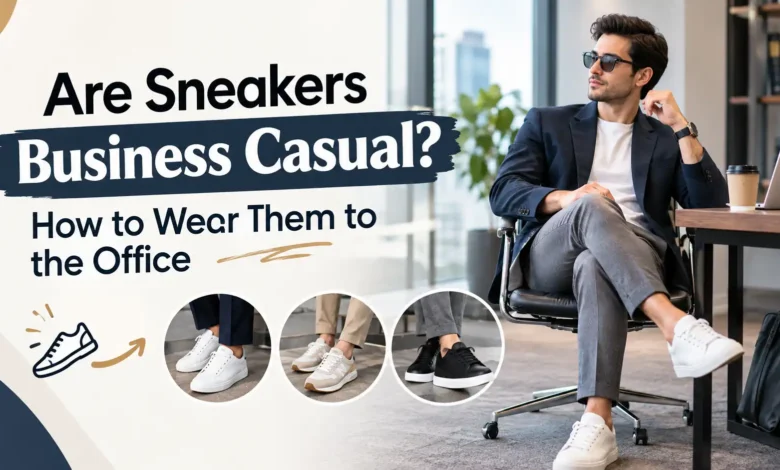
Are sneakers business casual? Some are. Plain, low-profile sneakers in leather or suede, in white, black or another neutral color, are accepted in many business casual workplaces. Running shoes, chunky athletic styles and anything scuffed or loudly branded are not, and in traditional offices even the sleekest pair is a Friday-only shoe.
What matters is which pair you choose and where you wear it. This guide covers what separates a work sneaker from a gym shoe, which styles and colors pass, how to read your dress code’s footwear rules, and outfit ideas for men and women. If you call them trainers or runners, the same rules apply.
- Most likely to pass: minimal leather or suede low-tops in white, black, gray, navy or brown.
- Casual Friday at most: plain canvas low-tops.
- Rarely business casual: running shoes, trail shoes, chunky sneakers and bright or heavily branded pairs.
- Condition matters as much as style: scuffs, gray soles and dirty laces make any pair look sloppy.
- Skip sneakers for: interviews, formal client meetings and workplaces whose policy asks for dress shoes.
Are sneakers business casual? What career guides and workplaces say
The career guides below don’t list sneakers under business casual, but many workplaces now accept a specific kind: plain leather or suede sneakers that look closer to a dress shoe than a running shoe. Athletic sneakers are still widely treated as casual footwear.
Here’s how three university career offices describe business casual shoes. Creighton University’s career center says athletic sneakers “are generally not recommended unless the company culture permits it” and asks for shoes that are “clean and polished, ideally leather or another dress style (like loafers or flats).” Virginia Tech’s dress code guide mentions tennis shoes only under casual, the least formal of its four levels. Penn State Engineering’s guide asks for “clean, polished boots or closed-toe shoes made of leather or another high-quality material,” and its examples are dress styles such as oxfords, flats and pumps.
In other words, the guides describe dress shoes, not sneakers. The acceptance of leather sneakers comes from workplace culture: where it’s allowed, the pairs that fit in are the ones that look most like those dress shoes, with smooth uppers, a slim shape and no sporty details. Because that’s a norm rather than a rule, your own workplace decides it. Our guide to the types of dress codes shows how business casual compares with the levels on either side of it.
Dress sneakers vs athletic sneakers: what’s the difference?
A business casual sneaker is designed to look tidy, not to perform. It has a smooth leather or suede upper, a slim flat sole, minimal stitching and little or no branding. An athletic sneaker has mesh panels, a thick cushioned or sculpted sole, reflective details and a prominent logo. The closer a pair is to the first description, the more workplaces it will pass in.
| Detail | Work-ready | Too athletic or casual |
|---|---|---|
| Upper | Smooth leather or suede | Mesh, knit, nylon, bright canvas |
| Color | White, black, gray, navy, brown, muted tones | Neon accents, multicolor panels |
| Sole | Slim, flat rubber sole | Thick foam, air units, sculpted soles |
| Shape | Low, slim and streamlined | Chunky “dad” shapes, trail treads |
| Branding | None, or a small tonal logo | Large contrasting logos or stripes |
| Laces | Flat, clean, matching the upper | Frayed, stained or bright laces |
| Condition | Spotless uppers, bright soles | Scuffed toes, gray soles, cracks |
Which sneakers are business casual?
Minimal leather and suede low-tops are the safest sneakers for business casual. Plain slip-ons and slim retro court styles can work in sneaker-friendly workplaces, canvas belongs to casual days, and running, trail and chunky styles stay out of the office.
| Sneaker style | Verdict | Notes |
|---|---|---|
| Minimal leather low-top | Yes | Where sneakers are allowed at all |
| Suede low-top | Yes | Softer and less sporty than white leather |
| Leather slip-on | Often | Plain leather only; canvas slip-ons are casual |
| Retro leather court style | Sometimes | Only if slim, plain and low on branding |
| Canvas low-top | Casual Friday | Keep them clean and plain |
| High-top | Usually no | Sleek leather high-tops are a gray area |
| Running, trail or chunky sneaker | No | Fine for the commute, not the desk |
What color sneakers are business casual?
Plain white leather sneakers are the classic business casual choice and pass in many workplaces that accept sneakers. The catch is that white shows everything, so a pair with gray soles or scuffed toes looks worse than no sneakers at all. Black, gray, navy and brown are more forgiving and look a little dressier with dark trousers. All-black pairs are a good pick if you want something close to a dress shoe. Muted colors such as burgundy, olive or soft gray work in relaxed settings, while bright or multicolor pairs read as weekend wear.
A quick guide to sneakers at work by situation
Can you wear sneakers for business casual every day? That depends on where you work. In workplaces that lean toward smart casual, sneakers are everyday shoes. Elsewhere, they’re easiest on regular days once you’ve seen coworkers wear them, and riskier when you’re meeting people who expect a more formal look.
| Situation | Sneakers? | What to do |
|---|---|---|
| Regular day in a tech, creative or startup office | Usually yes | Minimal leather or suede in good condition |
| Traditional finance, law or client-facing government role | Rarely | Loafers, derbies, boots or flats unless the written policy says otherwise |
| Casual Friday | Usually | Check that your policy doesn’t exclude athletic footwear |
| Client meeting | Depends on the client | Wear leather shoes if the client dresses formally |
| Job interview | Almost never | Dress shoes, loafers, flats or low heels |
| First week at a new job | Wait and see | Start in dress shoes and watch what others wear |
| Commute | Yes, to travel in | Change into work shoes when you arrive |
How to read your dress code’s footwear rules
Your employer’s policy outranks any general advice, but footwear rules are often written in a few common phrases. Here’s what they usually mean for sneakers:
- “Business casual” with no shoe details: sneakers depend on workplace norms, so look at what people wear on ordinary days before you try a pair.
- “No athletic shoes” or “no athletic footwear”: running and gym shoes are out. Minimal leather sneakers are a gray area worth asking about.
- “Dress shoes required”: no sneakers, including leather ones.
- “Clean, neat footwear”: sneakers may pass if they’re plain and spotless.
- “Closed-toe shoes”: in an office policy, this usually just rules out sandals and open-toed styles; plain leather sneakers generally meet it, but the rest of the policy still applies.
- “Slip-resistant” or “safety” footwear: these are safety rules, common in labs, kitchens, warehouses and hospitals. Follow them first; they take priority over style.
If the wording is unclear, a quick check settles it:
- Search the handbook for “footwear,” “shoes,” “sneakers” and “athletic.”
- Look at people one or two levels above you on a normal weekday, not just on Fridays.
- Ask your manager or HR something specific, such as “Are plain white sneakers okay on regular days?”
Business casual with sneakers: outfits that work
Sneakers look most professional when everything above them is a notch sharper. Pair them with pressed chinos, tailored trousers or dark jeans and a collared shirt, blouse, knit or blazer, and keep your pants hemmed so they sit neatly on the shoe instead of bunching over it.
For men
- Office staple: white leather sneakers, slim navy chinos, a tucked light-blue oxford shirt and a brown belt.
- Sharper day: black leather sneakers, charcoal wool trousers, a white shirt and a soft-shouldered gray blazer.
- Cooler months: gray suede sneakers, dark jeans and a merino crewneck over a collared shirt.
For women
- Tailored and easy: white leather sneakers with cropped wide-leg trousers and a tucked silky blouse.
- With a skirt: black leather slip-ons with a pleated midi skirt and a fine-knit sweater.
- With a dress: minimal white sneakers with a knee-length or midi shirt dress and a light cardigan or blazer.
Slim flatform sneakers in plain leather can work in relaxed workplaces, but tall or chunky platforms read as fashion or weekend shoes. With skirts and dresses, no-show socks or bare legs look cleanest. Where sneakers are a gray area, loafers and pointed flats are lower-risk choices that many people still find comfortable for a full day.
Sneakers also suit the relaxed side of business casual, as long as each piece is crisp. Dark denim is a natural match, and our guide on whether jeans can be business casual covers which pairs pass. For tops, a structured knit or piqué polo goes easily with minimal sneakers; here’s when a polo is business casual.
What socks to wear with business casual sneakers
Choose no-show socks with cropped or ankle-length trousers, so the sneaker looks clean from every angle. With full-length trousers, thin socks that match your pants or your shoes work well. Avoid thick white athletic crew socks with chinos or trousers, because they make any sneaker look like gym wear.
How to keep work sneakers looking sharp
A dirty sneaker looks careless in a way a slightly worn loafer doesn’t, so work pairs need regular attention. Always check the maker’s care instructions first, then build these habits:
- Wipe smooth leather often: a damp cloth after wet or dusty days stops dirt from setting in.
- Keep suede dry: brush it with a suede brush and avoid water, which can leave marks.
- Clean the soles: the edge of the sole is what people notice; a soft brush with mild soap keeps it bright.
- Test products first: try any leather conditioner or cleaner on a hidden spot, especially on white leather, since some products darken or discolor it.
- Replace laces: new flat laces make an older pair look fresh for very little money.
- Rotate pairs: a day off between wears lets sneakers dry out and hold their shape.
- Retire them on time: once the leather cracks or the soles yellow for good, move them to weekend use.
Frequently Asked Questions
Are tennis shoes business casual?
Usually not. In many parts of the US, “tennis shoes” means any athletic sneaker, and athletic styles with mesh uppers, thick soles and bold logos read as casual. Virginia Tech’s guide mentions tennis shoes only under its casual dress code. If your workplace accepts sneakers, choose minimal pairs in smooth leather or suede instead.
Can you wear sneakers to a business casual interview?
It’s safer not to. Interviews call for dressing a level above the daily dress code, so choose leather dress shoes, loafers, flats or low heels even at a company where staff wear sneakers. The exception is when the recruiter or hiring manager explicitly tells you to dress casually, and even then pick your cleanest, plainest pair.
Are sneakers okay on Casual Friday?
Usually. Casual Friday is the easiest day to wear sneakers, and plain canvas pairs often work alongside minimal ones. Some policies still exclude athletic footwear on casual days, so check yours. Running shoes and worn-out pairs look careless on any day, so keep the same standard you’d apply to other work shoes.
Can you wear sneakers with a blazer?
Yes, and it’s one of the easiest ways to make sneakers look work-appropriate. Choose a soft-shouldered blazer, tailored trousers or dark jeans, and sleek sneakers in white, black or brown. A formal suit with sneakers is more of a fashion statement and suits creative settings better than conservative ones.
What can you wear if sneakers aren’t allowed?
Choose shoes that are just as comfortable but read as dress styles. Leather loafers, derbies and Chelsea or chukka boots work for men; loafers, pointed or ballet flats, low block heels and ankle boots work for women. Cushioned insoles in a well-fitting dress shoe can make a long day easier without breaking the dress code.
The short version
So are sneakers business casual? Only the ones that could pass for a plain leather shoe from across the room. That means smooth leather or suede, a slim low shape, a spotless sole, a neutral color and little or no branding. Everything athletic, chunky or scuffed stays home. Dress the rest of the outfit a notch up, skip sneakers for interviews and formal meetings, and let your written policy, and what coworkers wear on ordinary weekdays, have the final say.




One Comment