

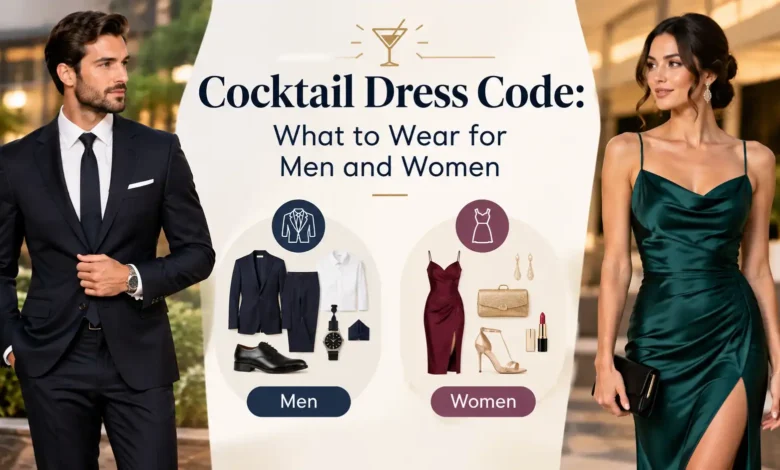
The cocktail dress code calls for clothes that are dressy but not formal. For men, that means a dark suit with a tie as the safe default; for women, a cocktail dress that ends between the knee and mid-calf, a dressy jumpsuit, or elegant separates. It sits above office wear and below black tie, so a tuxedo (a dinner jacket in the UK) or a floor-length gown is more than the invitation asks for.
The real questions start in the gray areas. Do you need the tie? How short or long can the dress be? And what does the host mean by “cocktail chic” or “casual cocktail”? Each has a workable answer once you know how etiquette guides and hosts actually use the term.
- Men: a well-fitted dark suit, a crisp dress shirt and leather dress shoes, with a tie unless the event is clearly relaxed.
- Women: a knee-to-midi dress, a dressy jumpsuit or tailored separates in an evening fabric; heels are optional.
- Timing matters: evening events run darker and dressier, while daytime and summer events allow lighter colors and fabrics.
- Leave at home: jeans, sneakers (trainers), a tuxedo and a floor-length gown.
- When unsure: wear the tie and choose the dressier fabric.
What the cocktail dress code means
The cocktail attire dress code is how you dress up for a party rather than for the office. On the ladder of types of dress codes, it sits above business wear and below black tie optional, at roughly the same level as semi-formal. The pieces can look like a good work outfit (a dark suit or a tailored dress), but the finish changes: richer fabrics, dressier shoes, and more room for color and personality.
The name comes from the cocktail parties that took off in the 1920s. According to The Metropolitan Museum of Art’s essay on dressing for the cocktail hour, “The cocktail affair generally took place between six and eight p.m.,” and “Christian Dior was the first to name the early evening frock a ‘cocktail’ dress in the late 1940s.” The idea behind it hasn’t changed much since: an outfit polished enough for an evening event, without the length or strict rules of formal evening wear.
In the UK, the code is framed a little differently. Debrett’s, the British etiquette authority, notes that “other terms for this code include ‘smart frocks’ or ‘party dress'” and that these codes “release guests, especially men, from rigid strictures.” Men “can discard dinner jackets and bow ties if they choose and opt for smart lounge suits, velvet jackets, Nehru jackets and so on.” In other words, Debrett’s frames cocktail as a relaxed alternative to black tie, while U.S. wedding guides like The Knot place it between semi-formal and formal. Both land in the same place: a sharp suit or a party dress.
Cocktail dress code for men
The suit
Start with a well-fitted suit in a dark or mid-tone color. Gentleman’s Gazette’s guide to men’s cocktail attire lists “Navy, Charcoal, Dark Blue, and Mid-Gray” as common options, with lighter colors appropriate at daytime events. Pair it with a crisp dress shirt; white and light blue are the easiest to get right. Fit matters more than price here: sleeves that show a little shirt cuff and trousers with little or no break look sharper than an expensive suit that’s too big.
If you own one good dark suit for work, it can do double duty. It’s the same suit that anchors business professional dress, as our comparison of how business professional differs from business casual explains. Styling alone moves it from office to evening: a richer tie, a pocket square and well-polished shoes do most of the work.
Do you need a tie?
Usually, yes. Most guides treat a tie as the default for cocktail attire, though a few allow exceptions. Gentleman’s Gazette says some kind of neckwear “will be expected for nearly every Cocktail Attire occasion.” Bridal fashion stylist Gabrielle Hurwitz, quoted in The Knot’s guide to cocktail wedding attire, says “traditionally, cocktail attire means a tie,” while allowing “a little more flexibility with the tie these days,” such as a turtleneck under a blazer or a summer event. Debrett’s doesn’t address the necktie directly; its point is that British guests can swap black tie for a smart lounge suit or a velvet jacket.
A simple rule: wear a tie unless the invitation, the venue or the season clearly says relaxed. An evening wedding, a hotel ballroom or a company gala calls for one. A low-key summer rooftop party or an invitation that says “casual cocktail” can go open-collar, as long as the rest of the outfit stays sharp. A regular necktie or a colored bow tie both work, but Gentleman’s Gazette advises against a black bow tie because it is “closely associated with the Black Tie dress code.”
Shoes and finishing touches
Black oxfords are the safest choice for an evening event. Gentleman’s Gazette is specific: “Black shoes are best suited to a Cocktail Attire event, although very dark brown or dark oxblood are also acceptable.” The same guide rules out loafers as too casual. The Knot is more flexible and suggests “oxfords, loafers or derbies for men.” Sleek leather loafers are the easiest fit at daytime and summer events. Skip sneakers, boat shoes and sandals. Choose dress socks in solids or subtle patterns in muted colors, never athletic socks. Finish with a belt that matches your shoes, a simple watch and, if you like, a pocket square that complements the tie rather than matching it exactly.
A tuxedo is too much. Gentleman’s Gazette warns against wearing one because it belongs to its own, more formal dress code. The same goes for a white dinner jacket or any black tie accessories.
Blazer and trousers instead of a suit
The Knot lists “a tailored blazer and dress pants” as an alternative to the full suit. It works best at daytime, summer or smaller events. Choose trousers in wool or another dress fabric rather than chinos, and pick colors that clearly contrast, such as a navy blazer with mid-gray trousers, so the outfit doesn’t look like a mismatched suit. Suit or blazer, keep the jacket on. Gentleman’s Gazette says a jacket is needed “certainly for any event taking place in the evening.” In hot weather, choose a lighter fabric rather than going without.
Cocktail dress code for women
Dress length and silhouette
Hurwitz tells The Knot that a cocktail wedding guest dress “typically means a mini, knee-length or midi dress.” Knee to midi length is the safest range for most events. A mini works well at parties and nightlife venues, but it can feel too casual at a daytime wedding or a work event. Floor-length gowns belong to formal and black tie codes, so they tend to look overdressed at a cocktail event.
The little black dress remains the classic choice, and it’s hard to get wrong. Sheath, wrap, fit-and-flare and slip dresses all work, as long as the fabric and fit look evening-ready.
Fabric is the deciding factor
As Hurwitz puts it, “The fabric is often the deciding factor on whether a dress is cocktail attire appropriate or not.” Silk, satin, crepe, chiffon, velvet, jacquard, lace and subtle beading all read as cocktail. Casual cotton, lightweight jersey and denim usually don’t, even when the cut is right. If you’re choosing between two outfits, the one in the dressier fabric is almost always the better pick.
Jumpsuits, pantsuits and separates
You don’t need a dress: pants work for a cocktail event. A jumpsuit or pantsuit in an evening fabric fits the code, and so do dressy separates, such as wide-leg silk trousers with an elegant top or a satin midi skirt with a fine blouse. The tailoring and the fabric are what make the look cocktail-level.
Shoes, bags and layers
Heels are welcome but not required. Hurwitz adds that “Heels aren’t a requirement for a cocktail-attire dress code,” as long as the shoe is still dressy, like a satin or patent flat. Block heels are the practical choice on grass, gravel or cobblestones. Carry a small clutch or shoulder bag rather than a tote, and let one piece of jewelry lead. For cold evenings, a tailored wool coat or an elegant wrap keeps the look intact; a puffer or rain jacket is fine for the journey, but leave it at the coat check or cloakroom.
How time, season and venue change cocktail attire
The same dress code can look quite different at 2 p.m. and at 8 p.m. The Emily Post Institute’s attire guide, in its advice on semi-formal events, says that “if the event is later than 6 in the evening, you’ll want to err on the side of formality,” and the same logic applies to cocktail events. Gentleman’s Gazette describes daytime cocktail events as usually taking place before five p.m., when lighter suit colors become appropriate.
| Situation | Men | Women |
|---|---|---|
| Daytime (before about 5 p.m.) | Mid-gray or medium blue suit, lighter tie, brown oxfords or loafers | Knee-length or midi dress in lighter colors or prints |
| Evening (from about 5 or 6 p.m.) | Navy or charcoal suit, tie, black oxfords | Darker or jewel-tone dress, richer fabrics like satin or velvet |
| Summer or outdoors | Lightweight wool or linen-blend suit; tie optional if the setting is relaxed | Breathable dress in chiffon or a silk blend, block heels or dressy flats |
| Winter or holiday | Dark suit, festive tie; a velvet jacket works | Velvet, brocade or a touch of sparkle, with a tailored coat |
The venue fine-tunes the outfit. A hotel ballroom or formal restaurant pushes you toward the dressier end of the code, while a garden, beach or rooftop allows lighter fabrics and more practical shoes.
Cocktail variations you’ll see on invitations
Hosts often add a word to “cocktail” to set the mood. None of these have a strict etiquette definition, but they are generally used in these ways:
- Cocktail chic: the fashion-forward end of the code. Think a statement dress or jumpsuit, and for men a sharp suit, perhaps in a richer color or with a velvet or patterned jacket.
- Casual cocktail or cocktail casual: the relaxed end, sitting between cocktail and the smart casual dress code. Men can wear a blazer with tailored trousers and skip the tie; women can choose a dressy midi or a silk top with tailored trousers. Jeans still don’t qualify.
- Cocktail formal or elevated cocktail: the dressier end. Choose midi rather than mini, a dark suit with a tie, and evening fabrics, but a gown or tuxedo still isn’t required.
- Festive cocktail: common for holiday parties. Emily Post describes festive attire as “essentially cocktail party attire with a seasonal and festive holiday touch,” so add velvet, jewel tones or a little sparkle.
- Business cocktail: used for work receptions, conferences and client events. Dress on the conservative side of cocktail: your best work suit with a tie, or a polished dress with a jacket.
- Summer or garden cocktail: lighter colors, breathable fabrics and shoes that won’t sink into grass.
- Cocktail hour: at a wedding, this is the drinks hour between the ceremony and dinner, not a dress code. Wear whatever the wedding’s own dress code asks for.
Destination weddings and cruise daywear often use the resort casual dress code instead, which sits closer to smart casual.
Cocktail attire vs semi-formal, black tie optional and business wear
Cocktail and semi-formal are close, and guides disagree on which is dressier. Emily Post lists the cocktail dress under semi-formal, while The Knot says cocktail attire “falls between semi-formal attire and formal attire.” In practice, both call for a dark suit or a knee-to-midi dress. Semi-formal tends to feel a little more traditional; cocktail invites more color and flair.
| Dress code | Men | Women | Compared with cocktail |
|---|---|---|---|
| Smart casual | Chinos or dark jeans, collared shirt, optional blazer | Tailored trousers or a simple dress | More relaxed; no suit needed |
| Business professional | Dark suit, often a tie | Suit or dress with a jacket | Similar pieces with office styling |
| Cocktail | Dark suit, tie by default | Knee-to-midi dress, jumpsuit or dressy separates | – |
| Semi-formal | Dark suit and tie | Short afternoon or cocktail dress | About the same level, a little more traditional |
| Black tie optional | Tuxedo, or dark suit and tie | Floor-length gown or dressy cocktail dress | A step up; tuxedos and long gowns welcome |
For women, the gap between cocktail and semi-formal is mostly tone. When you look at what semi-formal means for women, the little black dress is the benchmark; cocktail welcomes brighter color and bolder fabric. If the invitation moves up to black tie, the rules tighten, so check what not to wear to a black tie event before reusing a cocktail outfit.
What not to wear to a cocktail event
- Jeans, even dark ones. Wedding and menswear guides, from The Knot to Gentleman’s Gazette, rule out denim here, blazer or not.
- Shorts, sneakers, flip-flops and casual sandals. The Knot lists all of these as things to avoid.
- Chinos and a polo as the main outfit. Fine for smart casual, too relaxed here unless the invitation says casual cocktail.
- A tuxedo, a black bow tie or a floor-length gown. These belong to formal and black tie codes.
- Casual fabrics. T-shirt jersey, sweatshirt knits and everyday cotton look out of place, even in a dressy cut.
- Anything too revealing for the venue. Very short, sheer or low-cut pieces can work at a nightclub party but not at a wedding or work event.
- White, cream or ivory at a wedding. Leave those shades to the couple unless they ask guests to wear them.
Frequently Asked Questions
Can you wear black to a cocktail wedding?
Yes. For women, the little black dress is closely tied to this dress code. For men, sources split: The Knot lists black alongside navy and gray, while Gentleman’s Gazette warns that a black suit can look like a tuxedo, so navy or charcoal is safer. At a wedding, a touch of color keeps all-black from looking somber.
Can I wear a long dress to a cocktail event?
A floor-length gown is more formal than cocktail attire asks for, and The Knot steers guests toward mini, knee-length or midi styles. A flowing maxi is different. At a beach or garden event, a maxi in silk or chiffon can work. Elsewhere, skip casual versions: Hurwitz says a cotton-blend maxi “would probably be too casual unless it’s on the beach somewhere.”
Is cocktail attire the same as business casual?
No. Business casual drops the suit and often the tie, while cocktail expects at least a tailored jacket with dress trousers, or an evening-ready dress. If a work reception calls itself a cocktail event but the office is business casual, wear a suit or blazer with dress trousers, and keep the tie unless the invitation or your colleagues clearly signal relaxed.
What colors are appropriate for cocktail attire?
Almost any color works if it suits the hour: darker shades and jewel tones at night, lighter colors and prints by day. Greg Shugar, co-founder of The Tie Bar, tells The Knot, “No color is off limits,” but adds, “the bolder the color, the less of it you should have.” At a wedding, leave white, cream and ivory to the couple.
Can you wear jeans to a cocktail party?
Not if the invitation says cocktail. That includes dark, well-fitted jeans with a blazer. If the invitation says casual cocktail, men can wear a blazer and tailored trousers without a tie, and women can choose dressy separates, but jeans still read as too casual.
What should I wear to a cocktail party at someone’s home?
Follow the dress code, then adjust to the setting. A party at home often feels a little more informal than one at a hotel or restaurant, so men can skip the tie if the host suggests it, and women might choose dressy flats over heels. If you’re unsure, ask the host; it’s a normal question.
The short version
The cocktail dress code sits between office wear and black tie. Men wear a dark, well-fitted suit, a dress shirt and polished leather shoes, with a tie unless the event clearly signals relaxed. Women wear a knee-to-midi dress, a dressy jumpsuit or tailored separates in an evening fabric, with heels or dressy flats. Go darker and richer at night, lighter in daytime and summer, and read any extra word on the invitation, like “chic,” “casual” or “festive,” as a nudge up or down. When you’re unsure, wear the tie and choose the dressier fabric.

One Comment