
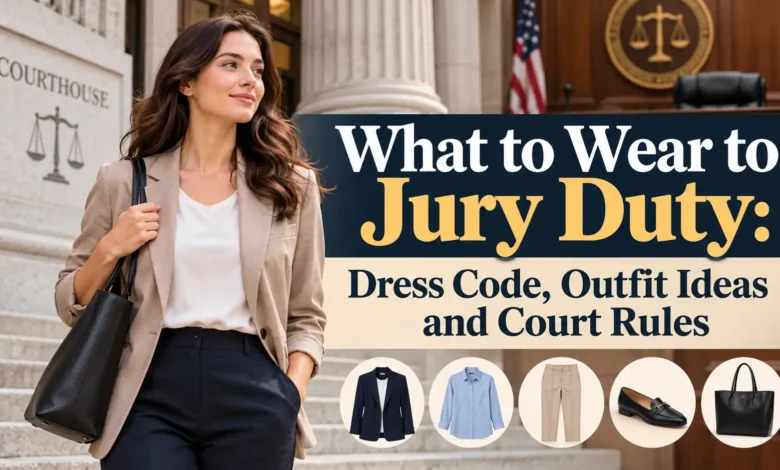
What to wear to jury duty, in one line: business casual, unless your summons says something different. Think slacks, chinos or a knee-length skirt or dress, a collared shirt, blouse or sweater, comfortable closed-toe shoes and an extra layer, because courtrooms are often cold. Skip shorts, tank tops, flip-flops, hats and anything with slogans or graphics. Jeans depend on your court: some allow them and some don’t.
This guide covers what to wear for jury duty in real detail: what actual court rules say (quoted and compared side by side), outfit ideas for women and men, quick answers on jeans, sneakers and leggings, getting through security, and what to bring. It’s part of our guide to types of dress codes.
- Default: business casual. Neat, clean and comfortable enough to sit in all day.
- Avoid: shorts, tank tops, flip-flops, beachwear and clothing with offensive words or images.
- Check first: jeans, sneakers and hats. Courts disagree on these.
- First time? You don’t need new clothes. Comfortable business casual you already own is enough.
- Easy rule: covered shoulders, hems at the knee or longer and closed-toe shoes, in calm solid colors, are safe even under the strictest rules we found.
- Pack: summons, photo ID, a pen, something to read and a sweater, since several courts warn that courtrooms can be cold.
- The final word: your summons and your court’s juror web page. Their rules beat any general guide, this one included.
- Outside the U.S.? England and Wales and Canada have their own section near the end of this guide.
Is there a dress code for jury duty?
Yes. Almost every U.S. court we checked has one, though the details vary from court to court, and most ask for something between business casual and business attire. England and Wales is the relaxed exception, with “no strict dress code.” The U.S. District Court for the Central District of California, which covers Los Angeles, spells its rule out clearly on its juror dress code page: “Business attire is strongly suggested. Ties are not required.”
The same page lists what not to wear: “Jurors should not wear shorts, mini-skirts, tank tops, flip-flops, or hats (except for religious purposes).” It also explains what happens if you get it wrong: “Jurors who are not appropriately dressed will be sent home and ordered to appear for jury service on a future date.”
That’s the real risk of dressing too casually: the consequence these courts name is being sent home, so you may lose a day and have to come back.
The Circuit Court of Cook County in Illinois, which bans shorts, mini-skirts, tank tops and halters, tells jurors: “If you report wearing any of these items, you will be asked to return home, at your own expense, to change into more suitable attire.” A few minutes checking your summons saves you that second trip.
C.D. California explains the reason itself: “A trial is a formal legal process, and jurors should take the seriousness of the proceeding into consideration with respect to attire and personal conduct.” In practice, that means looking neat and respectful, not dressed for a wedding.
Jury duty dress code at a glance
This table sums up what to wear to jury duty based on the most common rules across the court pages we checked. Use it as a starting point, then confirm with your own court.
| Usually fine | Check your court first | Usually not allowed |
|---|---|---|
| Slacks, chinos, dress pants | Jeans (dark, no rips) | Shorts |
| Collared shirts, blouses, sweaters | Plain T-shirts | Tank tops, halters, sleeveless tops |
| Knee-length skirts and dresses | Sneakers | Mini-skirts |
| Cardigans, blazers, light jackets | Leggings | Flip-flops and beachwear |
| Loafers, flats, low boots, clean closed-toe shoes | Work uniforms | Hats (religious head coverings are the usual exception) |
| Polo shirts, neat knitwear | Sweatshirts and athleisure | Clothes with offensive words or images |
How real courts compare
Most jury duty guides give general advice without saying where it comes from. Here’s what a sample of real courts in the U.S., the UK and Canada actually say, taken from their official web pages in September 2026. If you’re still deciding what to wear to jury duty, notice how much they differ on jeans.
| Court | What its official page says | Jeans? |
|---|---|---|
| U.S. District Court, C.D. California (Los Angeles) | Business attire strongly suggested; ties not required. No shorts, mini-skirts, tank tops, flip-flops or hats (religious exception). | Not mentioned |
| U.S. District Court, S.D. Florida (Miami) | “Appropriate dress, casual business attire, is required.” | No: “Shorts, jeans and t-shirts are not considered appropriate.” |
| U.S. District Court, E.D. New York (Brooklyn) | Dress “business casual” or “business.” No jeans, shorts, tank tops or sweats. | No |
| U.S. District Court, N.D. Illinois (Chicago) | “Please dress for an office type setting.” | Not mentioned |
| U.S. District Court, New Jersey | “You may wear casual business attire.” Not permitted: “shorts, sleeveless tops, jogging suits (nylon or otherwise) and hats.” | Not mentioned |
| U.S. District Court, N.D. Iowa (Cedar Rapids, Sioux City) | “Comfortable but appropriate business-like clothing.” No shorts, t-shirts, tank tops or sweatshirts. | No |
| U.S. District Court, E.D. Wisconsin (Milwaukee) | “Casual attire is acceptable,” but jurors are expected to dress for the formality of the court. | Not mentioned |
| U.S. District Court, S.D. Texas (Houston) | Proper attire, “i.e., slacks, jeans, shirts, dresses, etc., without holes, rips, or tears.” | Yes, if they’re not ripped |
| U.S. District Court, W.D. North Carolina (Charlotte) | No shorts, tank tops, bare midriffs, or clothing with offensive wording or images. | Not mentioned |
| California state courts | No shorts, tank tops or bare midriffs. “Business attire is always appropriate.” | Not mentioned |
| Miami-Dade County, Florida | Business attire. “Shorts and uniforms are not permitted.” | Not mentioned |
| England and Wales (gov.uk) | No strict dress code. No beachwear, and nothing on your head unless it’s for religious reasons. | Yes |
| British Columbia, Canada (general courtroom conduct page, not juror-specific) | “Dress as if you were going to an important job interview.” | Not mentioned |
The pattern is clear. Eight of these 13 name business attire, business casual, “business-like” or “office” dress as the target, and several ban shorts and tank tops by name. Jeans are where the rules split: the federal courts in Miami, Brooklyn and Northern Iowa ban them, while Houston’s federal court and England and Wales allow them.
When a page says nothing about jeans, dark, unripped jeans may be fine, but a pair of chinos is the safer choice if you can’t confirm. Rules also change, and one courthouse can differ from the next in the same county. The only page that counts for you is your own court’s juror page, usually linked on your summons.
What to wear to jury duty for women: 3 outfit ideas
For female jurors, dresses and skirts widen the options, but the rules are the same. These outfits are built from clothes most people already own, and each one is comfortable enough to sit in for a full day. The details of business casual are in our guide to business casual vs business professional.
1. Trousers, a blouse and a cardigan
Straight-leg or wide-leg trousers in navy, black, gray or khaki, a simple blouse or knit top with sleeves, and a cardigan you can take on and off. Add flats, loafers or low block heels. Of the three, it’s the safest pick for any court, since it meets both business casual and the stricter “business attire” rules.
2. A knee-length dress with a layer
A plain or softly patterned dress that reaches at least the knee, with sleeves or a cardigan or blazer on top, since some courts ban sleeveless tops. Pick a fabric that doesn’t wrinkle easily, and check that it’s comfortable when you sit, because you’ll be sitting a lot. Tights or closed-toe shoes make it work in colder months.
3. Dark chinos, a sweater and loafers
Dark chinos or ankle pants, a fine-knit sweater (over a collared shirt if you like), and loafers or leather flats. It sits at the relaxed end of business casual, which suits courts that ask for “office” or business casual dress, and it’s easy to pull together on a busy morning.
For all three outfits, keep jewelry simple, because you’ll go through a metal detector. Skip very short skirts, low-cut or cropped tops and anything see-through. If you’d feel slightly overdressed at a casual office, you’re probably dressed right for court.
How to dress for jury duty as a man: 3 outfit ideas
Men’s jury duty clothes follow the same rule: business casual, neat and comfortable. A suit isn’t required, and C.D. California says plainly that ties aren’t either.
1. Chinos and a button-down shirt
Khaki, navy or gray chinos with a long- or short-sleeve button-down shirt, tucked in, with a simple belt. Add loafers, derbies or polished leather shoes. Few outfits are harder to get wrong in a courthouse. Bring a sweater or light jacket for the courtroom.
2. Dress pants and a polo
Dress pants or chinos with a plain, well-fitting polo is as casual as these ideas get while still looking tidy. Polos sit near the edge of business casual, so our guide on whether a polo is business casual explains when they work. In a court that asks for business attire, choose the button-down instead.
3. A sweater over a collared shirt
A crewneck or V-neck sweater over a collared shirt with dark trousers is warm, neat and good for colder months or chilly courtrooms. You can remove the sweater if the room is warm, and the shirt underneath still looks complete. Leather shoes or plain dark sneakers, where allowed, finish it.
Avoid T-shirts with graphics or slogans, sports jerseys, cargo shorts and baseball caps. If your court is on the formal side, a blazer over any of these outfits is a simple upgrade.
Jeans, sneakers, leggings and more: quick answers
Can you wear jeans to jury duty?
Only if your court allows them. Some federal courts ban them outright, and others allow them if they’re not ripped. If your court’s page doesn’t mention jeans, a dark, unripped pair with a collared shirt or sweater is usually the most you’d want to risk.
If your closet is mostly work clothes, dark, unripped jeans (where allowed) with your neatest collared shirt or sweater and clean boots or sneakers is a reasonable starting point. For how jeans fit into business casual in general, see can jeans be business casual.
Can you wear sneakers?
Plain, spotless sneakers are usually fine in courts that allow casual dress, and they’re comfortable for a long day on your feet. Choose leather or simple canvas styles in white, black or neutral shades. Skip running shoes with bright colors and anything worn out. Our guide on whether sneakers are business casual covers which styles look neat.
Can you wear leggings?
On their own, leggings read as athletic wear, and some courts rule out gym-style clothing by name: New Jersey’s federal court bans jogging suits, and Northern Iowa’s bans sweatshirts. If you want the comfort, wear thick, opaque leggings under a dress or with a long tunic or sweater that covers your hips, or switch to stretch trousers. If your wardrobe is mostly athleisure, pull-on stretch trousers or dark chinos with a plain sweater are the closest comfortable swap.
Shorts, tank tops and flip-flops?
No, at least in the U.S. Most of the U.S. court pages we checked rule out at least one of the three by name, and none invites them, even in hot places like Florida and Texas. England and Wales bans only beachwear, but a neater choice is still the safer one. Wear light trousers or a dress instead, and carry a layer for inside.
Work uniforms and scrubs?
Check first. Miami-Dade County’s jury guidelines say: “Shorts and uniforms are not permitted.” Other courts don’t mention uniforms at all. If you’re coming straight from a shift and your court is silent on it, bring a change of clothes to be safe.
Dressing for a long, cold day
Jury duty days can be long, with waiting in a jury assembly room before you’re called and hours of sitting if you’re chosen. Comfort matters as much as looking neat.
- Bring a layer. The C.D. California page says “Courtrooms can be cold, so a sweater or jacket is recommended,” and Miami-Dade County and the Western District of North Carolina also recommend a sweater or jacket. A cardigan, blazer or light jacket you can carry is enough.
- Choose soft waistbands and stretch fabrics. You’ll be sitting for long periods, so skip anything tight at the waist or that rides up. Ponte-knit or pull-on trousers and a cardigan instead of a fitted blazer feel neat without pinching at the waist or underarms.
- Wear shoes you can walk in. Expect to walk from parking or transit, stand in a security line and possibly climb stairs. Save new or high heels for another day.
- Avoid clothes that wrinkle badly. Linen crumples after hours in a chair. Knits and cotton blends hold up better.
- Skip strong perfume or cologne. You’ll be in a small room with other people for hours.
In summer, dress for the room, not the weather outside. Light trousers or a midi dress with a cardigan in your bag works well. In winter, you may have to carry your coat or put it through security, so a lighter coat plus a sweater is easier than one heavy parka.
Getting through courthouse security
Expect a security screening at the entrance. Your outfit can make it faster or slower.
- Keep metal to a minimum. The Southern District of Florida’s juror FAQ says: “Since you will be passing through a metal detector, please leave excess metal and jewelry at home to speed up your entry into the building.”
- Wear socks. The Harris County District Clerk in Texas recommends socks, “given the fact you will have to take off your shoes when you go through the security screening.”
- Pick a simple belt. A plain belt, or pants that don’t need one, saves time if you’re asked to remove it.
- Leave banned items at home. The California courts juror page says “Objects like knitting needles, scissors, nail clippers, pocket knives, and weapons are not allowed.” Check your keychain for small tools before you go.
If you wear a religious head covering, it’s normally allowed. Courts that ban hats, including C.D. California and England and Wales, make an exception for religious reasons.
What to bring to jury duty (and what to leave at home)
Your summons usually lists what you need. These are the items official court pages mention most often:
- Your jury summons. Southern District of Florida lists “your jury summons, photo identification and your parking lot stub.”
- Photo ID. A driver’s license or other government ID.
- Parking ticket or stub, if the court validates parking.
- Something to read. The Northern District of Illinois asks jurors to “bring your summons, a pen and reading materials with you.” Waiting time is common.
- A pen. Useful for forms and questionnaires.
- A sweater or light jacket. See above.
- Any medication you’ll need during the day, plus glasses if you use them for reading.
Phone rules vary the most. The Northern District of Illinois says “You may use your laptop and cellphone in the jury lounge only.” The Northern District of Iowa’s page says cell phones, laptops and other electronic devices aren’t permitted in the courthouse at all, and the Southern District of Texas says each division has its own rules. Check your court’s page before you bring a laptop or tablet.
Food and drinks also vary. Some courts have a cafeteria, and some don’t allow food in the assembly room. Your court’s juror page or the staff on the day will tell you.
Can what you wear keep you off a jury?
Many people search for what to wear to jury duty to not get picked. We found no official source suggesting an outfit makes you less likely to be chosen. Official descriptions of jury selection focus on jurors’ answers to questions, not their clothes.
The U.S. courts’ juror selection page explains that in federal court, “The judge and attorneys ask the potential jurors questions, general or related to the specific case before them, to determine their suitability to serve on the jury.” This process, called voir dire, “typically results in some prospective jurors being excused, based on their answers, from serving in that trial.”
Dressing inappropriately on purpose doesn’t get you out of jury service. As the C.D. California rule shows, it can get you sent home and ordered back on another date, so you’d still serve, only later.
Answer the questions truthfully, and if serving would cause a real hardship, follow the instructions on your summons for asking about a postponement or excuse. For anything beyond that, contact the court directly. This guide isn’t legal advice.
Jury duty in the UK and Canada
Outside the U.S., the rules still vary. England and Wales are notably relaxed, while Canadian guidance can be closer to U.S. business casual.
England and Wales. The gov.uk jury service guidance says: “There is no strict dress code and you can wear clothes you’re comfortable in, such as jeans and a t-shirt.” You can’t wear “very casual clothing, such as beachwear,” or anything on your head “unless it is for religious reasons.”
Most jurors there serve at a Crown Court, and this is the guidance that applies. Scotland and Northern Ireland have their own court services, so check their guidance if you’re summoned there.
Canada. Jury service is run by each province and territory. British Columbia doesn’t publish a juror-specific dress code, but its general courtroom conduct page, which applies to anyone attending court, says: “Dress as if you were going to an important job interview. Shorts, tank tops and inappropriate logos are not allowed.” In other provinces, check your jury summons and your provincial court website.
Going to court for something else, such as a hearing, is a different situation from jury duty, with its own expectations. This guide covers jurors only.
Jury duty clothing questions
Do you have to dress up for jury duty?
Not in the formal sense. No court on our list requires a suit, and C.D. California says ties aren’t required. Most U.S. courts want business casual: neat clothes like slacks and a collared shirt or a simple dress. Think of what you’d wear to a normal office, not a wedding or a gym. Comfort is fine as long as you look tidy.
What happens if you dress wrong for jury duty?
You may be sent home, either to change and come back or to serve on a later date, as the C.D. California and Cook County rules quoted above show. That costs you time. If you’re unsure about one piece, bring a backup, such as a cardigan for a sleeveless top, so you can fix it on the spot.
Can you wear a hat or head covering?
Regular hats and caps are banned in some courts, including C.D. California and New Jersey’s federal court, and many other court pages don’t mention hats at all. A religious head covering, such as a hijab, kippah, kufi or turban, is the usual exception. If you expect questions at security, call the jury office before your date.
Can you bring your phone to jury duty?
Rules differ. Some courts allow phones and laptops in the jury lounge only, some don’t allow electronic devices in the building at all, and some set rules by division. Your summons or court web page will say. Where phones are allowed, a “jury lounge only” rule like the Northern District of Illinois’s means they stay out of the courtroom itself.
What should you wear if you’re picked for a long trial?
The same business casual works on selection day and on trial days, so rotate the basics: two or three pairs of trousers or skirts, a few shirts or blouses, and one reliable layer. Nobody expects a new outfit each day. Keep the comfort rules, like soft waistbands, walkable shoes and socks for security, and follow any extra instructions the judge or jury staff give once the trial starts.
Is it OK to wear the same outfit two days in a row?
Yes. Jury duty isn’t a fashion event, and nobody is keeping track. If you want variety without extra effort, swap only the top or the layer: the same trousers with a different sweater or shirt looks like a new outfit. What matters is that your clothes are fresh, neat and within your court’s rules.
Before you leave for the courthouse
If you remember one thing about what to wear to jury duty, make it this: business casual, a layer for a cold courtroom, and your own court’s rules above everything else. Slacks or chinos with a collared shirt, blouse or sweater, or a knee-length dress with a cardigan, work almost anywhere. Leave shorts, tank tops, flip-flops and hats at home, and check before you wear jeans, sneakers or leggings.
The night before, read your summons, lay out your outfit, and pack your summons, photo ID, a pen, something to read and a sweater. Wear socks and skip extra jewelry for security. Then you’re ready for a long day of doing something important.