
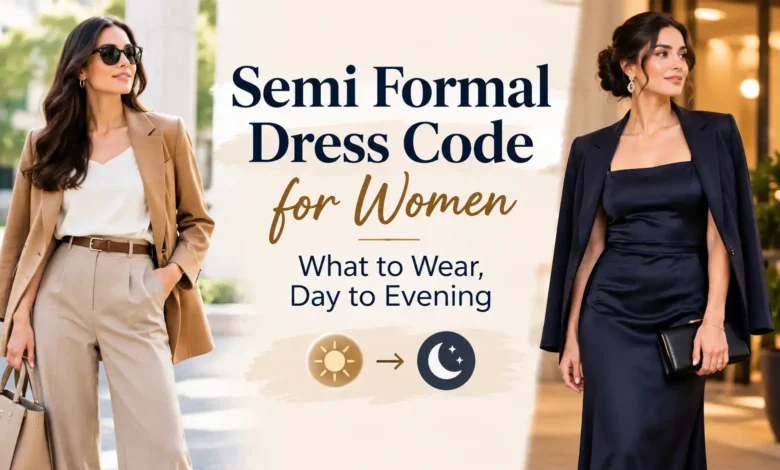
The semi-formal dress code for women means dressing a step up from office wear without going as far as a gown: a knee-length or midi cocktail dress, a little black dress, a dressy skirt and top, a jumpsuit, or a tailored pantsuit in a nice fabric. Add heels, wedges or dressy flats and a small bag, and you’re there.
If you’ve searched “semi formal dress code female,” you’re probably holding a wedding invitation or a work event email that just said “semi-formal.” Either way, the details that matter are the same: how long the dress can be, which fabrics look right, and whether the event starts before or after 6 p.m.
- What works: a knee-to-midi cocktail or afternoon dress, a little black dress, dressy separates, a jumpsuit or a tailored pantsuit.
- Long is fine if it isn’t a gown: a dressy maxi skirt with a blouse, or a flowing maxi in a light fabric.
- Time of day: go darker and richer after 6 p.m.; choose lighter colors and fabrics by day.
- Skip: jeans, sneakers, flip-flops, sundresses and ball gowns, plus white, cream and ivory at weddings.
- The rule: dress up from office wear, but stop short of a gown.
What is the semi formal dress code female?
The Emily Post Institute’s attire guide puts it neatly: semi-formal is “more formal than what you would wear to an office, but slightly less formal than what you would wear to a formal event.” Our guide to every dress code from casual to white tie places it next to cocktail and below black tie optional.
The name confuses people for a reason. Wikipedia’s entry on semi-formal attire explains that “The traditional interpretation for men is black tie for evening wear and black lounge suit for day wear, corresponded by either a pant suit or an evening gown for women.” Modern usage has moved well away from that; in the same entry, “semi-formal has been defined closer to what is traditionally considered ‘informal wear.'” In traditional etiquette, “informal” means a lounge (business) suit rather than casual clothes, so the modern code is still a dressed-up one: a dark suit for men, a cocktail dress or dressy separates for women.
On most U.S. and Canadian invitations today, semi-formal means the modern version described here. The term is less common in the UK, where Debrett’s, the British etiquette authority, doesn’t include it among its dress codes. If a traditional host uses it for an evening event, it’s worth asking whether they mean black tie. Asking is normal anywhere: Grinnell College’s career center says “it’s okay to have a quiet conversation” with the host about what semi-formal means for their event.
Semi-formal attire for women: dresses, separates and jumpsuits
Dresses
Emily Post’s list for women is short and practical: a “Short afternoon or cocktail dress,” a “little black dress,” a “long dressy skirt and top,” or “dressy separates.” Knee-length and midi dresses are the easiest to get right, and a tea-length dress, which usually ends at or just below mid-calf, works well too. A mini can suit an evening party, but for weddings and work events a knee-length or longer hem is the safer choice.
Can the dress be long?
Yes, as long as it doesn’t read as a gown. This is where guides seem to disagree, but they’re really describing the same line. Emily Post includes a “long dressy skirt and top.” Grinnell’s guide says “a dressy maxi skirt and blouse will work (but skip the full-length ball gown).” In The Knot’s guide to semi-formal weddings, stylist Risa Kostis says a longer dress is okay “as long as it’s not overly formal,” and the guide suggests a flowy printed maxi for summer. For an outdoor daytime or casual wedding, though, Kostis says “a tea-length, midi or knee-length dress may feel more in line with the semi-formal dress code.”
So the length itself isn’t the problem; the formality is. A floor-length gown in heavy satin or beading belongs to formal and black tie codes. A flowing maxi in a light fabric, or a long skirt with a blouse, fits semi-formal.
Separates, jumpsuits and pantsuits
You don’t need a dress. A silk blouse with wide-leg trousers, a satin midi skirt with a fine knit, a dressy jumpsuit, or a tailored pantsuit in crepe or velvet all fit the code. Grinnell’s guide notes that “Accessories like high heels and fine jewelry can dress up a traditionally tailored suit,” which is a good way to turn a work suit into an evening outfit.
Fabrics
Fabric often decides whether an outfit feels semi-formal. Grinnell suggests “slightly more lavish climate-appropriate materials, including cashmere or silk.” Silk, crepe, chiffon, satin, velvet and lace all work; denim, T-shirt jersey and everyday cotton usually don’t, even when the cut is dressy.
Five outfits that work at most semi-formal events
- The classic: a black or navy knee-length sheath dress, pointed pumps or block heels, a small clutch and simple earrings.
- The daytime wedding: a floral or pastel chiffon midi dress, wedges or dressy sandals and a light wrap.
- The evening event: a satin slip dress in a jewel tone with a tailored blazer, strappy heels and fine jewelry.
- The no-dress option: a silk blouse, wide-leg crepe trousers, heels or polished flats and a structured clutch.
- The work dinner: a tailored pantsuit in a dark color with a silk shell, heels and one statement necklace.
Winter and summer
In cold weather, semi-formal moves into heavier fabrics rather than down a level: velvet, wool crepe, long sleeves, sheer or opaque tights, and a tailored wool coat you can check at the door. The Knot suggests “a polished ankle-length sweater dress for winter.” In summer, lighter fabrics like chiffon and silk crepe keep the polish without the heat.
Daytime vs evening semi-formal
The same dress code looks different at a noon ceremony and at an 8 p.m. dinner. Emily Post advises that “if the event is later than 6 in the evening, you’ll want to err on the side of formality.” Kostis makes a similar point about color and fabric in The Knot’s guide: “Lighter colors and fabrics are typically seen as more appropriate for daytime events, while you’ll find darker tones and different textures at evening celebrations.”
| Daytime (before about 6 p.m.) | Evening (after about 6 p.m.) | |
|---|---|---|
| Colors | Pastels, soft neutrals, florals and other prints | Black, navy, jewel tones, deeper solids |
| Fabrics | Chiffon, crepe, cotton-silk blends, linen blends in summer | Silk, satin, velvet, lace, subtle shine |
| Lengths | Knee, tea or midi; a light, flowing maxi in summer | Knee to midi; a long skirt and top |
| Shoes | Block heels, wedges, dressy sandals, refined flats | Heels, strappy sandals, polished flats |
| Accessories | Light jewelry, a straw or fabric clutch | Fine jewelry, a satin or leather clutch |
Shoes, bags and accessories
- Shoes: The Knot suggests high heels, wedges, strappy sandals or refined flats, and rules out casual sneakers and flip-flops. Block heels are the practical choice on grass, gravel or cobblestones.
- Bag: a clutch or small shoulder bag. Leave the tote or work bag at home or in the car.
- Jewelry: fine rather than chunky, with one statement piece at most. Grinnell’s guide recommends “minimalism.”
- Layers: a wrap, a tailored blazer or a dressy coat. A cropped jacket or cardigan helps in air-conditioned venues without hiding the outfit.
What to wear to a semi-formal wedding
Weddings are where most people meet this dress code, and a few guest-specific points apply. Start with the couple’s wedding website, since many list the dress code with a note about the venue. Then match the time of day using the table above: lighter and brighter for an afternoon ceremony, darker and richer for an evening reception.
Think about the ground, too. Lawns, beaches and old stone paths all favor block heels, wedges or dressy flats over stilettos. Leave white, cream and ivory to the couple. Jeans are out unless the couple specifically asks for denim.
A beach or destination wedding labeled semi-formal is dressier than one that uses the resort casual dress code: think a flowing midi in chiffon or silk rather than a cotton sundress. And if you’re torn between two outfits, choose the dressier one, as long as it doesn’t look like a bridesmaid’s dress or a black-tie gown.
Semi-formal at work events and holiday parties
Semi-formal work events, like a company dinner, an awards night or a client reception, sit at the same level as a semi-formal wedding, but with a workplace filter. A tailored dress with a blazer, a dressy pantsuit, or silk separates all work well. Keep necklines and hemlines in line with what you’d be comfortable wearing in front of a manager, and add a jacket or cardigan over a sleeveless dress if the room is conservative.
Holiday parties add a little festivity: velvet, jewel tones, a touch of sparkle in shoes or jewelry, or a metallic top with dark trousers. The event is still a work event, so festive is fine; costume-like is not.
Semi-formal vs formal, cocktail and other dress codes
| Dress code | What women usually wear | Compared with semi-formal |
|---|---|---|
| Dressy casual | A dress, a skirt and dressy top, dressy pants, or “nice jeans and dressy top” (Emily Post) | More relaxed than semi-formal; jeans can work here but not at semi-formal |
| Business casual | Trousers, skirts, blouses, knitwear, flats or low heels | Office wear; semi-formal is clearly dressier |
| Cocktail | Cocktail dress or dressy separates, often with a little more flair | About the same level; guides disagree on which is dressier |
| Semi-formal | Knee-to-midi cocktail or afternoon dress, LBD, dressy separates, jumpsuit, pantsuit | – |
| Formal | Floor-length gown or a sleek full-length jumpsuit | A step up; floor-length is the norm, especially at weddings |
| Black tie optional | Floor-length gown or a dressy cocktail dress | Dressier again; long gowns are welcome, and a very dressy cocktail dress also works |
| Black tie | Evening gown; a very dressy cocktail dress at some non-wedding events | Clearly dressier; a semi-formal outfit will look underdressed |
One more source of confusion: The Knot notes that semi-formal is sometimes referred to as “dressy casual,” but Emily Post treats dressy casual as a separate, more relaxed code that allows “nice jeans and dressy top.” If your invitation says dressy casual, you can dress down a notch.
Cocktail and semi-formal are the pair people mix up most. Emily Post lists the cocktail dress under semi-formal, while The Knot calls semi-formal “a slightly toned-down version of cocktail attire.” In practice, the same knee-to-midi dress works for both, though cocktail tends to invite a little more color and sparkle. If your invitation says cocktail instead, our guide to the cocktail dress code covers it in detail.
Business casual is everyday office wear: trousers or a skirt with a blouse or knit, and flats or low heels. Semi-formal swaps those for a dress or dressy separates in evening fabrics and dressier shoes. For the office end of the scale, our comparison of business casual vs business professional shows how the two work dress codes differ.
At the other end, if the invitation moves up to black tie, a floor-length gown or a very dressy cocktail dress takes over, so check what not to wear to a black tie event before reusing a semi-formal outfit.
What not to wear to a semi-formal event
- Jeans, even nice ones. Emily Post puts “nice jeans” under dressy casual, a level below semi-formal. The Knot doesn’t recommend jeans at any wedding; its stylist’s one exception is a ranch wedding where the couple encourages denim.
- Casual sneakers and flip-flops. The Knot rules out both for semi-formal weddings.
- Sundresses, T-shirts and casual cotton. Grinnell’s guide says to “Avoid brightly colored socks, sneakers, and t-shirts,” and the same logic applies to beachy or everyday dresses.
- Ball gowns and heavy black-tie beading. The Knot rules out “a ball gown or anything resembling black-tie attire.”
- Very short or low-cut pieces at work events. Save them for a night out.
- White, cream or ivory at a wedding. Those shades belong to the couple.
Frequently Asked Questions
Can I wear a long dress to a semi-formal event?
Yes, if it doesn’t look like a gown. Emily Post includes a “long dressy skirt and top,” and a flowing maxi in a light fabric can work, especially in summer. What doesn’t fit is a formal, floor-length gown in heavy satin or beading; that belongs to formal and black tie codes.
Can women wear pants to a semi-formal event?
Yes. Emily Post lists “dressy separates,” and a tailored pantsuit, wide-leg silk trousers with a blouse, or a dressy jumpsuit all fit. The key is fabric and finish: evening-ready trousers and heels or dressy flats, not work chinos or jeans.
Can I wear black to a semi-formal wedding?
Yes. The little black dress is a semi-formal classic, and black is especially at home at evening weddings. For a daytime wedding, lighter accessories or a colorful wrap keep an all-black outfit feeling celebratory rather than somber.
What’s the difference between semi-formal and formal?
Mostly length and fabric. Semi-formal calls for a knee-to-midi cocktail dress, dressy separates or a long skirt and top. A “formal” invitation usually means a floor-length gown or a sleek jumpsuit, and The Knot notes that formal, black tie and white tie “are the only wedding dress codes that require floor-length gowns.” If the invitation says formal, a knee-length semi-formal dress can look underdressed.
Is semi-formal the same as cocktail attire?
They’re very close, and guides disagree on which is dressier. The same knee-to-midi dress usually works for both; semi-formal leans a little more classic, while cocktail allows more color, shine and flair. If you can’t tell which way the host leans, choose the dressier fabric.
What does semi-formal mean for a daytime event?
It means the same level of polish in lighter form: pastels, florals or soft neutrals, fabrics like chiffon or crepe, and block heels, wedges or dressy sandals. Traditionally, the line between day and evening dress fell at 6 p.m., and it’s still a useful cue for when to dress up.
The short version
The semi-formal dress code for women sits between office wear and a formal gown. Choose a knee-to-midi cocktail or afternoon dress, a little black dress, a dressy skirt and top, a jumpsuit or a tailored pantsuit, in fabrics like silk, crepe, chiffon or velvet. Go lighter by day and darker after 6 p.m., finish with heels, wedges or dressy flats and a small bag, and leave jeans, sneakers, sundresses and ball gowns at home. At weddings, skip white, cream and ivory. When in doubt, dress up from office wear, but stop short of a gown.