

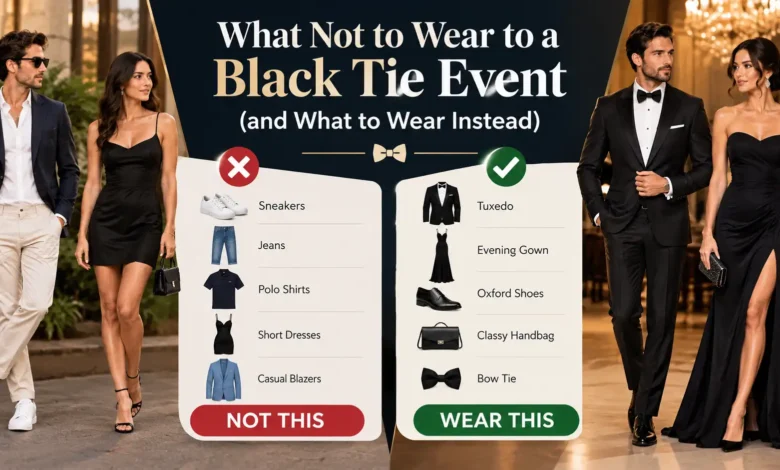
What not to wear to a black tie event comes down to one rule: skip anything that belongs to the office or the daytime. For men, the biggest mistake is a regular business suit with a long tie; black tie means a tuxedo, which the British call a dinner jacket, worn with a black bow tie. For women, it’s a casual or daytime dress. An evening gown is the classic choice, and a dressy cocktail dress works at many events, though not at every black-tie wedding.
Beyond those two, most black tie mistakes are small details: a belt, a notch lapel, a sports watch, the wrong bag. Each one has an easy fix, listed below.
- Men: skip the regular suit, long tie, belt and brown shoes. Wear a tuxedo, a black bow tie and black patent or highly polished shoes.
- Women: skip daytime dresses, casual fabrics and work bags. Wear an evening gown, a dressy cocktail dress where it’s accepted, or elegant evening trousers.
- Weddings: at a U.S. black-tie wedding, floor-length is the safe choice; at any wedding, skip white, cream and ivory.
- Black tie optional is different: like a plain “formal” invitation, it allows a dark suit and tie; black tie doesn’t.
- Quick test: if it would look right at the office or a daytime barbecue, it isn’t black tie.
What the black tie event dress code actually requires
Black tie is an evening dress code. As Wikipedia’s overview of black tie puts it, “Traditionally worn only for events after 6 p.m., black tie is less formal than white tie, but more formal than informal or business dress.” Wikipedia also cites the guidance that “Weddings before 6:00 P.M. are not usually black tie unless specified.” If an invitation does say black tie for an afternoon ceremony, follow the invitation: the hosts have chosen the code, and it applies to whatever part of the day they’ve set it for. On the full ladder of dress codes, it sits just below white tie and a step above black tie optional.
For men, the Emily Post Institute’s black tie guide lists a “Black tuxedo jacket and matching trousers,” a “Formal (piqué or pleated front) white shirt” with studs and cufflinks, a “Black bow tie (silk, satin, or twill),” a cummerbund or vest, and “Black patent shoes and black dress socks.” For women, it lists a “Formal (floor length) evening gown,” a “Dressy cocktail dress” or “Your dressiest ‘little black dress.'”
A regular suit belongs to the codes below black tie. At black tie optional, for example, Emily Post accepts a “Dark suit, white dress shirt, and conservative tie.” If the invitation simply says black tie, the business suit stays in the closet.
Men: what not to wear to a black tie event
The black tie dress code for men is mostly about details, the ones that make a tuxedo a tuxedo. Here are the common ones, and what to wear instead:
| Don’t wear | Why it’s wrong | Wear instead |
|---|---|---|
| A regular business suit, even a black one | It lacks the satin or grosgrain lapel facings and the matching stripe (braid) down each trouser leg that set a tuxedo apart | A black or midnight blue tuxedo (dinner suit) |
| A long necktie | “Traditionally, the only neckwear appropriate is the black bow tie” (Wikipedia) | A black bow tie |
| Notch lapels | A notched lapel “is usually considered more appropriate for a business suit than a dinner jacket” (Wikipedia) | Peaked lapels or a shawl collar |
| A belt | “Belts are never worn with black tie trousers” (Wikipedia) | Braces (suspenders), hidden under the waistcoat or jacket |
| A cummerbund and a waistcoat together | Either one may be worn, “but never both at the same time” (Wikipedia) | One or the other |
| Brown shoes, casual loafers or sneakers | Emily Post calls for “Black patent shoes and black dress socks” | Black patent shoes or highly polished black oxfords |
| A sports watch or smartwatch | “Traditionally visible timepieces are not worn with formal evening dress” (Wikipedia) | No watch, or a slim dress watch on a leather strap |
| A clip-on or pre-tied bow tie | Debrett’s advises: “avoid clip-on or ready-tied ties and learn how to tie your own” | A self-tie bow tie. Pre-tied versions often come with U.S. rentals, but the traditional rule everywhere is self-tied. |
| A white dinner jacket at a winter city event | Emily Post allows it “In summer, in the tropics, or on a cruise” | A black or midnight blue jacket |
| A tuxedo that doesn’t fit | Sleeves or trousers that are too long look borrowed | Get fitted or tailored before the event |
| A novelty or brightly colored tuxedo | Color and texture belong to creative black tie, not standard black tie | Classic black or midnight blue |
The suit mistake is the easiest one to make, because many people already own a good dark suit. A dark suit is the backbone of business professional attire: right for an interview or a boardroom, but built for the office, not for evening formal wear.
Destination events add one wrinkle. The white dinner jacket is the warm-weather exception, so a black-tie dinner at a beach resort is where it shines. The rest of that trip may follow the resort casual dress code, but the black-tie evening doesn’t: leave the linen suit and sandals in your room.
Women: what not to wear to a black tie event
For women deciding what to wear to a black tie event, the mistakes usually come from clothes that are pretty but belong to a different occasion. These are the ones to avoid:
| Don’t wear | Wear instead |
|---|---|
| A sundress or daytime dress | An evening gown, or a dressy cocktail dress in an evening fabric |
| Casual fabrics like cotton, jersey or denim | Silk, satin, velvet, crepe, lace or taffeta |
| A casual or very short dress | Floor-length, or a knee-length cocktail dress where the event accepts it (see below) |
| White, cream or ivory at a wedding | Black, navy or deep jewel tones |
| Daytime trousers or a work pantsuit | A jumpsuit or wide-leg evening trousers in a luxe fabric |
| Cutouts or low backs at a work event | An elegant neckline and a covered back |
| A tote, backpack or work bag | A clutch or a small evening bag |
| Flip-flops, sneakers or casual sandals | Evening heels or dressy flats |
| A smartwatch or fitness tracker | Jewelry, with your phone in your bag |
On color, The Knot’s guide for black-tie wedding guests recommends “dark colors like black and navy or deep jewel tones like emerald, aubergine or burgundy,” and fabrics such as “jacquard, brocade, velvet, lace, silk and taffeta.” For guests who’d rather not wear a dress, it suggests jumpsuits with “full-length pants” and structured tailoring. At work events, Corporette, a career site for women, sums up the rule on skin well: “avoid skin in unexpected places.”
Can you wear a short or cocktail dress to a black tie event?
Short dresses are the most debated part of the black tie dress code for women. Guides disagree, and the right answer depends on the event:
- Emily Post (U.S. etiquette) lists a “Dressy cocktail dress” and “Your dressiest ‘little black dress'” alongside the floor-length gown.
- Debrett’s (UK etiquette) says “knee length cocktail dresses are the most popular choice, though floor-length evening dresses can also be worn.”
- The Knot (U.S. weddings) is the strictest: “A black-tie wedding guest dress should always be a floor-length gown,” and it says black-tie events are “not the time” for even your fanciest mini, midi or tea-length dress.
- Corporette (work events) says “a cocktail-length dress (above the knee) can be acceptable if the dress is fancy enough.”
Put together, a practical rule emerges. At a U.S. black-tie wedding, wear floor-length. At galas, charity dinners, work events and most UK occasions, a dressy cocktail dress in an evening fabric is widely accepted: Emily Post lists one for black tie in general, Debrett’s calls knee-length the most popular UK choice, and Corporette allows one at work events. The Knot would still say floor-length, and if you’re unsure, floor-length is never wrong. A casual short dress, a sundress or a mini you’d wear to a bar isn’t acceptable at any of them.
The cocktail dress that works at black tie sits at the dressy end of its category: silk, satin, velvet or beading, with evening shoes and a clutch. For a sense of how that differs from an ordinary party look, see what the cocktail dress code allows. A short afternoon dress belongs under the semi-formal dress code for women, not at a black-tie evening.
Shoes, accessories and outerwear mistakes
- Men’s shoes: Wikipedia calls patent leather opera pumps (slip-ons with a grosgrain bow) the most traditional choice and “the black lace-up Oxford shoe, in patent leather or calfskin” the more popular one. Skip brown shoes, suede and rubber-soled loafers, and any brogueing, which “should never be seen on black tie footwear.”
- Socks: black dress socks only. White or patterned athletic socks show when you sit down.
- Pocket square: keep it simple. Wikipedia notes that pocket squares are “normally white,” so skip a square that matches your bow tie or cummerbund.
- Shirt: a formal white shirt with studs and cufflinks, not an everyday office shirt or a button-down collar.
- Jewelry: fine but restrained. One statement piece, such as earrings or a necklace, reads more polished than several competing ones.
- Bags: a clutch or small evening bag, not a tote. If you’re coming straight from work, leave the backpack or laptop bag at the coat check.
- Outerwear: a dark overcoat for men and an evening coat or wrap for women. A puffer or rain jacket is fine for the journey; just don’t wear it into the room.
- Shoes you can’t stand in: black-tie events often mean long receptions. Evening flats or block heels are better than heels you’ll take off halfway through the night.
Black tie in the UK vs the U.S.
The code is shared, but a few expectations differ across the Atlantic (Canadian usage mostly follows the U.S.):
- Names: Americans say tuxedo; the British say dinner jacket or dinner suit.
- Dress length: UK guidance is more relaxed about knee-length dresses (see above).
- Weddings: in the UK, black tie is uncommon at weddings and, when used, usually applies only to the evening reception. Wikipedia notes that it “is seldom worn at church weddings or civil ceremonies where morning dress or a lounge suit is normally favoured.”
- Evening trousers: Wikipedia adds that “In England, evening trousers with a palazzo cut are another acceptable option” for women.
No tuxedo? What to do instead
If you don’t own a tuxedo, you can rent or buy one. Renting is widely available in the U.S., UK and Canada; get measured early and try it on before the event, since sleeve and trouser length make the biggest difference. Buying makes sense if you expect more than one or two black-tie invitations, and a classic black tuxedo with peaked lapels or a shawl collar can last for many years. And if neither is possible, a quick, polite note to the host is better than guessing.
As a last resort, the closest substitute is a black or very dark navy suit with a white dress shirt, a black bow tie and black polished shoes. It isn’t true black tie, and people who know the code will notice, so treat it as a stopgap and mention it to the host. For women without a gown, a long skirt with an elegant top, or a dressy jumpsuit, works well.
Frequently Asked Questions
Can I wear a black suit to a black tie event?
Not if the invitation says black tie. A black suit lacks the satin or grosgrain lapel facings and trouser braid of a tuxedo, and paired with a long tie it reads as business wear. A dark suit and tie works at black tie optional or a plain “formal” event, not at black tie. If a tuxedo isn’t possible, see the stopgap above and tell the host.
Can women wear pants to a black tie event?
Yes, if they’re evening trousers rather than daytime ones. The Knot suggests jumpsuits with “full-length pants” in luxe fabrics, or a women’s tuxedo, and in England, wide palazzo-cut evening trousers are an accepted option. A work pantsuit or everyday trousers, even with a dressy top, look out of place.
Do you have to wear black to a black tie event?
No. “Black tie” names the men’s bow tie, not a color rule for guests. The Knot says your dress at a black-tie wedding “doesn’t have to be black,” and Wikipedia notes that cocktail dresses at black tie “need not be black.” Black, navy and deep jewel tones are all safe; if you go brighter, let an evening fabric do the work.
Can I wear a colored or velvet tuxedo?
At standard black tie, stick to black or midnight blue. Wikipedia describes the dinner suit as “a black, midnight blue, or white” suit, with white usually kept for warm climates. Colored, patterned or velvet jackets and bold bow ties are safest at creative black tie, which Emily Post says allows “textures, colors, and accessories to personalize your look.”
Is black tie the same as formal?
Not quite. On many U.S. invitations, “formal” sits just below black tie optional: a tuxedo is welcome but not expected, and a dark suit and tie is standard. Black tie is stricter and expects a tuxedo. If a formal event starts in the evening and you’re unsure, a tuxedo is never wrong.
Can I wear national or religious dress to a black tie event?
Often, yes. Wikipedia notes that alternatives such as “mess dress uniform, religious clothing (such as cassock), folk costumes (such as highland dress)” may be accepted for black tie. Choose the most formal evening version of that attire, and if you’re unsure, a quick note to the host settles it.
Can I wear a watch with a tuxedo?
Traditionally, no. Wikipedia notes that “visible timepieces are not worn with formal evening dress.” Many modern guides, including tuxedo rental companies, now accept a slim dress watch on a leather strap. What stands out for the wrong reasons is a chunky sports watch or a smartwatch, so leave those at home for the evening.
The short version
The simplest rule for what not to wear to a black tie event: leave office and daytime clothes at home. Men should skip the regular suit, long tie, belt, brown shoes and sports watch, and wear a black or midnight blue tuxedo with a black bow tie and black patent or polished shoes. Women should skip daytime dresses, casual fabrics and work bags, and wear an evening gown, evening trousers, or a dressy cocktail dress where the event accepts it. At a U.S. black-tie wedding, choose floor-length, and at any wedding avoid white, cream and ivory. And if it would look right at the office or a daytime barbecue, it isn’t black tie.

One Comment