
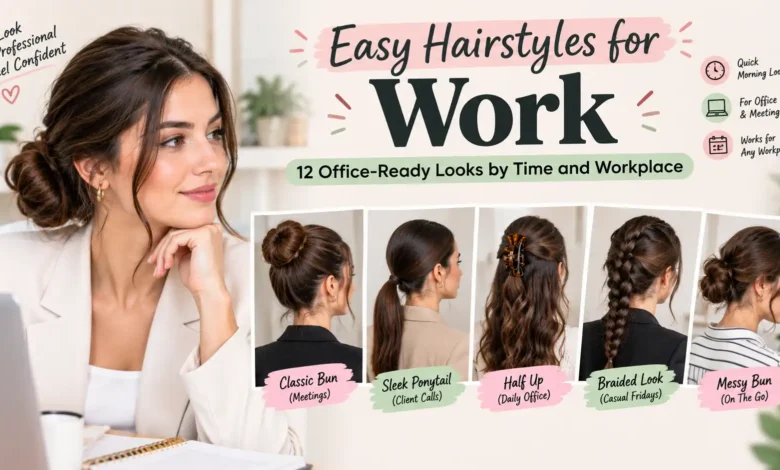
The best easy hairstyles for work are a sleek low ponytail, a claw clip twist, a low chignon and a half-up style with a barrette. Each one takes a few minutes, keeps hair off your face and holds its shape until the end of the day. What changes from job to job is how polished you need to look and if your workplace has hair rules.
This guide sorts 12 easy hairstyles for work by the time you have in the morning: two, five or ten minutes. Each style has numbered steps, a note on why it stays neat, and the hair it suits best, from pixie cuts to long, coily hair. If you’re new to styling your own hair, start with the basic moves in our guide to easy hairstyles to do yourself.
- Short on time: a sleek low ponytail or claw clip twist takes about two minutes.
- Client meetings: a low chignon or French twist looks the most polished.
- All-day hold: add texture at the base and anchor pins in an X.
- Hair rules: food, healthcare and machinery jobs may require hair tied back or covered.
Easy hairstyles for work, matched to your workplace
There’s no single “professional” hairstyle. Natural textures, braids and twists are just as work-appropriate as a sleek bun. What matters most is that your hair looks intentional and stays out of your way. Use this table to match hairstyles for work to where you work.
| Workplace | What looks right | Styles to try |
|---|---|---|
| Corporate or client-facing | Smooth and off the face | Low chignon, French twist, sleek low ponytail, flat twists into a low bun |
| Business casual | Neat but relaxed; texture is fine | Half-up with a barrette, knotted low ponytail, claw clip twist |
| Creative | More room for texture and accessories | Low braided ponytail, braided low bun, flat twists into a low bun |
| Remote, on video calls | Clear part, hair off the face | Half-up with a barrette, tucked bob, low puff |
| Jobs with hair rules | Tied back or covered, per employer rules | Braided low bun, low chignon, flat twists into a low bun |
Not sure what your office’s dress code expects? Our guide to business casual vs business professional explains the difference, and your hair can follow the same level of polish as your clothes.
Two-minute styles
These four need no skill and no heat. They’re the ones to reach for on rushed mornings. A plain headband or scarf over a low ponytail is another two-minute option.
Sleek low ponytail with a wrapped base
- Brush your hair back toward the nape of your neck.
- Secure it with an elastic, snug but not tight.
- Take a small section from underneath the ponytail and wrap it around the elastic.
- Push a bobby pin up through the wrap into the base of the ponytail.
Stays neat because: the ponytail sits low, so it doesn’t bump against a chair back, and the wrap hides the elastic.
Works best on: straight, wavy and curly hair, shoulder length and longer. If fine hair slips, mist a little texture spray or dry shampoo at the nape first. For a sleek high ponytail, follow the same steps at the crown.
Claw clip twist
- Gather your hair at the nape as if for a low ponytail.
- Twist the length in one direction until it starts to coil.
- Fold the twist up against the back of your head.
- Hold the open clip with its teeth facing your head and close it over the twist.
Stays neat because: the clip grips both the twist and the hair underneath, so it doesn’t slide down as you move.
Works best on: shoulder-length and longer hair. Thick hair needs a larger clip. For half-up and French twist versions, see our claw clip hairstyles step by step.
Half-up with a barrette
- Take a section from each temple and bring them to the back of your head.
- Hold them together just above the crown.
- Slide a barrette or small clip across the join.
- Smooth the top layer with your palms.
Stays neat because: the front pieces, which usually fall into your face, are held back while the rest stays down.
Works best on: most lengths past the chin, including curly hair. No barrette? Twist the two sections together once and pin the twist with two crossed bobby pins.
Tucked bob
- Make a side part.
- Tuck the thinner side behind your ear.
- Slide two bobby pins in behind the ear, crossed in an X.
- Smooth the other side so it frames your face.
Stays neat because: crossed pins hold short hair better than a single pin, and one tucked side keeps the look tidy.
Works best on: bobs, lobs and other chin-length cuts.
Five-minute styles: cute hairstyles for work that still look polished
With a few more minutes, you can try styles that look more finished. These cute hairstyles for work suit most offices.
Low chignon
- Make a low ponytail at the nape.
- Twist the ponytail until it starts to coil on its own.
- Wrap it around the elastic into a bun.
- Pin around the edge, pins pointing toward the center.
- Smooth any flyaways with a little cream or water on your palms.
Stays neat because: pinning around the whole edge spreads the weight, so the bun doesn’t droop.
Works best on: shoulder-length and longer hair of any texture.
Knotted low ponytail
- Split your hair into two equal sections at the nape.
- Tie the two sections in a simple knot, like the first step of tying shoelaces.
- Hold the knot in place and secure the ends together with an elastic just below it.
- Loosen the knot slightly with your fingertips.
Stays neat because: the knot itself holds the ponytail in place, and the elastic keeps it from loosening.
Works best on: long hair. Shoulder-length hair may be too short to knot.
Low braided ponytail
- Make a low ponytail at the nape.
- Split the ponytail into three sections and braid to the ends.
- Tie the end with a small elastic.
- Wrap a small piece of hair around the top elastic and pin it underneath.
Stays neat because: the braid keeps the lengths together, so they don’t frizz or tangle by the afternoon.
Works best on: shoulder-length and longer hair, from straight to curly.
Pinned-back side part
- Make a deep side part with the tail of a comb.
- On the heavier side, take a section from the front and twist it back, away from your face.
- Pin the twist behind your ear with two pins crossed in an X.
- Leave the rest of your hair down.
Stays neat because: the heavy side is the one that falls forward, and the twist holds it back.
Works best on: short and medium hair, including pixie cuts long enough to twist.
Ten-minute styles for meetings and long days
These take a little more time, but they look the most finished and hold the longest.
French twist with pins
- Brush your hair back and gather it at the nape, without an elastic.
- Twist the length upward against the back of your head.
- Tuck the ends into the fold of the twist.
- Push bobby pins along the seam of the twist, catching hair from the twist and from underneath.
- Add more pins at the top and bottom, where the twist is most likely to loosen.
Stays neat because: the pins along the seam hold the twist flat against your head, so little hangs loose.
Works best on: medium to long hair. Very slippery hair holds better with a little texture spray first.
Braided low bun
- Make a low ponytail at the nape.
- Braid the ponytail to the ends and tie it.
- Coil the braid around the base of the ponytail.
- Tuck the end underneath and pin around the edge.
Stays neat because: a braided bun is firmer than a twisted one, so it keeps its shape through a long day.
Works best on: long hair of any texture. If your uniform policy says hair must be off the collar, place the bun a little higher on the back of your head so it sits above your collar.
Flat twists into a low bun
- Part the front of your hair into two to four sections, from the hairline back.
- At the front of one section, split off a small piece into two strands.
- Twist the two strands over each other, adding a little hair to one strand each time, so the twist lies flat along your scalp.
- Continue to the crown or nape, then repeat on the other sections.
- Gather the ends with the rest of your hair into a low bun and pin it.
Stays neat because: the flat twists hold their shape longer than loose hair, so the front can stay neat for a few days while you redo only the bun.
Works best on: coily and tightly curled hair. Twist firmly but without pulling at the hairline. This one takes the most practice on the list, so try it on a weekend first; uneven sections are normal at the start.
Low puff
- Gently smooth your hair back with your fingers or a wide-tooth comb.
- Gather it at the nape.
- Secure it loosely with a wide, covered elastic, a stretchy headband or a scarf.
- Fluff the puff with your fingers and smooth the edges with your palms.
Stays neat because: a low, loose puff keeps your hair together without needing pins.
Works best on: coily hair. Keep the band loose; the puff should never pull at your edges. It sits with the ten-minute styles because gentle smoothing with your fingers takes longer than brushing.
Work hairstyles for short, medium and long hair
Your hair length matters more than your job title when you choose a style. Here’s where to start.
| Hair length | Easiest options | Tip |
|---|---|---|
| Short (pixie to chin) | Tucked bob, pinned-back side part, half-up with a barrette | Small clips and crossed pins grip short hair better than elastics |
| Medium (shoulder length) | Claw clip twist, low chignon, half-up with a barrette | Pin the shorter layers that fall out |
| Long | Braided low bun, French twist, low braided ponytail, knotted low ponytail | Braids and pins take the weight better than one tight elastic |
| Coily or tightly curled, any length | Flat twists into a low bun, low puff, claw clip twist | Keep bands loose and smooth with fingers, not a brush |
Among work hairstyles for long hair, braids are one of the most reliable choices. They hold the length together, so nothing tangles or falls forward while you work.
How to make work hairstyles last all day
A style that looks good at 8 a.m. but falls apart by lunch isn’t much use. These habits help any of the styles above last until the end of the day:
- Add grip first. Freshly washed hair is slippery. A little dry shampoo or texture spray at the base helps elastics and pins hold.
- Settle the elastic. After tying a ponytail, split it in two and pull the halves apart to push the elastic up snugly.
- Pin in an X. Where a bun or twist feels loose, add a second pin crossing the first.
- Pin toward the center. On buns, pins pointing inward hold better than pins pointing out.
- Smooth, don’t spray heavily. A little cream or water on your palms tames flyaways without making hair stiff.
Keep a small kit at your desk: a spare elastic, a few bobby pins, a small claw clip and a mini comb. On days when your roots look oily, our hairstyles for greasy hair turn the problem into a sleek, deliberate look.
Hairstyles for work on video calls
On camera, people mostly see your face and the top of your head. A few small things make a difference:
- Keep hair away from your eyes. Stray pieces across your face can stand out more on screen than in person.
- Smooth the part and hairline. They’re the most visible parts of your hair on a webcam.
- Choose a style that frames your face. A half-up style, tucked bob or low ponytail all work well.
- Check the preview. Look at your camera preview before joining, especially the top of your head.
Jobs with hair rules: food service, healthcare and machinery
In some jobs, how you wear your hair is a safety rule, not a style choice. Your employer’s policy is the one that applies, but here’s the background.
Food service: the FDA Food Code is a model code that state and local food regulators adopt. Its rule says food employees must wear hair restraints, such as hats, hair coverings or nets, to keep hair from touching exposed food and clean equipment. State versions can exempt some roles, such as staff serving only drinks or packaged food. A braided low bun or low chignon fits neatly under a cap or net.
Machinery: in its guide to safeguarding equipment, OSHA advises that “long hair should be worn under a cap or otherwise contained to prevent entanglement in moving machinery.” That’s safety guidance, and your workplace may set specific rules.
Healthcare: rules are set by each employer. In the UK, for example, one NHS trust’s uniform policy says long hair “should be tied up and secured” when handling food or during clinical work. In the U.S. and Canada, hospitals and clinics also set their own uniform rules, so if you’re a nurse or care worker, your facility’s policy is the one to follow.
Natural hair and protective styles at work
Braids, locs, twists, puffs and Afros are professional hairstyles, and several of the styles above are designed for coily and tightly curled hair. In the U.S., some states also protect these styles by law.
California was the first state to pass the CROWN Act, which the CROWN Coalition describes as prohibiting “discrimination based on natural hair texture and protective hairstyles.” According to the CROWN Coalition, “As of March 2026, twenty-four states have enacted CROWN Act legislation.”
Counts vary by source: the Economic Policy Institute counted 30 states with some version of the law in August 2026. A federal CROWN Act was introduced in Congress in 2025 but hasn’t passed.
This isn’t legal advice. Protections depend on where you live and work, so check your state’s law, talk to HR, or ask an employment lawyer about your situation. Outside the U.S., your country’s equality or human rights body is the place to start.
Keep all-day styles comfortable
A work style stays in for eight hours or more, so comfort matters. The American Academy of Dermatology (AAD) notes in its advice on hairstyles that pull: “Every once in a while, it’s okay to wear your hair tightly pulled back, but you want to avoid doing so often.” It also gives a simple test: “If your hairstyle feels painful, the style is too tight.”
Keep elastics snug, not tight, and change the position of your ponytail or bun from day to day. Take your hair down when you get home.
Frequently Asked Questions
What hairstyles are considered professional for work?
Any style that looks neat and intentional and keeps hair out of your face. A low chignon, French twist, sleek low ponytail, half-up style, braids, flat twists and a low puff are all work-appropriate. Natural textures are professional as they are. If your job has safety or uniform rules, follow your employer’s policy.
What is the easiest hairstyle for work?
A sleek low ponytail is the easiest. It takes one elastic and about two minutes, and it works from shoulder length down. A claw clip twist is just as quick and doesn’t need an elastic. For short hair, a tucked bob with two crossed bobby pins is the fastest option.
How do I make my hairstyle last all day at work?
Start with some grip: a little dry shampoo or texture spray at the base helps on freshly washed hair. After tying a ponytail, split it and pull the halves apart to settle the elastic. Pin buns around the edge with pins pointing inward, and cross two pins in an X wherever the style feels loose.
Are claw clips professional for work?
Yes, in most offices. A plain claw clip in a neutral color, holding a neat twist, looks polished. Choose a size that closes fully over your hair so it doesn’t slip, and skip very large or brightly colored clips for client meetings. In jobs with hair rules, check your employer’s policy.
Is it unprofessional to wear your hair down at work?
No. Hair worn down is fine in most workplaces if it looks tidy and doesn’t fall into your face while you work. A half-up style or a tucked side keeps the front out of the way. Jobs with food, healthcare or machinery rules may require hair tied back or covered.
Can my employer tell me to change my natural hair?
It depends on where you live. As of March 2026, the CROWN Coalition reported that 24 U.S. states had enacted CROWN Act laws, which generally prohibit discrimination based on natural hair texture and protective styles at work and often in schools. Safety rules, like hair restraints in food service, can still apply. For your situation, check your state’s law or ask an employment lawyer.
The short version
The best easy hairstyles for work are the ones that match your morning and your workplace. With two minutes, reach for a sleek low ponytail, claw clip twist, half-up with a barrette or tucked bob. With five, try a low chignon or knotted ponytail. With ten, a French twist, braided bun or flat twists hold all day.
Add a little grip before you style, pin in an X, and keep elastics snug, not tight. If your job has hair rules, your employer’s policy comes first. Getting ready for a big day? Our guide to interview hairstyles covers the styles that make a calm, polished first impression.

One Comment