Interview Hairstyles: 8 Polished Looks for Any Industry, In Person or on Video

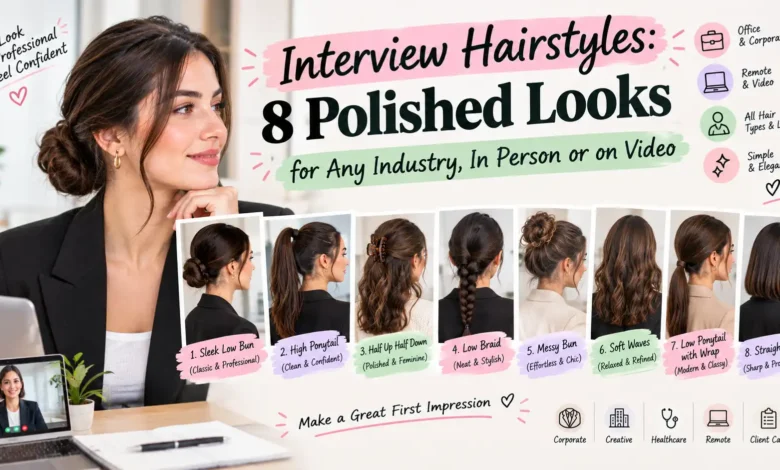
The best interview hairstyles are neat, off your face and familiar to you. That might be smooth hair worn down, a sleek low ponytail or updo, or your natural texture, defined and tidy. Match the style to the company’s dress code, and pick one you’ve worn before, so you’re not fixing it in the middle of an answer.
This guide covers job interview hairstyles for every industry: when to wear your hair up or down, eight polished styles with numbered steps, natural and textured hair, short, fine and gray hair, video interviews, and a simple prep plan for the night before. For everyday styles once you’ve landed the job, see our guide to easy hairstyles to do yourself.
- Goal: neat and off your face, so the interviewer notices you, not your hair.
- Up or down: down if it stays put on its own; up if you tend to touch it.
- Natural hair: professional as it is. Defined and tidy is the only standard.
- Timing: no new cut, color or style in the last week. Do a trial run first.
Interview hairstyles at a glance
| Style | Up or down | Good for | Hair type | Time (approx.) |
|---|---|---|---|---|
| Smooth blowout | Down | Any industry | Straight, wavy, loose curls | 25–40 min |
| Sleek straight with a deep side part | Down | Corporate, conservative | Straight to wavy | 15–30 min |
| Soft brushed-out waves | Down | Corporate, creative | Straight to wavy | 20–30 min |
| Low side ponytail | Up | Any industry, video | Any, shoulder length and longer | 5 min, no heat |
| Inside-out low ponytail | Up | Any industry | Any, shoulder length and longer | 5 min, no heat |
| Tuck-and-roll low updo | Up | Conservative, formal | Any, shoulder length and longer | 10 min, no heat |
| Defined twist-out or braid-out | Down or gathered | Any industry | Coily, curly | Set the night before |
| Defined wash-and-go | Down or gathered | Any industry | Curly, coily | Up to an hour or more to dry |
Up or down? How to choose for your interview
There’s no rule that says interview hair must be up. What matters is that it stays neat and out of your eyes the whole time. Northwestern University’s Career Advancement office puts the basics simply: “Make sure your hair is clean and well groomed.” Western Michigan University’s career center lists hair as “clean, groomed and out of eyes.”
Use these questions to decide:
- Does your hair stay off your face on its own? Then wearing it down is fine.
- Do you touch your hair when you’re nervous? Wear it up, so there’s nothing to fiddle with.
- Is it humid, windy or raining? A low updo or ponytail survives the trip better than a blowout.
- How formal is the dress code? Match your hair to your outfit. A suit pairs well with a sleek style; business casual leaves more room. Our guide to types of dress codes explains each level.
Match your hair to the industry
Look at the company’s website, team photos or LinkedIn to see how people present themselves, then aim for the tidy end of that range. “Sleek” here means neat and controlled. A defined twist-out or a smooth natural style is just as polished as straightened hair.
| Setting | What reads as polished | Good choices |
|---|---|---|
| Conservative: law, finance, government | Neat, controlled, nothing in your face | Tuck-and-roll updo, low ponytail, smooth blowout, defined natural styles |
| Corporate or business casual | Polished but relaxed | Any style in this guide, including soft waves |
| Creative, tech, startups | Personal style is welcome | Waves, twist-outs, your usual color and cut, kept tidy |
| Food service, labs, healthcare, trades | Fully secured hair | A low updo or ponytail that could go under a cap or net |
Polished styles to wear down
Hair worn down looks relaxed and confident, as long as it’s smooth enough not to need touching. These three take the most time, so leave room for them in your morning, or do a trial run the day before.
Smooth blowout
- Let your hair partially dry first. The AAD’s advice on styling without damage is: “Allow your hair to partially air dry before you style or comb.”
- Smooth a heat protectant and a little smoothing cream through the lengths.
- Divide your hair into sections. Dry each one with a round brush from the roots to the ends, pointing the dryer nozzle down the hair.
- Finish each section with the cool-shot button, then brush through.
Why it works: airflow pointed down the hair lays it flat and smooth, and the cool shot helps set the shape.
Works best on: straight, wavy and loosely curly hair, chin length and longer.
If it frizzes: on a humid day, skip the full blowout and wear a low updo instead. For everyday hair health, the AAD adds: “Decreasing the number of times per week that you blow dry also helps limit damage.” Save full blowouts for days that count.
Sleek straight with a deep side part
- Start with completely dry hair.
- With the tail of a comb, make a deep side part, roughly in line with the arch of one eyebrow.
- Take small sections and run a flat iron through each one once, on low or medium heat, with a comb just ahead of the iron.
- Tuck the lighter side behind your ear, and smooth flyaways with a drop of cream on your palms.
Why it works: a deep part gives straight hair shape and softness, so it looks styled rather than flat.
Works best on: straight to wavy hair, bob length and longer.
A note on heat: the AAD’s guidance is: “Flat irons should be used on dry hair on a low or medium heat setting, no more often than every other day.” That’s about how often you straighten as a habit. One pass per section on interview day follows the same idea.
Soft brushed-out waves
- Start with dry hair, and divide it into sections 1 to 2 inches wide.
- On medium heat, wrap each section around a large-barrel curling iron or wand, turning it away from your face.
- Release it, and let each curl cool in your hand or on your shoulder.
- When all the curls are cool, brush them out gently with a paddle brush or your fingers into soft waves.
Why it works: brushing out the curls turns them into loose, polished waves that look finished without looking “done.”
Works best on: straight to wavy hair, shoulder length and longer.
A note on heat: the AAD advises: “If you use a curling iron, only leave it in place for a second or two.” That caution is about limiting contact time: the shorter you can hold each section and still get a wave, the better. Use a heat protectant and medium heat rather than high, don’t re-wrap a section that has already curled, and let the curls cool fully before brushing.
Sleek ponytails and updos for job interview hairstyles
These three take less time than the down styles, and they don’t move all day. Each builds on a basic low ponytail. For more office styles, including a half-up style with a barrette, a low chignon, a French twist or a braided low bun, see our guide to easy hairstyles for work.
Low side ponytail
- Make a deep side part.
- Brush your hair toward the side opposite the part, and gather it just below and behind your ear.
- Tie it with an elastic that matches your hair, snug, not tight.
- Wrap a thin strand from the ponytail around the elastic and pin the end underneath. Bring the ponytail forward over your shoulder.
Why it works: it keeps your face clear but looks softer than a center ponytail, and it shows well on camera.
Works best on: any texture, shoulder length and longer.
If it slides: tie it slightly further back, behind the ear rather than below it, so it has more hair to grip.
Inside-out low ponytail
- Tie a low ponytail at the nape, a little loose.
- Use your fingers to open a small gap in the hair just above the elastic.
- Flip the ponytail up and push it through the gap from top to bottom.
- Split the ponytail into two halves and pull them apart gently to tighten it.
Why it works: the twisted sides hide the elastic, so a basic ponytail looks finished in under five minutes.
Works best on: any texture, shoulder length and longer.
If the elastic shows: tie the ponytail looser before you flip it. A tight elastic has no room to turn.
Tuck-and-roll low updo
- Start with the inside-out low ponytail above, tied fairly low and loose.
- Roll the length of the ponytail up toward the gap above the elastic.
- Tuck the rolled hair into the gap, forming a neat roll at the nape.
- Pin along the roll with bobby pins, wavy side against your scalp, crossing them in an X where it needs extra hold.
Why it works: all the length is tucked away, so nothing can fall in your face, and the roll looks tailored.
Works best on: shoulder-length to long hair.
If layers fall out: tie the ponytail lower so shorter pieces reach it, and pin any stray ends into the roll. Use an elastic that matches your hair.
Natural and textured hair for interviews
Natural hair is professional as it is. Indeed’s interview-hair guide says: “It’s important to be authentic in an interview, and that includes your professional appearance.” The standard is the same for every texture: defined, tidy and comfortable.
Defined twist-out or braid-out
- On clean, damp hair, apply a leave-in conditioner and a styling cream or butter.
- Make two-strand twists or braids all over. Bigger sections give a looser pattern; smaller ones give tighter definition.
- Let them dry completely. Thick hair may need more than one night, so use a hooded dryer or set them two nights before if you’re not sure.
- In the morning, coat your fingers with a little oil, unravel each twist gently, and separate. Lift the roots with a pick, leaving the ends alone.
Why it works: setting the pattern ahead of time gives neat, even definition, and the style holds all day.
Works best on: coily and curly hair.
If it frizzes: the twists usually weren’t fully dry. Do a trial run beforehand so you know your own drying time.
Defined wash-and-go
- On soaking-wet hair, apply a leave-in conditioner, then a gel, section by section.
- Rake the product through, or smooth it down each curl, so the curls group together.
- Diffuse on low heat, or let it air dry. Don’t touch it until the gel has dried into a firm cast.
- Once it’s fully dry, scrunch out the stiffness with a drop of oil on your palms.
Why it works: the gel holds each curl group, so the definition lasts through a long day.
Works best on: curly and coily hair.
Plan for the time: fully drying a wash-and-go can take an hour or longer, even with a diffuser. Practice it before the interview, and don’t try it for the first time that morning.
Braids, locs and twists are polished as they are. Wear them down, or gather them into a low ponytail or bun. Keep edges neat without pulling them tight. For healthcare or food-service roles, where employers often want hair off the collar and away from the face, a low bun usually covers it.
A silk press is a salon option if you want it. Book it a few days ahead rather than the day before, and bring an umbrella, because moisture from rain or sweat can make it revert.
Head coverings. If you wear a hijab, turban, headwrap or other covering for religious reasons, it’s part of your professional look as it is. Make sure it’s comfortable and secure, the same as any interview outfit.
Bias against natural hair does exist in some workplaces, and that’s a problem with the bias, not with your hair.
In a study first published online in 2020 in Social Psychological and Personality Science, researchers Christy Zhou Koval and Ashleigh Shelby Rosette found that evaluators rated Black women with natural hairstyles as less professional and less competent, and recommended them for interviews less often, compared with Black women with straightened hair and White women with curly or straight hair.
Some U.S. states now ban hair discrimination under CROWN Act laws. Our guide to easy hairstyles for work, linked above, has a section on CROWN Act laws. Protections vary by state, and this isn’t legal advice.
Interview hairstyles for short, fine or gray hair
Short hair: a pixie needs only a smooth or lightly textured finish, with the fringe swept off your eyes. For a bob, tuck one side behind your ear or wear a smooth blowout. If you’re growing it out, two small clips hold the in-between pieces back neatly. Our guide to easy hairstyles for short hair has more options by length.
Fine or thin hair: sleek styles can look flat by the afternoon, so add a little lift at the roots and avoid heavy products. Our guide to hairstyles for thin hair covers volume tricks that hold.
Gray hair: it doesn’t need color for an interview. A fresh trim, a neat shape and a little shine are enough.
Bangs: keep them trimmed above your eyes, or pin them to the side, so you’re not brushing them away while you talk. On a humid day, a little light-hold cream helps curtain bangs stay in place.
Video interview hair
On video, the camera frames your face and shoulders, so your part, your hairline and anything near your face are what the interviewer sees most. Indeed’s video interview tips advise: “Wear clean clothes and style your hair as you would for an in-person interview…” Elsewhere in the same guide, they note: “Ensure you have adequate lighting (preferably natural) and that nothing behind you is distracting.”
- Do a test call the day before, in the same spot and at the same time of day.
- Wearing a hijab or other head covering? Do your test call in the covering and color you plan to wear, and check how it looks in your light.
- Face the light. A window behind you turns flyaways into a bright halo, and one in front of you softens them.
- Check your part and face-framing pieces on screen. Smooth them with a drop of cream or a little hairspray on a clean toothbrush.
- Choose a style that won’t need touching. A low side ponytail over one shoulder works well on camera.
- Short or chin-length hair: tuck one side behind your ear, so it doesn’t fall forward into the frame when you lean toward the screen.
Your interview hair prep plan
Interview tomorrow and no time to practice? Wear the style you already know best. For most people, that’s a low ponytail, which takes about five minutes. Tonight is not the time to try something new.
- 1–2 weeks before: get a trim if you need one. Then skip any new cut or color in the final week, so there are no surprises.
- A few days before: do a full trial run of your chosen style, and time it.
- The night before: wash if your style needs it, set twists or braids, and lay out your pins and elastics.
- The morning of: give yourself extra time, and check the finished style in daylight, including the back.
- In your bag: two elastics, a few bobby pins, a small comb, a travel-size smoothing cream, and an umbrella if rain is possible. For a panel or a long day of interviews, a little dry shampoo can refresh flat or shiny roots between rounds.
Simple accessories are fine: a plain headband, a small barrette or a matching claw clip. Keep them in quiet colors for conservative settings.
What to avoid
- A style you’ve never tried. Interview morning is not the time to learn it.
- Hair in your eyes. If you’ll be tucking it back all interview, choose another style.
- Anything you’ll fiddle with, like a loose claw clip or a headband that slips.
- A messy, “undone” bun or a high top knot for a conservative role. Save it for creative settings, and even then keep it tidy.
- Strong-scented products. You may be in a small room with the interviewer.
- Fresh bold color right before the interview. If bright color is part of who you are, that’s a personal call. Just don’t try it for the first time that week.
Frequently Asked Questions
What is the best hairstyle for a job interview?
A neat style you’ve worn before that keeps hair off your face. For most people, that’s a low ponytail, a sleek low updo, a smooth blowout, or a defined natural style like a twist-out. Match it to the dress code: sleeker for conservative industries like law and finance, more relaxed for creative and tech roles.
Should I wear my hair up or down for an interview?
Either works if it stays neat. Wear it down if it stays off your face on its own and holds its shape. Wear it up if you tend to touch your hair when nervous, if the weather is humid or rainy, or if the dress code is very formal. The goal is hair you won’t think about once the interview starts.
Is a ponytail professional for an interview?
Yes. A low ponytail is one of the most common interview hairstyles because it’s neat and keeps hair out of your face. Tie it at the nape or to the side, smooth the top, and wrap a strand around the elastic so it looks finished. An inside-out ponytail is a quick way to make it look more polished.
Can I wear my natural hair to an interview?
Yes. Natural hair is professional as it is, and the standard is the same for any texture: defined, tidy and comfortable. A twist-out, braid-out, wash-and-go, braids, locs or twists all work. Some U.S. states have CROWN Act laws that ban hair discrimination, and protections vary by state.
Is curly hair unprofessional for an interview?
No. Curly hair is professional. Aim for defined, even curls rather than frizz, which a leave-in and gel, or a style set the night before, usually handles. If the day is humid or you’re worried about frizz, gather your curls into a low ponytail or bun. Do a trial run first so you know how your curls behave.
Does hair color matter for a job interview?
Your natural or usual color is fine, and gray hair doesn’t need coloring. Bright or unusual colors depend on the industry: creative and tech workplaces are usually more relaxed than conservative ones. If you keep a bold color for a conservative interview, a sleek, controlled style keeps the overall look polished. Either way, avoid a brand-new color in the final week.
What should I do with my hair for a video interview?
Style it the same way you would for an in-person interview, then check it on camera the day before. Face a window or light rather than sitting with it behind you, which makes flyaways stand out. Keep your part and the pieces around your face smooth, and choose a style you won’t need to touch.
The short version
The best hairstyles for interviews are neat, off your face and tried in advance. Wear your hair down if it stays in place, or choose a low side ponytail, an inside-out ponytail or a tuck-and-roll updo if you tend to touch it. Natural hair is professional as it is: a defined twist-out, a wash-and-go, braids or locs all work.
Match the style to the dress code, do a trial run, skip new cuts or colors in the last week, and pack a few pins and an elastic. On video, face the light and check your part on screen.