

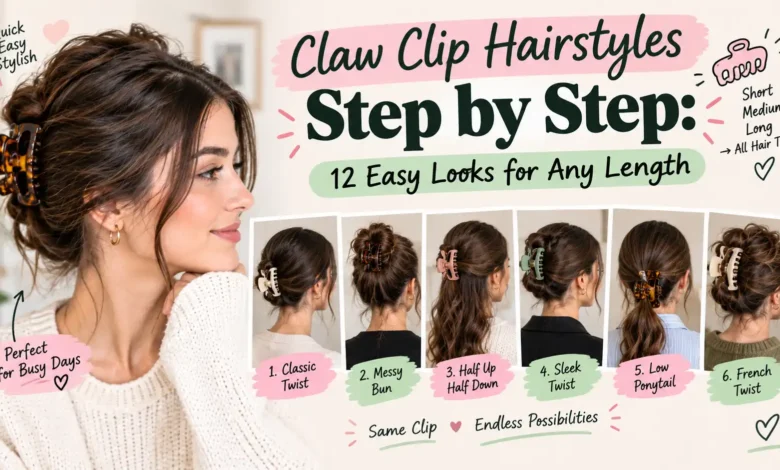
Claw clip hairstyles step by step come down to one move done a few different ways: gather your hair, twist or fold it, and close the clip over it with the teeth facing your head. Once you know that grip and the right clip size for your hair, you can do a French twist, a messy bun, a half-up coil or space buns in a minute or two.
This guide covers 12 easy claw clip hairstyles with numbered steps, grouped into everyday looks, buns and updos, thick or long hair, and short hair. You’ll also find a size guide and fixes for a clip that keeps slipping. For more no-heat styles to rotate with these, see our guide to easy hairstyles to do yourself.
- The grip: teeth face your head, and the clip closes over the twist plus some hair underneath.
- The size: small clips for short or fine hair, larger clips for long or thick hair.
- The fix for slipping: a bigger clip, a tighter twist, or a second clip.
- Comfort: keep it snug, not tight, and take it out before you lie back or drive.
How to use a claw clip: the basic grip
Every style below builds on this grip. Get it right and most slipping problems disappear.
- Start with dry hair. Wet hair is heavier, harder for a clip to grip, and more fragile under a clamp.
- Gather and twist or fold your hair where you want the clip to sit.
- Open the clip by squeezing its two ends together, then turn it so the teeth face your head.
- Place it across the twist so the teeth close over as much of it as possible.
- Close the clip so it grabs the twist and a little of the flat hair underneath.
That last step is what keeps a clip in place. If it only holds the twist, it slides down. Which way to turn the clip depends on the style: across a coiled bun or a fold, it usually sits horizontally, and along an upright twist it sits vertically. On thick or heavy hair, turning the clip vertically usually holds better, since it closes over more of the twist’s length.
On curly or coily hair, the section under the clip will flatten a little, so keep the twist loose rather than smoothed flat, and scrunch that section back into shape once the clip is out.
Which claw clip size do you need?
Clip size matters more than most people expect. Teleties sums it up: “The right claw clip size depends on your hair length and texture.” Here’s a rough guide based on one brand’s claw clip size guide. Sizes and names vary between brands, so treat the widths as approximate.
| Size | Approx. width | Best for |
|---|---|---|
| Mini | 1 to 1.5 in | Bangs, accents, half-up on short to medium hair |
| Small | 1.5 to 2.5 in | Full updos on short or fine hair |
| Medium | 2.5 to 3.5 in | Most shoulder-length and average-thickness hair |
| Large | 3.5 to 4.5 in | Long or thick hair, heavy updos |
| Jumbo | 4.5 in and up | Very thick or very long hair |
The same guide suggests going one size smaller than your length suggests if your hair is fine, and one size larger if it’s thick. If you’re between sizes, a clip that’s slightly too big usually holds better than one that’s too small.
Everyday claw clip hairstyles step by step
These four cute claw clip hairstyles take a minute or two and work on most hair from shoulder length down.
Vertical French twist
- Brush your hair back and gather it at the nape, without an elastic.
- Twist the length upward, so the twist runs vertically up the back of your head.
- Tuck the ends down into the fold of the twist.
- Hold the clip vertically, teeth facing your head, and close it along the twist.
Works best on: shoulder-length and longer hair; a medium or large clip.
If it slips: twist tighter at the nape, and make sure the clip’s bottom teeth catch the hair underneath.
Half-up coil
- Take the top section of your hair, from temple to temple.
- Twist it two or three times until it starts to coil.
- Wind the twist into a small, flat coil at the back of your head.
- Close a small or medium clip horizontally over the coil.
Works best on: medium and long hair. It keeps the front off your face while the rest stays down.
If it slips: use a smaller clip, so it closes fully over the coil.
Claw clip ponytail
- Brush your hair up into a ponytail at the crown and secure it with a covered elastic.
- Flip the base of the ponytail up and forward, just above the elastic.
- Turn a large clip so the teeth point down toward your scalp, and close it over the flipped base.
- Let the length fall forward over the clip like a fountain.
Works best on: long, thick hair that’s heavy for an elastic.
If it slips: gather the hair a little lower. The higher the ponytail sits, the more its length can lever the clip loose.
Space buns with small clips
- Part your hair down the middle, front to back.
- On one side, gather the top half of the hair and twist it into a small coil.
- Close a small clip over the coil.
- Repeat on the other side, and check in a mirror that the buns are level.
Works best on: shoulder-length hair and longer bobs; two small clips.
If it slips: make the coils tighter and a little smaller, so each clip closes easily.
Buns and updos: hairstyles with claw clips
These hairstyles with claw clips give you a bun or updo with no elastic and no pins.
Messy bun
- Flip your head forward and gather your hair loosely at the crown.
- Twist it loosely and wrap it around itself into a bun.
- Close a medium or large clip horizontally over the bun.
- Pull out a few pieces around your face and at the nape.
Works best on: medium and long hair, especially second-day hair. It’s the fastest fix for second-day hair.
If it slips: spray a little dry shampoo or texture spray at the roots first for grip.
Low chignon
- Gather your hair at the nape.
- Twist it until it coils.
- Wrap the coil into a low, flat bun close to your neck.
- Close the clip horizontally across the bun.
Works best on: shoulder-length and longer hair; a medium clip. It’s neat enough for work.
If it slips: keep the bun flat against your head, so the clip can grip both the bun and the hair above it.
Folded updo
- Gather your hair at the nape and smooth it with your hand.
- Instead of twisting, fold the length straight up against the back of your head.
- Hold the fold in place with one hand.
- Close a large clip over the fold, catching the hair underneath, and let the ends fan out on top.
Works best on: long, straight or wavy hair that doesn’t hold a twist well.
If it slips: fold the hair once more so the section is thicker for the clip to grip.
Braid folded up
- Make a loose three-strand braid at the nape and tie the end.
- Fold the braid up against the back of your head.
- Tuck the end under the fold.
- Close a medium clip over the folded braid.
Works best on: long hair; the braid adds grip, so it holds well on slippery hair.
If it slips: braid a little tighter at the top, where the clip sits.
Claw clip hairstyles for thick or long hair
Thick and long hair is heavy, and a single small clip can pop open or slide down. These two styles handle the weight.
Double claw clip
- Split your hair into a top and a bottom section.
- Twist the bottom section up and close a large clip over it.
- Twist the top section up over the first clip.
- Close a second clip over the top twist, just above the first.
Works best on: very thick or very long hair. It holds the most weight of any style here.
If it slips: turn both clips vertically, so each one holds more of the twist. Use sturdy large or jumbo clips here; a thin, flimsy clip is more likely to crack under very thick hair.
Fan-out twist
- Gather your hair at the nape and twist it tightly.
- Lift the twist up against the back of your head.
- Let the ends spill over the top instead of tucking them in.
- Close a large clip over the twist, below where the ends fan out.
Works best on: long hair, any texture. The fanned ends look intentional rather than undone.
If it slips: twist tighter and place the clip lower on the twist, where it’s thickest.
Claw clip hairstyles for short hair
Short hair needs mini or small clips. A large clip closes on air and slides out. Fine hair has the same problem even at longer lengths, so size down. For more volume, gently tease the roots of the top section before you twist; the clip hides it. Our guide to hairstyles for thin hair has more options.
Mini clip side twists
- Take a small section at one temple.
- Twist it back, away from your face.
- Close a mini clip over the twist just behind your ear.
- Repeat on the other side, leaving the rest down.
Works best on: chin-length bobs and grown-out pixies.
If it slips: twist a smaller section, tighter, so the mini clip closes fully.
Stacked mini clips
- Sweep one side of your hair back above your ear.
- Close a mini clip at the front of the section.
- Add one or two more mini clips in a row behind it.
- Space them evenly, so each one grips its own piece of hair.
Works best on: short hair of any texture, including pixies with enough length at the sides.
If it slips: catch a little hair from underneath with each clip, not just the top layer.
For more ways to style a pixie, bob or lob, see our easy hairstyles for short hair.
Why your claw clip keeps slipping
A slipping clip is almost always about size, grip or weight. Here’s how to fix the common problems.
| Problem | Likely cause | Fix |
|---|---|---|
| Slides down | Clip holds only the twist | Close it so it also grabs the flat hair underneath |
| Pops open | Clip too small for your hair | Size up, or use two clips |
| Falls out of short hair | Clip too big | Size down to a mini or small clip |
| Front pieces fall out | Layers too short to reach the twist | Add a mini clip or two bobby pins at the sides |
| Won’t hold on clean hair | Hair too silky | Dry shampoo or texture spray at the roots first |
| Clip cracks or snaps | Clip too small or flimsy for the weight | Size up to a sturdier large or jumbo clip; don’t force a small one over a heavy twist |
| Heavy hair drags it down | Too much weight on one clip | Double claw clip, or turn the clip vertically |
Keep claw clips comfortable
A claw clip can feel more comfortable than a tight elastic because it doesn’t cinch the hair, but it can still pull if it’s clamped too hard or sits in the same place all day. The American Academy of Dermatology’s list of hairstyles that pull includes “Buns, ponytails, and up-dos that are tightly pulled.”
Keep your twists snug, not tight, and move the clip’s position from day to day. On coily or tightly curled hair, keep clips off your edges, since the hairline is the most delicate spot.
Take the clip out before you lean back or drive. Dermatologist Mina Amin, of California Dermatology Specialists, told Byrdie (via AOL): “It’s advisable to avoid wearing a claw clip when driving because it can interfere with your comfort and safety.” As she explains, a clip that sticks out can press against a headrest. For the same reason, take it out or loosen it before bed.
A plain, neutral clip over a neat twist also works in most offices. For more styles that hold through the workday, see our easy hairstyles for work.
Frequently Asked Questions
Which way does a claw clip go?
The teeth always face your head, so they close over the twist and grip some hair underneath. For a coiled bun or folded updo, the clip usually sits horizontally. For an upright twist, like a French twist, it sits vertically. On thick or heavy hair, a vertical clip tends to hold better because it can close over more of the twist.
What size claw clip do I need?
It depends on your hair’s length and thickness. Mini and small clips suit short or fine hair, a medium clip suits most shoulder-length hair, and large or jumbo clips suit long or thick hair. Go one size smaller for fine hair and one size larger for thick hair. Sizes vary by brand.
Why does my claw clip keep slipping?
Usually the clip is the wrong size, or it’s only holding the twist and not the hair underneath. Size up for thick hair and down for short or fine hair. Twist tighter, close the clip so it catches the flat hair beneath the twist, and add dry shampoo or texture spray if your hair is very clean and silky.
Are claw clips bad for your hair?
Not when they’re used gently. A claw clip holds hair without a tight elastic, which many people find more comfortable. Problems come from clamping too tightly, wearing the clip in the same spot every day, or clipping wet hair. Keep it snug, not tight, move it around, and clip your hair once it’s dry.
Can you sleep with a claw clip in?
It’s best to take it out. A hard clip at the back of your head presses into the pillow and can be uncomfortable, and it can dig in when you lie on it. If you want your hair off your neck at night, a loose braid or soft scrunchie works better.
Are claw clips good for short hair?
Yes, with the right size. Mini and small clips work on bobs and grown-out pixies, where a large clip would close on air and slide out. Try mini clip side twists or a row of stacked mini clips, and twist small sections tightly so each clip closes fully.
Do claw clips flatten curly hair?
A little, in the spot the clip grips. It presses that section down, so it can look flatter once you take the clip out. Twist the hair loosely instead of smoothing it flat, clip on dry hair, and scrunch the section back into shape afterward. The curls outside the clip stay untouched.
The short version
Claw clip hairstyles step by step all start with the same grip: teeth toward your head, clip closed over the twist and some hair underneath. Pick a clip that suits your hair: mini or small for short or fine hair, medium for most shoulder-length hair, large or doubled for long or thick hair.
From there, choose your look: a vertical French twist, half-up coil or claw clip ponytail for everyday, a messy bun or low chignon for an updo, or mini clips for short hair. If it slips, change the size, twist tighter, or add a second clip. Keep it snug, not tight, and take it out before you lean back or drive.



One Comment