

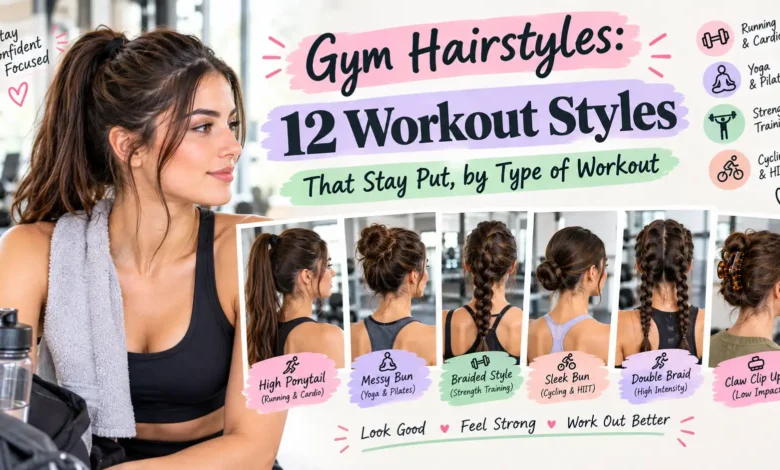
The best gym hairstyles depend on what your head does during the workout. For lifting on a bench, keep your hair low and flat, in tight braids or a low ponytail. For HIIT and cardio, a high ponytail or bun that’s secured twice won’t bounce loose. For yoga and floor work, choose a braid that lies flat, so nothing presses into the mat.
This guide matches 12 workout hairstyles to the way you train, with numbered steps and a note on why each one stays put. It also covers long, short, curly and coily hair, what to do with sweaty hair afterward, and how to keep workout styles gentle. For everyday styles off the gym floor, see our guide to easy hairstyles to do yourself.
- Lifting: low and flat, so nothing digs in when you lie back.
- HIIT and cardio: high and double-secured, so it doesn’t bounce loose.
- Yoga and floor work: braids that lie flat against your head and neck.
- After: take it down, let your scalp dry, and wash when your hair needs it.
Gym hairstyles at a glance
| Style | Best for | Hair length |
|---|---|---|
| Tight boxer braids | Lifting, bench work, boxing | Shoulder length and longer |
| Looped low braid | Rows, deadlifts, rowing machine | Long |
| Double-tied low ponytail | Lifting, machines | Shoulder length and longer |
| Stacked high ponytail | HIIT, cardio, classes | Shoulder length and longer |
| French braid ponytail | HIIT, jumping, dance classes | Shoulder length and longer |
| Secured messy bun | HIIT, spin, floor work | Medium to long |
| Low side braid | Yoga, Pilates, stretching | Shoulder length and longer |
| Half-up braid into a low braid | Yoga inversions | Long |
| Low pigtails | Cycling with a helmet | Shoulder length and longer |
| Headband and pinned front | Any workout | Short |
| Workout pineapple | Any workout | Curly |
| Twists or braids with a wide headband | Any workout | Coily |
For light sessions like walking or stretching, a simple half-up ponytail is enough. Save these styles for workouts that make you sweat and move.
For lifting and bench work: keep it low and flat
When you lie on a bench or a mat, anything at the back of your head presses into it. These three styles sit low and flat, so you can lie back comfortably.
Tight boxer braids
- Part your hair down the middle and clip one side out of the way.
- At the front of the other side, split a small section into three strands.
- Cross the outer strands under the middle one, adding a little hair to each strand before you cross it.
- Keep the braid tight and close to your scalp all the way to the nape, then braid to the ends and tie.
- Repeat on the other side. Don’t pull the braids wider; for the gym, flat and tight holds best.
Why it stays put: every section is woven into the braid, so nothing can slip out, and the flat braids let you lie back on a bench.
Looped low braid
- Make a low ponytail at the nape with a covered elastic.
- Braid the ponytail tightly and tie the end with a second elastic.
- Fold the braid up so the end meets the base of the ponytail.
- Slide the end under the first elastic, or tie the two together with a third elastic.
Why it stays put: the loop stops the braid from swinging into your face or getting caught during rows and deadlifts.
Double-tied low ponytail
- Brush your hair back into a low ponytail at the nape and secure it with a covered elastic.
- Split the ponytail in half and pull the halves apart to push the elastic up snugly.
- Add a second elastic about 2 inches below the first.
- If your hair is long, add a third elastic further down.
Why it stays put: the extra elastics keep the length together, so it doesn’t fan out or tangle on machines.
For HIIT, cardio and classes: cute gym hairstyles that don’t bounce
Jumping and fast moves shake loose anything that isn’t anchored. These cute gym hairstyles are high, secure and quick. They suit kickboxing too, since punches and footwork move your head as much as any cardio class.
Stacked high ponytail
- Section off the top half of your hair and tie it in a ponytail at the crown.
- Gather the bottom half and tie a second ponytail just underneath the first.
- Let the top ponytail fall over the bottom one.
- Smooth the sides and tighten both elastics by splitting each ponytail and pulling the halves apart.
Why it stays put: two elastics share the weight, so the ponytail doesn’t sag or loosen during jumps.
French braid ponytail
- Take a section at your front hairline and split it into three strands.
- French braid back toward the crown, adding hair to each side strand as you cross it over the middle.
- Stop at the crown and gather the braid with the rest of your hair.
- Tie a high ponytail with a covered elastic.
Why it stays put: the braid holds the front and sides, which are the pieces that usually fall into your face.
Secured messy bun
- Gather all your hair at the very top of your head and tie a ponytail.
- Twist the ponytail loosely and wrap it around the elastic.
- Stretch a second elastic over the whole bun.
- Push two or three bobby pins through the edge of the bun into the hair underneath, then gently tug a few pieces loose.
Why it stays put: the second elastic over the bun locks the wrap, so it can’t unravel. Placed right on top of your head, it also lets you lie on your back for floor work; expect some pressure on it in backbends.
For yoga and Pilates: cute workout hairstyles that lie flat
Yoga and Pilates put your head on the mat, and sometimes upside down. These cute workout hairstyles keep your hair flat, so it stays out of the way from any angle. If your hair is too short to braid, the headband and pinned front style below works just as well on the mat or upside down.
Low side braid
- Brush all your hair over one shoulder.
- Split it into three sections and braid to the ends.
- Tie the end with a covered elastic.
- Secure any short front pieces behind your ear with a bobby pin.
Why it stays put: nothing sits at the back of your head, so you can lie flat, and the braid rests on your shoulder instead of swinging.
Half-up braid into a low braid
- Take the top section of your hair and French braid it back from the hairline to the crown.
- Let the rest of your hair join the braid at the crown.
- Continue as a regular braid down the back and tie the end.
- Tuck any loose pieces at the nape into the braid with bobby pins.
Why it stays put: in a headstand or shoulder stand, a bun on your crown could take your weight. This braid lies flat, so nothing presses into the mat.
For hot yoga, add a moisture-wicking headband to keep sweat off your face.
For cycling, spin and swimming: gym hairstyles under a helmet or cap
A helmet leaves no room for a bun or a high ponytail. Spin classes don’t need a helmet, so any of the HIIT styles above works there, or the headband and pinned front if your hair is too short to tie back.
Low pigtails
- Part your hair down the middle.
- Tie a low ponytail behind each ear, below where the helmet sits.
- Braid each ponytail if your hair is long, and tie the ends.
- Put on the helmet and check that it still sits level without rocking, and that the straps lie flat over the pigtails.
Why it stays put: nothing sits under the helmet shell to lift it off level, and the pigtails stay tucked behind your ears.
For the pool, braid your hair tightly before you put on a swim cap. The American Academy of Dermatology’s summer hair care tips suggest you “Apply oil or a leave-in conditioner to your hair before entering the pool.” Afterward, it advises you to “rinse your hair immediately after swimming,” then wash it with a shampoo made for swimmers.
Running brings its own problems with bounce, wind and hats. We cover those in our guide to running hairstyles.
Gym hairstyles for long hair
Long hair is heavier, swings further and tangles more. A few rules make any of the styles above work better:
- Braid the length. A braid keeps long hair together, so it doesn’t whip around. The looped low braid and the half-up braid into a low braid are the most secure picks.
- Use more elastics, not tighter ones. A second or third elastic down the length holds better than one elastic pulled hard.
- Fine hair needs grip, not tightness. A single elastic slides down fine, slippery hair, so add a second elastic or a little texture spray at the base instead of pulling the first one tighter.
- Go lower for heavy hair. A very heavy high ponytail pulls on the crown and swings more; a stacked ponytail or a low style spreads the weight.
- Secure the ends. Looping or tucking the ends stops them catching on straps, bars and machines.
The same tips work for workout hairstyles for long hair outside the gym, too, from hiking to a long bike ride.
Short, curly and coily hair
Not every workout style needs a ponytail. These three are built for hair that doesn’t tie up easily, or that needs more gentle handling.
Headband and pinned front
- Push a wide, grippy headband back over your hair, about an inch behind your hairline.
- Twist any bangs or short front pieces back.
- Pin each twist with two bobby pins crossed in an X.
- Tuck the pieces at your temples behind your ears.
Why it stays put: the headband holds everything back and soaks up sweat at the hairline, and the crossed pins hold the short pieces a headband misses. For more ideas for pixies and bobs, see our easy hairstyles for short hair.
Workout pineapple
- Flip your head forward and gather your curls at the very top of your head.
- Loop a soft scrunchie around them, secure enough to survive movement but still loose; it should never pull.
- Flip back up and let the curls fall forward over the scrunchie.
- Add a headband if shorter curls fall into your face.
Why it stays put: the curls are gathered high and loose, so they stay out of your way without being flattened or crushed.
Twists or braids with a wide headband
- Start with your hair already in two-strand twists or braids.
- Gather them loosely at the nape or the top of your head with a soft scrunchie.
- Place a wide, soft headband along your hairline.
- Check that nothing pulls at your edges.
Why it stays put: twists and braids are already secure, and the headband soaks up sweat before it reaches your edges, without adding tension.
How to make workout hairstyles stay put
Most workout styles fall out for the same few reasons. These habits fix them:
- Use covered elastics. They usually grip better than a plain rubber band and are gentler on your hair.
- Double up. A second elastic, or a second elastic over a bun, does more than tightening the first one.
- Pin in an X. For short front pieces and bangs, two crossed bobby pins hold better than one.
- Add a headband. A wide, grippy headband catches flyaways and sweat. On its own, it’s the fastest option when you’re short on time.
- Keep it off your neck for bar work. For pull-ups, a ponytail right at the base of your skull can catch between your neck and the bar, so wear it higher or braid it.
- Skip the claw clip. A hard clip at the back of your head presses into benches and mats, and it can come loose when you jump.
After your workout: what to do with sweaty hair
Take your hair down as soon as you can, so your scalp can dry and the elastics stop pressing in. If you can’t wash right away, a little dry shampoo at the roots helps, but dry shampoo absorbs oil; it doesn’t clean your hair. Our guide to hairstyles for greasy hair has styles that hide sweaty roots until you can wash.
How often you need to wash depends on you. The AAD’s advice is simple: “Wash your hair based on how often it gets dirty or oily.”
Sweat is worth taking seriously if you’re prone to dandruff. In an AAD article on how workouts affect your skin, board-certified dermatologist Edidiong Kaminska, MD, FAAD, notes that heavy sweating can bring on dandruff-like flaking (seborrheic dermatitis) in people who are already prone to it. If your scalp gets flaky or itchy after workouts, a board-certified dermatologist can help.
Keep workout styles gentle on your hair
Workout styles are often tight, and many people wear them several times a week. The AAD’s list of habits that can damage your hair includes “Pulling your hair back tightly, such as in a ponytail, bun, or cornrows.” Its page on hairstyles that pull adds: “Anyone who wears tight hairstyles or puts repeated stress on their scalp can get traction alopecia.”
Secure, not tight, is the goal. Use more elastics instead of tighter ones, move your ponytail’s position from session to session, and take daily styles down after you train. If you wear twists or braids as a protective style for several workouts, check the tension at your edges each time and redo any section that pulls. If a style hurts, redo it looser.
Frequently Asked Questions
What is the best hairstyle for the gym?
It depends on your workout. For lifting and bench work, tight boxer braids or a low ponytail stay flat when you lie back. For HIIT and cardio, a stacked high ponytail or a secured messy bun won’t bounce loose. For yoga, a low side braid lies flat on the mat. Braids tend to hold up best overall, since the hold doesn’t depend on one elastic.
How do I keep my hair out of my face when I work out?
Braid or twist the front pieces back, then add a wide, grippy headband. A French braid ponytail holds the front and sides firmly for fast moves. For short bangs, twist them back and pin each twist with two bobby pins crossed in an X. A headband also stops sweat from running into your eyes.
Should I wear my hair up or down at the gym?
Up, for almost every workout. Loose hair falls in your face, sticks to your skin when you sweat, and can catch on machines and bars. Choose a style that suits the workout: low and flat for lifting and floor work, high and secured for cardio. Take it down afterward so your scalp can dry.
Is a tight ponytail bad for working out?
Wearing tight styles often can damage your hair. The AAD lists pulling hair back tightly in a ponytail or bun among habits that can damage hair, and notes that repeated stress on the scalp can lead to traction alopecia. Use more elastics instead of tighter ones, change the position often, and take it down after you train.
Can I skip washing my hair after a workout?
Often, yes. The AAD suggests washing based on how dirty or oily your hair gets, not on a fixed schedule. Let your scalp dry, and use a little dry shampoo if needed. If you’re prone to dandruff, though, heavy sweating can make it worse, so washing sooner may help your scalp.
What hairstyle doesn’t bounce when I jump?
A stacked high ponytail or a secured messy bun. In a stacked ponytail, two elastics share the weight, so it doesn’t sag. A secured messy bun has a second elastic stretched over the wrap, so it can’t unravel. A French braid ponytail also keeps the front and sides from shaking loose.
The short version
The best gym hairstyles match your workout. Keep it low and flat for lifting and bench work, high and double-secured for HIIT and cardio, and in flat braids for yoga and floor work. With a bike helmet, choose low pigtails. Long hair holds best in braids with extra elastics, and short, curly and coily hair do well with a headband, a loose pineapple or twists.
Use covered elastics and more of them rather than tighter ones, take your hair down after you train, and wash when your hair needs it. Secure, not tight, keeps your hair healthy for the next session.


One Comment