

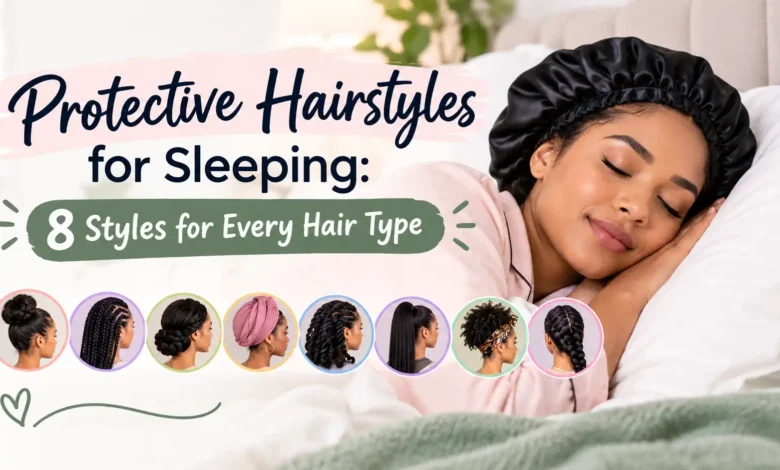
The best protective hairstyles for sleeping are loose and secured without tension: a loose braid, a pineapple, chunky twists or a wrap, on a satin or silk pillowcase or under a bonnet. They keep hair from rubbing and tangling against your pillow all night. Whatever your hair type, the rule is the same: gathered, not tight, and never soaking wet.
This guide matches eight overnight hairstyles to sleep in to your hair type, from straight and wavy to curly, coily, silk-pressed, braided and short hair, with numbered steps for each. It also covers bonnets vs scarves vs satin pillowcases, the wet-hair question, and a quick morning refresh. For everyday styles once you’re up, see our guide to easy hairstyles to do yourself.
- Loose, not tight: no tight elastics, pins or clips in bed.
- Gather long hair: so you’re not lying on it and it can’t tangle.
- Reduce friction: a bonnet, a satin scarf, or a satin or silk pillowcase all work. If you dislike head coverings, the pillowcase alone is fine.
- Dry first: hair is more fragile when it’s wet, so dry it before bed when you can.
Protective hairstyles for sleeping at a glance
| Style | Hair type | What it protects | You need |
|---|---|---|---|
| Loose low braid | Straight, wavy, long curly | Length, from tangles | A scrunchie |
| Loose top knot | Straight, wavy, fresh blowouts | Volume at the roots | A silk or satin scrunchie |
| Sleep pineapple | Curly, wavy | Curl shape | A scrunchie, plus a bonnet or satin pillowcase |
| Chunky twists | Coily, curly | Stretch and moisture | Leave-in, bonnet or scarf |
| Bantu knots | Coily, curly | A defined set for the morning | A satin scarf or bonnet |
| Doobie wrap | Silk press, relaxed, blowouts | Straightness and smoothness | Bobby pins, satin scarf |
| Loose bun under a bonnet | Braids, locs | Roots and edges | A large bonnet |
| Satin scarf wrap | Short hair, edges | Hairline and shape | A square satin scarf |
Why your hair needs protecting at night
Protective hairstyles for sleep work the same way for every texture: they take tension and friction off your hair while you rest.
You move a lot in your sleep, and every turn rubs your hair against the pillow. The American Academy of Dermatology (AAD), in its curly hair care tips, says: “If you’re able, you can pull your hair into a loose ponytail on top of your head (resembling a pineapple) or a loose braid before sleeping to preserve your curls and reduce friction against your pillowcase, which can make your hair frizzy and easier to break.”
Tension matters too. On its page about hairstyles that pull, the AAD lists “Styles that require rollers worn to bed most of the time” among styles that can cause traction alopecia, a type of hair loss from pulling, when they’re too tight. That’s why every protective hairstyle for sleeping in this guide is snug, not tight.
Up or down? Choosing hairstyles to sleep in
Good bedtime hairstyles depend on your length and texture more than on any one rule.
- Short or smooth hair can sleep down, especially on a satin or silk pillowcase.
- Long hair does better gathered. Down, it ends up under your shoulders, where it pulls and tangles.
- Curls do best up, in a pineapple, so you’re not lying on them.
- Side sleepers: keep the style at the top or front of your head, or bring a braid over the shoulder you don’t lie on.
- Skip anything hard or tight in bed: bobby pins, tight elastics and claw clips can press into your scalp and are uncomfortable to lie on. Flat pins in a doobie wrap under a scarf are the exception. Our guide to claw clip hairstyles step by step covers when a clip is fine.
Straight and wavy hair
Straight and wavy hair tangles most at the ends and flattens at the roots. These two protective hairstyles for sleeping handle each problem.
Loose low braid
- Brush out any tangles, starting at the ends.
- Gather your hair at the nape, but don’t tie it there.
- Make a loose three-strand braid down to the ends.
- Tie only the end, with a scrunchie or a soft spiral tie. On fine, slippery hair, a spiral tie usually holds better overnight.
Why it protects: the braid keeps the length together, so it can’t knot against the pillow, and with no elastic at the base there’s nothing to lie on.
Works best on: straight, wavy and curly hair, shoulder length and longer.
Very long or thick hair: make two loose braids instead of one. They’re less bulky to lie on, especially if you sleep on your side.
In the morning: undo the braid and brush from the ends up. You’ll often have soft bends too. If you want real waves, see the overnight braid waves in our guide to hairstyles for thin hair.
Loose top knot
- Flip your head forward and gather your hair at the top of your head.
- Twist the length loosely into a coil.
- Wrap the coil around itself into a soft knot.
- Secure it with one loop of a silk or satin scrunchie. Don’t cinch it tight.
Why it protects: gathering hair on top keeps it off the pillow and holds the roots up, so a blowout keeps its volume. A tight elastic, on the other hand, leaves a crease at the crown.
Works best on: straight and wavy hair, including a fresh blowout, shoulder length and longer.
In the morning: release the knot, shake your roots loose with your fingers, and brush through.
Curly hair
Waves close to curls (around 2C to 3A) usually do best with the pineapple below; looser waves suit the braid or top knot above. For curls, the goal is to keep your pattern from being crushed or roughed up overnight.
Sleep pineapple
- Flip your head forward and gather your curls at the very front of your crown, near your hairline.
- Wrap a soft scrunchie around them once or twice, loosely. The curls should spill over the top, not be pulled tight.
- Cover with a satin bonnet, or sleep on a satin or silk pillowcase.
Why it protects: gathering the curls at the front keeps them off the back of your head, where you’d crush them, and the loose scrunchie avoids a dent.
Works best on: curly and wavy hair long enough to gather.
In the morning: take the scrunchie out, flip your head, and shake gently. Mist any flat pieces with a little water and scrunch.
Short curls: if your curls are too short for one pineapple, try two or three small ones, or simply wear a bonnet.
Coily and natural hair
Coily hair is prone to dryness and tangles overnight. Stretched, protected sets help it keep moisture and shape. Keep everything loose at the hairline.
Chunky twists
- Start with dry hair, or hair with a little leave-in. Soaking-wet hair won’t dry by morning.
- Divide your hair into about four to eight large sections.
- Twist each section in two strands from the root to the ends, keeping the root loose.
- Cover with a satin bonnet or scarf.
Why it protects: big twists keep the hair stretched and grouped, so it tangles less and keeps its moisture through the night.
Works best on: coily and curly hair.
In the morning: unravel with lightly oiled fingers for a stretched twist-out, or keep the twists in and redo them when they start to look fuzzy.
Bantu knots
- Start with dry or well towel-dried hair. A tightly wound knot dries much more slowly than an open twist, so hair that’s still noticeably damp may still be wet, and smell musty, by morning.
- Take a small to medium section and twist it, starting about an inch out from the root so there’s no pull on your scalp.
- Keep twisting until the section coils around itself into a knot.
- Tuck the end loosely under the last loop. Cover with a satin scarf or bonnet.
Why it protects: the knots hold the hair in a set pattern, and the scarf keeps them from rubbing.
Works best on: coily and curly hair.
For comfort: make fewer, larger knots at the back of your head, where you lie, or skip that area and twist it instead. In the morning, unwind each knot with oiled fingers for a defined knot-out.
Silk press, relaxed hair and blowouts
Straightened hair needs to stay smooth and flat overnight, and it can revert if it gets damp. The traditional answer is a wrap.
Doobie wrap
- Start with dry, straightened hair and brush it smooth.
- From your usual part, comb the top section flat around your head in one direction, following the curve of your head.
- Keep combing the rest of your hair around in the same direction, so it lies flat in a circle. Hold it with a few bobby pins laid flat, or wrap clips.
- Cover with a satin scarf or wrap cap, snug but not tight.
Why it protects: the hair is wrapped smoothly against your head, so it keeps its shape and has nothing loose to rub or tangle.
Works best on: silk press, relaxed hair, and blowouts you want to keep smooth for several nights, chin length and longer. Very thick hair makes a bulkier wrap, so use a few more pins.
In the morning: remove the pins, then brush your hair down and back into place. Some people wrap in the opposite direction the next night so one side doesn’t flatten; others always wrap the same way to keep the set. Either works. Rewrap every night or two, depending on how smooth it stays. After a shower or on humid nights, put a shower cap over the wrap to keep steam and moisture off your hair.
Don’t pull your hair tight before you tie the scarf. The AAD notes that “The constant rubbing of a hat, head scarf, or other hair covering over the hair can also lead to traction alopecia, especially if you pull your hair back tightly before covering it.”
Braids, locs and extensions
Loose bun under a bonnet
- Gather your braids or locs at the top of your head.
- Twist them into a loose bun or pineapple, and hold it with a large soft scrunchie, or leave it untied.
- Cover everything with a large satin bonnet, big enough that nothing gets squashed.
Why it protects: a loose gather takes the weight off your roots, and the bonnet stops the hair from rubbing and picking up lint.
Long or heavy locs: if a bun on top presses into your neck when you lie down, gather them loosely at the nape or bring them over one shoulder instead, then cover with a large bonnet or scarf.
Works best on: box braids, knotless braids, twists and locs.
For new installs, including fresh cornrows: braids can feel tight for the first few nights. Leave them down under the bonnet until they relax, rather than gathering them.
Cornrows: they need no extra styling before bed. Cover them with a bonnet or satin scarf like any other braided style.
Clip-ins and wigs: take clip-in extensions out before bed. If you wear a wig, follow the maker’s care instructions, which often means removing it at night.
Short hair and edges
A pixie usually needs nothing more than a bonnet or a satin or silk pillowcase. For short cuts that you want to keep in shape, or edges you want to protect, a scarf wrap works well. A TWA (a short, natural afro) usually needs no twisting either: there’s rarely enough length to gather, so a bonnet or satin pillowcase is enough.
Satin scarf wrap
- Fold a large square satin scarf into a triangle.
- Place the folded edge along your hairline, with the point hanging down the back.
- Bring the two ends around to the back, cross them over the point, then bring them forward.
- Tie the ends at the front or side, and tuck them in. It should feel snug, not tight.
Why it protects: the scarf covers your hairline and smooths short hair flat, with no pressure on your edges. Tied this way, it’s sometimes called a sleep turban.
Works best on: short hair, edges, and any style you want to cover.
If it slips: tighten it slightly at the back of your head, never at the hairline, or wear a bonnet over it.
Bonnet, scarf or satin pillowcase?
| Satin bonnet | Satin scarf | Satin or silk pillowcase | |
|---|---|---|---|
| Covers all your hair | Yes | Mostly | No, it only protects what touches the pillow |
| Protects edges | Yes | Yes | Partly |
| Stays on | Can slip if it’s too big | Can loosen overnight | Always there |
| Best for | Curls, coils, braids, locs | Wraps, short hair, edges | Anyone who dislikes head coverings |
All three do the same job: they give your hair a smooth surface instead of a rougher one to rub against. Cleveland Clinic suggests switching from cotton to a satin or silk pillowcase to reduce friction. Be realistic about what they do. They’re widely recommended and low-cost, but most of the support comes from everyday experience rather than large studies, and none of them treats hair loss.
If you sleep hot, a satin pillowcase or a light scarf usually feels cooler than a full bonnet, which holds more heat around your head. Wash bonnets, scarves and pillowcases regularly, like the rest of your bedding. To keep a bonnet on, choose one that fits your volume of hair and has a comfortable band or ties that knot at the nape. You can also tie a satin scarf first and put the bonnet over it.
Can you sleep with wet hair?
It’s best not to. Shilpi Khetarpal, MD, a dermatologist at Cleveland Clinic, told the clinic’s newsroom: “Hair can be more fragile when it’s wet, meaning it’s more prone to snapping, stretching or breaking.” She also said: “We know that moisture on the scalp promotes an environment for bacteria and yeast to grow. This can lead to issues like folliculitis, which causes acne-like bumps in the scalp, as well as dandruff.”
The same article suggests letting your hair air dry before bed, or using a dryer on a low or cool setting if you need it faster. If your hair is still a little damp at bedtime, the best hairstyles for wet hair to sleep in are the loosest ones. Dry your scalp and roots at least, then sleep in a very loose braid or pineapple on a satin or silk pillowcase, rather than a tight style.
If your scalp is itchy, bumpy or flaky and it doesn’t settle, see a board-certified dermatologist.
Your morning refresh, by hair type
- Straight and wavy: undo the braid or knot and brush from the ends up. Shake the roots loose with your fingers.
- Curly: take down the pineapple, mist flat areas with water, and scrunch. Don’t brush dry curls.
- Coily: unravel twists or knots with lightly oiled fingers, then lift the roots with a pick, leaving the ends alone.
- Silk press and relaxed: unpin the wrap and brush the hair down and into place.
- Braids and locs: take off the bonnet, let the bun down, and smooth your edges with a soft brush and a little product.
- Oily roots: a little dry shampoo helps, but it absorbs oil; it doesn’t clean your hair. Our guide to hairstyles for greasy hair has styles for second-day roots.
What to avoid at night
- Tight ponytails, buns and braids. Loose and gathered is enough.
- Elastics with metal parts. Metal clasps can snag and pull hair, so use a scrunchie or a soft spiral tie.
- Bobby pins and claw clips you’d lie on, except flat pins in a wrap under a scarf.
- Rollers most nights. The AAD lists rollers worn to bed most of the time among styles that can cause hair loss when too tight.
- Going to bed with soaking-wet hair.
- A scarf or bonnet tied tight over tightly pulled hair.
Frequently Asked Questions
What is the best hairstyle to sleep in to prevent breakage?
The best protective hairstyles for sleeping keep your hair gathered without tension. For straight and wavy hair, that’s a loose braid tied only at the end. For curls, a loose pineapple. For coily hair, chunky twists or Bantu knots under a satin scarf. Pair any of them with a bonnet or a satin or silk pillowcase to cut friction, and avoid tight elastics.
Is it better to sleep with your hair up or down?
It depends on your length and texture. Short, smooth hair can sleep down. Long hair is better gathered in a loose braid or knot, so you’re not lying on it and it can’t tangle. Curls do best up in a pineapple. Whatever you choose, keep it loose, since tension all night is what causes problems.
Is it bad to sleep with a ponytail?
A tight one, yes. It pulls on your roots for hours and can leave a crease. A loose ponytail or pineapple tied with a soft scrunchie is fine. Place it at the top of your head so you’re not lying on it, and avoid elastics with metal parts, which can snag.
Should I braid my hair before bed?
For long hair, a loose braid is one of the best things you can do overnight. It keeps the length together so it doesn’t tangle against your pillow. Keep it loose, don’t tie it at the base, and secure only the end with a scrunchie. The AAD lists a loose braid as a way to reduce friction while you sleep.
Is it bad to sleep with wet hair?
It’s better to avoid it. A Cleveland Clinic dermatologist explains that wet hair is more fragile and prone to breaking, and that moisture on the scalp can encourage bacteria and yeast. Let your hair air dry before bed, or use a low or cool dryer setting. If it’s still damp, dry at least your scalp and use a very loose style.
Does a silk or satin pillowcase help your hair?
It can reduce friction, which may mean less frizz and fewer tangles, and Cleveland Clinic suggests one for that reason. Most of the support is from everyday experience rather than large studies, so think of it as a helpful extra, not a fix. It won’t treat hair loss. A satin bonnet or scarf does a similar job.
How do I keep my bonnet on at night?
Choose a bonnet sized for your hair, with a comfortable band or ties that knot at the nape of your neck rather than the top of your head. Tuck all your hair inside. If it still slips, tie a satin scarf around your head first and put the bonnet over it, or switch to a satin pillowcase as a backup.
The short version
The best protective hairstyles for sleeping are loose and gathered. Wear a loose braid or a soft top knot for straight and wavy hair, a pineapple for curls, chunky twists or Bantu knots for coily hair, a doobie wrap for a silk press or relaxed hair, and a loose bun under a bonnet for braids and locs.
Add a bonnet, a satin scarf, or a satin or silk pillowcase to cut friction, skip tight elastics, pins and rollers, and dry your hair before bed when you can. In the morning, a two-minute refresh brings everything back.




One Comment